Wednesday, April 18, 2012

Passage from Tarbert to Campbeltown

We slip back easily into ‘Preparing to set sail’ mode - engine on, depth and wind instruments switched on, plus the chartplotter and radio – then cast off our mooring lines and reverse away from the Tarbert pontoon. Work is going on here this morning to put a line of new pontoons in place, expanding the marina to accommodate more boats, so next time we visit we will hardly recognise the place.
For our first sail of the season we have chosen a quiet sort of day with predictable light winds so as not to test our strength or abilities at a time when the air is still quite cool. If we can combine this with a little gentle sun tanning of our faces and hands then this will be even better as it will give us a first layer of protection against summer sunshine.
We had driven to Campbeltown earlier in the day, to place the car there ready for our return, then caught the bus which runs along the west coast road into Tarbert. Kate pops into the Co-op to stock up with fresh food and by 10:30 am we are just about ready to go. As Cirrus leaves the harbour we comfortably slip into our normal roles on board, me on the helm and Kate coiling ropes and stowing away the fenders, just as we are used to. We move out into a light breeze across Loch Fyne but this fades as the wind struggles to make up its mind on what to do for the day. Our genoa is unrolled, optimistically, but in the end (and as the forecast predicted it would be) the passage south from Tarbert to Campbeltown Loch is largely a gentle spinnaker run downwind. In Kilbrannan Sound the wind is usually blowing one of two ways, either north or south, as it is channelled by the mountains of Arran on one side and Kintyre on the other, so it is no surprise to have to set up the spinnaker pole for downwind sailing on this occasion. Soon the sun comes out and we are drifting along at about four knots, binoculars out, ready to examine closely all the places we have visited on the land from this new angle. Despite sailing extensively in these waters this is our first time through the Sound and we are keen to pass close to Carradale if we can, to see what our small village looks like from the sea.

But neither of us fancy too much fiddling about with the sails today so the straightest course will be our best.

Some hours later after drifting slowly past Skipness Castle and Grogport, Carradale Harbour comes into view, interesting to see, although there is nobody about to wave at. Further on at Port Righ (royal port), the bay stays hidden from the north east until the last moment when it suddenly opens to reveal the cove where a king once stopped for shelter, Robert the Bruce, so the story goes. Then moving further south we pass Torrisdale where our picture is snapped, albeit from a distance away, by Celia and Jim from their house on the hill. In fact all the way down the Sound, being the only boat around under sail, we are conscious  that we are being observed by those we know.

Our neighbour Pat, returning from Campbeltown on the bus, tells us later that she spotted our red hull out at sea and our friend David also noticed our passing from his house in Peninver. This all adds a little spice to the voyage and prompts us to keep the sails set well, this being the nautical equivalent of combing your hair before going out.
The Isle of Arran seen from our angle close to the water looks like a sleeping giant, the southern slopes being the legs and the mountains at the northern end being a broad chest heaving upward. Few visitors get to see the mountains all with their tops clear of cloud and even less will see it from our position. Today the air is sharp and clear, no haze or mist about, and the sky is a grand canvas across which dramatic shapes and colours have been splashed. To the south of us now we can see the islet of Ailsa Craig, ‘Paddy’s Milestone’ as it is affectionately known, sticking out of the sea like the nose of some giant who fell asleep here long ago. The shape is echoed by cliffs on Davaar Island which lies further west, hardly surprising since these are all that is left of long-extinct, pre ice-age volcanoes.
Our passage speed slows as the wind fades with the onset of evening so the spinnaker is taken down and we fire up the engine again, motoring the last few miles to pick up our mooring in Campbeltown Loch. Again this is a tried and tested procedure for us so there is no rushing about, just a slow approach so that Kate can secure a rope to our round, soft plastic buoy, then my job is to finish off and make secure. This is now Cirrus’ home – she will spend the rest of the year afloat here.
As the temperature slides lower we light our cabin heater and cook a meal before bedding down for our first night of the season on board just as the sun drops neatly down behind the war memorial on shore making a dramatic picture to feast our eyes on.

Wednesday, April 11, 2012

Launch day visitors

There can be few other signs that shout ‘Spring!’ more loudly than the unfurling of leaf buds and tree flowers, the creases all falling out as they swell to full size ready for another action-packed summer of photosynthesis. It is an amazing process to watch in action on a large scale too, this gradual greening up of the landscape, all starting from tiny buds of life sprouting from otherwise lifeless twigs.
For boat owners, however, spring is all about launch-day, the day the boat is lowered into the briny after being closed up for many months during the winter. This is what signifies a new beginning, a new sailing season.

Cirrus  Cat stands ready onshore, freshly smooth-painted, as thick canvas lifting strops are wrapped around her hull. Then as the crane-driver inches in the cable and the tension increases there is a loud creaking sound as the load comes on - nothing to worry about really but alarming if you have never heard it before - and slowly we rise from the ground. From on board the sensation of movement is almost undetectable as we swing out over the water to descend gently into the boat’s natural element. This is always a nervous time for boat owners and friends Rich and Gerry who have come to visit for a week help us by remaining calm, taking pictures of the event for posterity.
We are lucky with the launch weather, almost no wind and dry as well, at least until later in the day, so soon we are motoring around the marina to a berth, tying up to a pontoon and the kettle is on for a cuppa. A short while later Graham & Cheryl arrive, more friends of ours on their way home from holidaying in Wester Ross, then by mid afternoon we are moving on to the next item on the busy agenda, a meal out in Campbeltown followed by a ‘Tasting’ of some fine Springbank malt whiskies at the Sailing Club. It is dark by the time we arrive home, floating on a peat-flavoured cloud of alcohol (well most of us), barely capable of coherent thought but delightfully satiated.
Rich & Gerry’s visit here has been an enjoyably relaxing experience for us (we hope it has been the same for them) despite each day seeming to fill up with activity almost without us trying. They have taken in their stride winning the Carradale weekly village quiz, Scottish country dancing in the village hall, circular walks around the village both in the rain and not, my driving along some of our more exciting single-track roads, single malt whisky consumption to near-excess, walks along miles of muddy tracks and pathways, irregular meal times tempered by countless cups of tea, and finally an evening-full of the Sicilian detective, Inspector Montalbano, on television.

They are hooked, by the way, as indeed are we.
On Rich and Gerry’s final day with us we all visit The Mull at the tip of the Kintyre peninsula, from where the cliffs of Northern Ireland’s County Antrim can be seen clearly just twelve miles away. Indeed Rich’s excitement is largely because he last saw this place from the other side. The forecast rain held off and the wind just sneaked along the cliffs instead of blasting us off our feet as it can do here. Rain showers came and went in a way that we could watch them drift away Ireland-wards like strange blurry waterfalls, out of focus and drifting slowly over the sea. Through the windows of the old, now disused, signal house the noise of the sea wafts upwards and echoes around the rusting steelwork, all that remains of the horn that once used to shout out a warning across the sea. This is now a redundant piece of equipment since fog signals all around Britain have been silent for some years now. They are no longer deemed necessary in an age when ships are fitted with so many electronic aids to navigation and their crew are all inside where they would not hear the signal anyway. So this rusting monument stands idle, silently watching the waves through its empty windows and when the fog comes its voice is no louder than the noise of the wind through its pipes.
Visiting friends have now taken their leave of us, flying south to the corner of England where it rarely rains and hose-pipes are banned, confined to the shed, never to see the light of day. Rather like paying car parking charges, a shortage of rain water is something quite hard for us to comprehend, living where we do. Not that we mind this. Having a little too much water seems a far more comfortable state of affairs than having too little of it and having to pay to park a car now just seems like a distant memory. I used to think that cutting the grass was an equally pointless activity until I realised that grass is a plant that needs to be trimmed down low, it cannot survive any other way. If it is left uncut then the land on which it grows will sprout taller plants which will shade the grass, leaving it without light. So grass and grazing must always go together and the lawnmower is really a grazing machine, made necessary because we have removed the natural grazers by fencing them out. Take the fence away and the grass will be grazed naturally, or at least it will where we live. Apologies for the rambling. It must be the time of year.

Thursday, April 5, 2012

Ready for launch

The bottom scraping is now complete and fresh antifouling paint applied. (In reality all that has occurred is an exchange of layers of costly, but old paint for more expensive new ones but we boat-owners do this sort of thing, willingly, year after year.)

Once Cirrus’ sails are bent on she takes on that fresh, ready-for-the-water look again, but regrettably not before Kate climbs on board over the stern and falls foul of the boom as she stands up on the deck, cracking her head on a sharp edge protruding beneath it. This is an embarrassing thing to do at the best of times but whilst the boat is still on dry land it takes some explaining to understand how this could happen. The boom was lashed up for winter, not in its normal position, and Kate’s momentary lack of attention, whilst not damaging the boom (just kidding), has left her with a nasty cut and mild concussion. All my fault, of course.
All is now ready for when, over Easter, Cirrus will be lifted gently back into her natural element and we can go sailing again. We are both (Kate included despite her altercation with the boom), keen to explore further the fabulous area we live in and we can only hope that the weather will be kind enough to us so we can make a start.
Kate’s poorly head prevents her from joining me and friends David and Hilary on a long walk along the sea cliffs down at the Mull, the headland at the southern tip of the Kintyre peninsula.

To get to the start we drive along the scary bit of single-track that leads to the Mull until we reach a point where we can cut across rough country towards the sea. From this angle the volcanic plug of Ailsa Craig appears to be just behind Sanda Island although in reality they are separated by many miles across the Firth of Clyde. It is a ‘too bright, too soon’ day and by 10.30 in the morning the sun has retreated south to a thin strip on the horizon but the three of us launch ourselves across Borgadale Water, traversing around the hillside until we find the ruins of the dun, an ancient fortified settlement standing on a high point which still today affords good visibility across the Channel to Ireland. While the sky is overcast and the view is predominantly grey, the greys come in so many shades that there is an ethereal feel to the place, haunted as it is by its past.

We now traverse west on difficult terrain following the line of the cliff as best we can, past another ancient monument, the fort at Sròn Uamha (try saying it like ‘uva’), the southernmost point of the Mull, where we stop to eat our lunch within the 2000 year-old walls of what must once have been an imposing stronghold. No less than three defensive walls once protected this place on the landward side and vertical sea cliffs running along the seaward edge still form a natural barrier second to none.
Walking on we arrive at a point where the inland crags of An Gobhann descend to meet the sea cliffs. There is only one passing point here, a grassy slope beneath a sheer rock face with another steep drop to the sea on the left. With no alternative apart from retracing our footsteps across miles of open country, we tread cautiously onwards to reach the relative safety of slightly more level ground just around the corner. Strictly for the goats, this one.

What I find most intriguing about this whole area is that there is evidence on the ground, even to our untrained eyes, that a considerable settlement existed here, amongst the cliffs along the shore, on terrain which most of us would regard as totally inhospitable. These people cultivated crops on the few reasonably flat patches, they kept livestock, built fortified dwellings; the marks of all of this are still evident on the landscape today. There must have been better, easier places to live but they chose this spot, for very good reasons, no doubt. We just can’t imagine what they were.
Over five hours after we started we are back at the car resting our weary legs. Somehow the forecast rain has held off although we were in cloud for a time on the top of the Mull above the lighthouse. This place attracts cloud like a moth to a flame so we consider ourselves very fortunate to come away dry. The ground is surprisingly dry just now after several weeks with no substantial rainfall at all. The air is still cool but spring is definitely coming now.

Saturday, March 31, 2012

Visited with solar power

Complex travel arrangements are made so that our son Mike can join us in Edinburgh where we all get to see and hear The Albion Band perform a gig at the Queen’s Hall with our youngest, Ben, playing lead guitar. It was a great night! Once the band started playing, not one of us in the audience could keep still. Feet were tapping, hands waving, heads nodding, whoops of joy, whistling and clapping. This was folk-rock at its best, music that touched us all and really got us jumping. Naturally Kate and I were overcome a bit by the proud-mum/dad thing on seeing our Ben up there on stage blasting away on his Strat (Fender Stratocaster guitar) - it was amazing how he connected with the audience – but everybody just wanted more and more. What a band, what a sound, what a night!
After the gig we brought Mike back with us to Carradale for a week’s visit, his first time here and it was intriguing to see his reaction to the place, a far cry from his home town of Yeovil in deepest Somerset. I was watching his face for reaction as we turned along the single-track and he realised that he had yet to endure many miles of the twisting and turning road. Traffic was light, almost non-existent, but nevertheless you are always straining to catch a glimpse of what might be a car coming around the next bend before it is too late to brake, hoping that you will spot the deer at the side of the road before it jumps out in front of the car, dodging the sheep too. Mike only knew this place from what he had read in this blog and it was difficult to guess how it would match up to his own mental picture. As it turned out the lurching along our bendy roads almost got the better of his stomach, spoiling much of his appreciation of the landscape around him.
The views were not at their best anyway as a white haze hung low over Kilbrannan Sound, masking the detail of the indented coastline beside us and completely hiding the coast of Arran. Naturally, we would like Mike to see and experience where we live as it more normally is - the air clear and sharp, freshly scrubbed after rain, a cooling breeze rippling the sea, cloud cover high above - but looking at the forecast for the week ahead we might only be able to offer him clear skies, sunshine and warmth. Convincing him that this weather is a far cry from normality is difficult but he seems happy with this weather nevertheless.

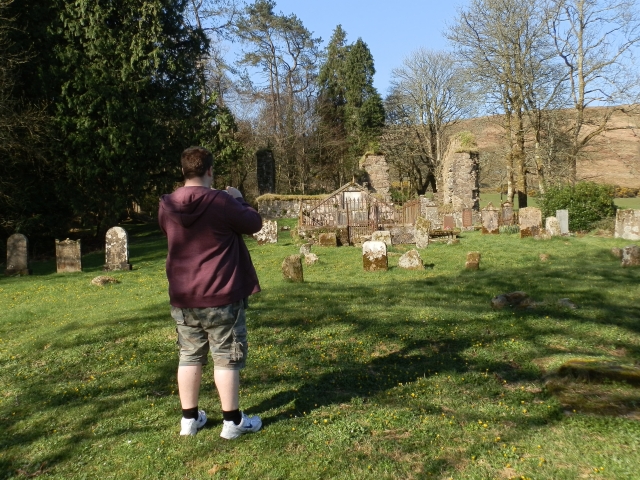
We do the tourist thing and take him out and about, showing off some of the local sights. We begin with what is left of Saddell Abbey, most of the stone from which was taken for use in other later construction projects like the castle by the beach or possibly for local houses. My research tells me that construction here started in 1148 (although how can anyone be so certain about this date is a mystery to me) and our eyes tells us that ever since then, even after the monastery had crumbled away, local people still regard the land as sacred, the gravestones clustered amongst the shadows of the former monastery walls bearing testament to this.
Later we move back in time to view Kildonan Dun, trying desperately to imagine what it might have been like to live in around the year 100 AD when this was most likely built.

The view across the sound from here is impressive today and almost certainly this will have changed little in the last 2000 years. Even the archaeologists can tell us little about this place beyond that it was constructed as a fortified settlement surrounded by farming land. Did the people also fish from boats which they drew up close by in the small bay? Were they able to live peaceably or was life constantly under threat? The stones in the boundary walls are beautifully set together, shaped and positioned back then exactly as they remain today. But by whom? Where did these people come from and where did they go?

Going further back again in time, our next trip takes us to the vitrified fort at Carradale Point. There are a number of these constructions in Scotland all dating from around 1000 BC, the real mystery being how it was possible to raise the temperature of the fort walls to the 1100 degrees Celsius needed to get the rock to melt and fuse together. Once again, nobody will ever know for sure.
Mike’s week with us ended with Betty’s dog, Ailsa, taking us for a walk up Deer Hill then on around the bay. Or at least, this is how she would see it, I’m sure. This normally golden retriever ended the day covered with black mud from the lower belly downwards after she decided to take a dip in a dark peaty pool, but this failed to dampen her enthusiastic tail-wagging. She just sprayed the stuff all over us.

Then having juggled emails with the solar power installation company for some weeks, finally one sunny morning a van-load of men arrive en masse and they are soon prancing about on our roof. It takes them but a few hours, during which time the sun shines effortlessly down, sunlight that is wasted until the final connection is made.
Suddenly we are online. From this moment on we are part of the National Grid, making electricity for the rest of the country (and ourselves), a thought that gives us a warm cuddly feeling as well as putting a little in the bank. And as we suspected the end result is visually striking, making our house stand out from the rest, the panels being a landmark we can now use to direct visitors by, a side-benefit we had previously overlooked.
‘Just look for the house with the solar panels.’

Saturday, March 10, 2012

Highland life

Progress on scraping blue paint from Cirrus’ bottom continues slowly and tiresomely, the job being made less pleasant by a fine rain which serves to keep the blue dust down but wets the ground on which I kneel. This alternates with bursts of sunshine; as ever the weather here is in constant change.
After many hours scraping I am tired, dirty and damp so I flop back into the car and set off home again. En route, as I cross the highest point of the Kintyre peninsula, a lady dressed in rough clothing steps out into the middle of the single track road, waving me to a halt, so I pull over and lower the window.
“Can you pull over here please for the Highlanders coming along the road”, she says.
My brain goes into overdrive as I imagine the approaching regiment in full dress uniform, bagpipes blasting out a marching tune and kilts swinging to and fro in time with each step.

Then I think how unlikely such a sight would be in this remote location and I peer ahead down the road to where a large brown animal is just coming into view, a huge pair of horns confronting me. Understanding dawns. These are the Highlanders. A herd of massive hairy ladies and one rather smaller but equally hairy calf come lumbering past us along the road, glancing warily at me as I take the picture. The ladies are all pregnant, I am told, due to give birth in May by which time there will hopefully be a little more warmth about. I bid them farewell and carry on homewards.

The procreation theme continues as in the damp area behind our house, just across the burn (Alt na Caillich or Stream of the Old Woman), there is evidence of an outburst of froggy promiscuity as the spawn bubbles up thickly forming small hillocks on the surface of a pool. Further away beside the forest track there are larger pools where frogspawn lies in dark masses and newts patrol the clear water around this like jackals weighing up their prey. There must be a balance here – the newts falling prey to something larger perhaps or maybe their bellies simply cannot accommodate all the tiny hatchlings before they grow large enough to defend themselves. Chaffinches are at it too, dividing their time now between our feeders and the task of collecting dried grass stems for their nests and sheep grazing beside the road leading down to Carradale bay appear more solid than usual, full to bursting with this year’s lambs.

Carradale Point offers another spectacle to those who are prepared to risk injury clambering over the jumble of rocks out on the end. Our feral goats are looking particularly stunning just now but to get a close look stealth is required as they are always alert to the slightest sound or movement. The landscape here offers plenty of opportunities for creeping up on them though – large tilted boulders to hide behind then peer over or else stay low and lift the camera up high enough to get a clear shot. Struggling around one obstacle I startle a heron standing up to its ankles in a shallow pool, waiting for his lunch to appear, no doubt. I am not sure who is more surprised, the bird or me, but it takes off away from me with much straining of its great muscles. Not having been this close to a heron before, less than 2 metres, I was struck by how little flesh there appears to be on the bird. The neck is stretched thinly out ahead as the bird strains for elevation and the body is no more than a swelling located some way further aft. The most spectacular feature is, of course, the wings that whistle downwards through the air on each stroke. When standing upright on the ground the eyes of an adult bird would be almost level with mine yet despite their size they build nests in the topmost tree branches, typically of conifers, from where their fledglings will sit and squawk monotonously all day long. I have always found the idea of our larger species of bird nesting in trees somewhat hard to comprehend. Years ago I was taken aback to discover that a peacock, a ground-loving bird ludicrously over-endowed with plumage, will roost in a tree at night. Which perhaps proves that gravity is not all it is cracked up to be.

Sunday, February 26, 2012

Scotland, one year on

A year ago on 19th March, Kate and I moved into a house in the remote village that is Carradale, a place previously unknown to us, in a country we had visited but not inhabited, and into an entirely new way of life. For most of our lives up to this point we had been what can best be described as ‘nomads’ - having neither house nor area which we could honestly describe as ‘home’, not belonging to any one place. Perhaps if you are born in a town which has a strong identity of its own then this sticks to you even after you leave – you will always be a Liverpudlian or a Londoner. Maybe those who maintain contact with old friends in the place they were brought up in find it easier to think of this location as part of their own origin. But neither Kate nor I have ever kept in touch with old school-friends and as we have moved about from one location to another over many years we have made and lost touch with so many friends that this has become more the norm than the exception.
Although many people do turn out as we have, others might regard our way of life as quite strange; they would feel comfortable only when close to ‘home’. For us, however, throughout our working lives, hardly had we begun to put down roots in one place when something would come along which caught the eye, an opportunity to change or to take up some employment opportunity, and we would grab at it and follow it across country, east to west, north and south.

 By the time we came to retire from work we had decided, so we thought, that we would be content to travel about endlessly on our boat, settling only temporarily during the winter months to catch our breath and prepare for the next sailing season. And so it continued for the first few years, our lives orientated around sailing with escapes every so often to meet up with one or other of our widely scattered family. Then quite suddenly, twelve months ago, we woke up one day feeling unsettled by the fact that we did not have a permanent base on land to come back to…. and this is how we are now living in Carradale.
Remembering back to last year (and also reading the blog entries we posted then) I can see it was a relatively dry Carradale we arrived at with enough warmth and sunshine to tempt us out exploring along the seashore before we had finished unpacking.

 Both of us can recall staring in awe and wonder at the scenery around us. With the anniversary of our arrival still a few weeks away the ground still needs to warm up and it is clear to see that it is holding far more moisture this year, moisture that as I write still drops out of the clouds just as it has done for many weeks. At this point we really cannot say whether this is the norm and last year the exception or whether the reverse is true. But neither do we really care because what the last year has taught us is to regard the weather in this place as neither good not bad, but always exciting. We take comfort from the fact that the house we have bought here has stood for many years and seen off so many gales in its past that it will continue to keep us safe too. It has a pleasant solid feel to it.
Just the other day we took another plunge towards permanence here by inviting a solar power installer to fit photo-voltaic panels on our south-facing roof. More than almost anything else you can do to a property, this is a long term decision as the financial payback for the investment will not occur for many years (if ever). Nevertheless we feel that this is a change we must make; each time the sun shines it feels like we are wasting something. We know that being in Scotland, the power of the sun is less than in southern Britain, for example, and this means less electricity will be generated by our roof. To compensate, however, we live in an area which is pollution-free, our air arriving fresh off the Atlantic and often nicely scrubbed by nice clean rain.

Clean air lets in more light, of course, so we can expect a better performance from our solar array than if we lived in a city. There are, so it seems, just too many variables for anyone to predict accurately how much benefit we will get once they are up and running. The best we can do is to measure what electricity we do get and smile smugly at our neighbours, most of whom will probably think we are slightly insane. One thing is certain, however. News of the installation will fly around this village like a wild rumour – news, good or bad, travels fast here – and it will be interesting to see what this leads to.

Twelve months ago Cirrus Cat languished miles away in a boatyard in Cornwall, lonely although not forgotten. This winter she rests in the marina car park in Tarbert so I have begun the long overdue task of scraping many layers of antifouling paint from her twin bottoms.
By any stretch of the imagination this is a miserable and thankless task as crouched between the hulls I work away with a scraper showering the ground with scrapings and filling the air with blue dust. I emerge after an hour or so stiff and sore, damp from lying on the ground and looking like an extra from a sci-fi movie. Using the tool two-handed I have to apply considerable pressure to cut my way through at least five or six layers of blue and several layers of black paint down to a white primer applied after the boat was epoxy treated many years ago. Trying to create a smooth surface whilst avoiding scratching the surface or cutting down too far, all the while kneeling or lying beneath the hull, is just about as physical a task as anyone would wish but this is the sort of punishment that all boat owners must endure for their hobby. Just part of the fun really!
The pressure is on now as we have been given a date for the lift-in, when a crane is booked, boats are lifted back into the water and the car park is restored to its summer use. Having this date will focus the minds of the owners of all the boats around us so we can expect company over the coming weeks as we all prepare for launching.

Tuesday, February 7, 2012

Carradale

We have been on another of our walks (it only takes a bit of sunshine to get us out), this one to a viewpoint just above the snowline from where the whole village spreads out like a map. It is very wet underfoot and the air is cold, but the view is well worth the effort of the climb. Before coming here we were told that snow rarely stays for long and that the climate is generally milder than its latitude justifies due to the influence of the Gulf Stream.

From the mid point of our first winter it is difficult to judge the accuracy of this statement but a photo taken recently from the lane close to my mother’s house in East Sussex seems to indicate that there may be some truth there. The contrast between the two landscapes is striking.

Arriving back from our walk we are barely out of our outdoor clothes when the phone rings and Kate is answering a query about the minutes she has drafted for either the Village Hall or some other committee. I nudge her gently to remind her that we must get ready to go out again soon as we are playing bowls tonight, an activity we have become involved in since moving here. Our coats go on again and we march off through the village then on down the lane towards the Village Hall. Night has fallen and the darkness beyond the reach of the yellow streetlights is impenetrable so we use torches to throw pools of light before us as we skirt the edge of a field then dodge the water-filled potholes to the door of the hall. Soon inside we greet our friends; all of us have turned out for the highlight of the week, carpet bowls.

In simple terms this is all about the art of the seemingly impossible, rolling a ball along a curved path on a flat surface. The target jack, a smaller white ball, is placed at one end of the mat behind an obstructing block, in such a way that it is impossible to aim in a straight line. The bowls are weighted on one side giving them a ‘bias’ which makes them swerve gently to one side and the trick is to get this just right so that the bowl comes to rest nestled up to the jack. Slight imperfections in the floor of our village hall add interest to the whole process so that even the most skilful players are sometimes caught out and beginners like us can strike lucky and appear impressively adept. Which all adds to the fun, of course. A perfectly targeted throw usually generates a satisfying inner glow although unlike in a game of football, hugging and kissing rarely takes place.

There are times now when our lives get quite busy and it seems we hardly have time to catch breath. The fact that it is all of our own doing is of little consequence. Sometimes it is very difficult to refuse when we are asked to take on this job or to sit on that committee – we are interested, proud of our village. We are suffering (not really the right word) the plight of many newcomers, seized upon as new blood by those who have lived here for many years, giving them the opportunity to step back for a while. Jobs like Village Hall Secretary have been passed around the community for so long that when someone new arrives they are weighed up for suitability and roped in. There is so much going on here. The carpet bowls we have tried and taken to – it is gentle fun – and then there is the badminton, netball and soon Scottish country dancing as well.

The Campbeltown Sailing Club keeps me fairly busy too. There is the website to look after and a newsletter to be produced every so often, and with the project to develop Carradale Harbour – moorings laid outside the harbour are just the start – there is now another website which will document the history of the harbour and track the forward progress of the Harbour User Group (CHUG) in its efforts to re-generate the harbour area. For Kate and I we must avoid taking on too much so that our lives here cease to be pleasurable.

Despite all this activity, sometime later this year we plan to take to the water again aboard Cirrus Cat.

We are delighted to learn that our friend Richard, who hails from our old sailing ground in Faversham, Kent, plans to bring his boat Endeavour to the Western Isles this year. What’s more, Richard’s son Tim, seen here playing music with dad in Endeavour’s cabin, now plans to bring his own boat (and music) to the Western Isles too. Is Scotland entirely ready for this influx of yachty Irish-Englishness or should we stand ready to repel them perhaps? No, their company will be most welcome and we look forward to sharing an anchorage with them some time soon.

Friday, January 27, 2012

Wildlife and landscapes

The other morning I arose early to try to bag a nice sunrise photograph. What I had in mind was to catch the sun just as it rose above the Isle of Arran, which lies to the east of us. To start the project I put on generous layers of warm clothing then left the house in the cold half-light of the morning. Passing the village bakery at this time the nostrils are assaulted with one of the most enticing smells known to man, fresh bread straight from the oven, but I walked on by and turned up the lane to the golf course, immediately regretting not wearing wellington boots as rainwater squirted up from each step I took across the sodden grass. It was a fine morning but before I could get into a good position overlooking Kilbrannan Sound a dark cloud had raced overhead to spoil the sunrise. The photographic results were hardly worth the effort but in one of the shots I managed to capture Airds Castle, or what little remains of it, in the foreground. [Sadly this picture has since been lost so you will just have to take my word for it.]

As I studied this from my viewpoint on the edge of the rain-drenched golf course I tried to imagine the role this place had played in this landscape. A river of ice had once scraped out the 100 metre deep chasm lying before me and as the glacier receded there would have been a terrific ice cliff here at which the waves nibbled away until eventually every drop had floated away. The sea level would then have been higher than today (there is a line of old cliffs all around the area as evidence of this) but over time this changed, the land itself rising higher to form a new shoreline. Then at some point humans began to settle here, one of whom spotted the craggy outcrop overlooking the water and saw it as a defensible position, from what, nobody knows. After the immensely powerful natural forces that had shaped everything around me, man’s impact here seems very small.

Back home again and the list of different creatures entering our back garden continues to rise. Two rabbits come through from the back now to nibble at some of the more succulent grasses, generally keeping pace with any winter growth, although it has to be said they they seem to prefer next door’s slightly longer herbage to our sodden greenery.


Then a pheasant dropped by and stood at the fence, gazing longingly at the longer grass next door but not quite being able to work out how to get there.

Most interesting is this specimen, strangely reminiscent of Kate, who stacked a trailer-load of wood into a neat pile next to our coal bunker. Memories came flooding back of our winter in the mountains of northern Italy two years ago when we survived on donations of olive wood for the fire and filled our glasses with wine in cartons from the local Lidl supermarket. The smell of the freshly split logs now invades us as we step outside but we must wait many months before we can reap the benefit of the heat energy stored here. Unlike the olive wood, these spruce logs are full of sap and need to dry out for many months before we can burn them.


We are delighted to learn that our youngest son Ben, having just returned from a musical trip to New York, is at last achieving some success and recognition in the world of music, such that we are beginning to lose count of the number of bands he now plays with. Over the next few months almost anyone living in Britain will have an opportunity to see and hear one of them, The Albion Band, in concert, as they are on a huge nationwide tour. We’ll be off to Edinburgh in March to see them.