Showing posts with label Canal. Show all posts

Tuesday, July 29, 2014

Time on the water

Arms straining, I pull myself up the sloping foredeck for the nth time and wriggle into position on the windward rail where my meagre seventy eight kilos helps to balance the boat as she accelerates upwind again, crashing and bashing through the waves. The next piece of sea thumps into the bow, jumping up and dousing me with salt water but my body protects the rest of our crew from a soaking, not that their gratitude is particularly overwhelming, I have to say. This wave is one of many I take full on for them, but I'm not complaining. I signed up for a week of racing on Owen’s 10 metre X-yacht, Jochr, and know full well that this is what goes with the territory, it is just part of the experience.

We have a mixed bag of weather thrown at us, fairly typical for any summer in the West Highlands I guess, heavy rain and winds one day and light airs the next, but despite this our fortune in the rankings for our class remains good. For the final passage race, a long southerly beat down the Sound of Mull from Tobermory to Oban, my role is to ensure that the genoa passes smoothly around the front of the mast on each tack without the sheets catching on the front of the mast or the sail getting hooked on the guard rail. Aside from this I am ballast, the weight of me and the other crew making a minor but significant difference to the performance of the boat. Our skipper drives us across the Sound then back again, against twenty five then up to thirty three knots of headwind, as we fight to keep our place in the fleet of yachts that surround us. For hour after hour we battle on, hardly pausing for breath, until after four hours we find ourselves jostling for position on a finish line beside Lismore Light. The current is running fast here calling for fine judgement in close proximity to other boats but the gun fires at last signalling a good finish to the final race of the week, the end of six tough days.

Jochr is on the far left of the picture, sail No. 9726

Our boat and crew have sailed through rain and shine, wind and calm, rough and smooth seas, enduring some excellent and challenging racing from which it takes my body some days to recover. At some point I will admit that I am too old for this sort of thing… but not yet.

As things turn out this year all this strenuous stuff follows soon after a family trip south into Yorkshire for a week long holiday on a narrowboat, motoring slowly along the Leeds to Liverpool canal, where the only real exercise is cranking the key to open the sluices on the many locks we pass through.


 With us here are Mike, Eleanor and of course, wee James, for whom this is a first boating experience.

The term narrowboat means literally that and for good reason; these boats are built to fit the canals (or is it the canals that were built to fit the boats). The locks on our canal are just big enough for two boats, each a maximum of seven feet wide, to fit side by side with only inches to spare. The canals were built for working boats which often towed a ‘butty’, an engine-less load carrier, and it was essential that both boat and butty could fit in the same lock side by side. If the lock is any wider then all that happens is that you waste water. The overall boat length is an issue too as any more than fifty feet long and we’d be bumping up against the lock gates on the Leeds Liverpool. But given these restraints, it is quite surprising how much can be fitted in on board. On Megan’s Drum we have separate bedrooms, toilets and a shower, a fully equipped kitchen and dining room, storage for all our stuff plus the convenience of mains electricity for the microwave oven and the TV.

Our days on board consist of chugging slowly westwards through the Yorkshire Dales at no more than four miles an hour, the canal speed limit, so our pace of life slows to accommodate this. Being in charge of steering I get to watch my crew opening bridges and lock gates ahead of me then once through, I manoeuvre the heavy boat to the bank to pick them up again. It becomes routine, eventually, with each member of the team knowing what to do. Steering the long vessel around a tight bend requires forward planning, anticipation of the way the stern will swing, as the boat pivots about its centre rather than its rudder, but generally we manage to avoid bumping the canal sides too often or entangling ourselves with the trees that frequently overhang the water on one side. One can certainly imagine that life has always gone on at the same slow pace on the canals but (not surprisingly perhaps) young James finds it hard coping with the speed the world drifts by. He is often happier sitting below playing games on his ipad and we worry that he misses the herons standing knee deep in the shallows or the amusingly named and brightly coloured narrowboats that are floating homes to a sizeable population on England’s waterways.

At dusk all traffic stops and we too pull over and moor to the bank. The water becomes still, only disturbed by the movements of the odd duck, the occasional swan and fish rising to take flies from the surface. Now the tree-clad banks and the painted boats are reflected almost perfectly by the water creating a surreal inverted image.


Monday, August 29, 2011

Home at last - job done!

Our delivery of Cirrus Cat to her new home was complete after we finished our passage of the Crinan Canal and then a day later tied her to a pontoon in Tarbert Harbour. What we started back at the beginning of July, launching the boat from a boatyard in Cornwall and sailing her anticlockwise around Britain to the west coast of Scotland, is now finished. Job Done!

On reflection, this was never going to be the most relaxed of sailing trips for us, largely because we always knew that the distance we had to cover was considerable, further in fact than we had ever previously sailed in one season. It was, first and foremost, a boat delivery trip and this was always in our minds. For this reason the trip never really became totally relaxing, it always had a more serious side to it, that of getting Cirrus close to home before the end of the sailing season. Setting off in July might have made the trip seem a little more pressured than it need have been but it did give us a wealth of new sailing experiences and a feeling of immense satisfaction over what we have achieved.

So was it worth it?

Well there were certainly a lot of fun moments and we do always feel very comfortable on board the boat – it is our home from home – so at no stage did we feel like giving up. What was most enjoyable was revisiting so many of the east coast harbours, places we visited in 2009 and many other places we have known for much longer. Once again we made friends along the way and met a lot of very charming people, preserving our good impressions of those that live in or around our coastal communities. On the downside, we did a little less sailing than we would have liked, making more use of the engine than we prefer to do because of the need to press on when the weather allowed us to do so. Along the way, as luck would have it, we managed to miss out on the best of the summer weather because by the time a heat-wave did arrive in the south of England, we were further north where we found cooler climes. But despite all this, yes, it was worthwhile doing the trip the long way round and we are secretly quite proud of what we have achieved.


Having now moved from boat to house we find ourselves having to re-learn old skills and to cope with the strangeness of things.

Flushing the loo without operating a pump is a strange experience and watching television is an art we have seem to have lost somewhere along the way (we never could see the point of having one on board the boat). We struggle to find programmes that interest us enough to keep us in our seats. Outside I observe that the birds which visit our garden are puny specimens compared with those that soared past us at sea although they do make up for this lack of size by energetic movement undertaken at high speed. We are fortunate that the sea is not far from us here and it takes only a few minutes walking to put us back in a more familiar environment, amongst the rocks off Carradale Point where a gull sits patiently digesting its last meal.


As I scramble about over the sun-kissed lichen I notice a sea urchin waving its tentacles at me from just beneath the surface and I bend low to take its picture before spotting the yellow sponge-like creature cuddling up to it. These are the colours of nature at its best.

Wednesday, August 24, 2011

Cornwall to Scotland days 47 to 50

Day 47/48 – Our little adventure around the British Isles is almost over. We feel now that we are rapidly approaching the point at which we can say “That’s it, we’ve done it”. One issue still outstanding, however, is the small matter of deciding where Cirrus Cat will live permanently now that we have brought her to Scotland. Carradale Harbour (for those who don’t know it) is tiny and not suitable for us but there are plenty of other choices, marinas or moorings, to consider. Our brief couple of days back home have given us an opportunity to draw up some plans, even to begin thinking about where next year’s sailing season will take us.

It has been lovely to pop back to Carradale and meet up with our neighbours after so long away. Our outdoor life must have left us looking quite healthy – there have been a number of comments on this – and once again the warmth of the greetings is just great. Most surprising to us (who expect to do everything on the boat ourselves with little or no help from others) has been an offer of assistance from Brian and Audrey to help us with the locks on our transit of the Crinan Canal. This is no mean offer since most of the fifteen locks are operated manually by a vessel’s crew and the whole experience is a physical one, particularly for two people. It gets easier and quicker the more helpers you have, particularly if someone can go ahead and prepare the next lock before the boat leaves the last one.

After only one full day at home, mostly taken up with taming the garden vegetation before it overruns the house, we set off again, driving to Tarbert to take the first of only two buses to return to Dunstaffnage. This misses the most spectacular part of the journey, the views from the west coast of Kintyre, but it gets us back on board by mid afternoon and just before another brief rain shower lands on Cirrus’ decks.

Day 49 – We start our twenty-five mile passage to the start of the Crinan Canal just before the top of high water.

Timing here is quite critical because our route takes us through the notorious Sound of Luing where twice a day the water rushes first one way then the other at speeds which our boat finds hard to match. The trick here is to arrive at one end just as the tide begins to sweep our way, southbound, so that we are squirted through the narrow passage like water in a hose pipe. In reality this is a poor analogy because this land was shaped by giants and the Sound is at least a mile across at its narrowest point. Being in the middle of it we get no impression of the rate at which we are being carried along as
the only evidence is the whirlpools which form on the surface, driven by upwelling currents as if one of those giants is waving his hands about far below us. The depths in the Sound vary from sixty to less than ten metres and in one spot an underwater hummock rises to within less than three metres of the surface. All these irregularities can produce dangerous conditions and overfalls, especially when combined with the giant winds which frequently blow here. Once again timing and a good boat are essentials here.

At the southern end of the Sound lie the Isles of Scarba and Jura, between which is the Gulf of Corryvreckan, a place we peer into as we pass by, from a comfortable distance.


I try to stand in the way so that Kate cannot see through the narrow gap that causes all the fuss.

The wind has dropped and the sun has come out making it very hot, for a change, as we slip into the Crinan Canal and tie up for the night. It is still and quiet, the noisiest sound being made by the swallows which are out here in force for their evening meal of midges and other flying fodder.

Day 50 – Our Crinan lock operating team meet us at Bellanoch keen and eager to get started.

At the first lock they are ahead of us, smiling and waving us in, then they rush ahead to get the next one ready. Brian is on sluices, winding them open to let the water rush into the pound, while Audrey puts her back to the heavy lock gate which slowly closes behind us. These two are canal experts and work together as a well oiled machine. We cannot believe the rate we are moving through the canal. Surely this must be a record passage time? We have to rein them in for a lunch stop at Cairnbaan then it’s off to Ardishaig for the last few locks before we exit the canal there and wave them farewell. Many thanks for all your hard work guys.

Tonight we are swinging to a mooring at Otter Ferry on Loch Fyne. It is cool here now and overcast, threatening rain but as yet it holds off. This is a sheltered, secure place to spend the night, to rest up after all our lock-related activities.

Saturday, August 20, 2011

Cornwall to Scotland days 44 to 46

Day 44 – Suddenly there is a new urgency to our movement westwards through the canal. Using the internet we have access to weather forecasts for the days ahead (we can see the future) and there are some strong winds ready to impale themselves on the west coast of Scotland over the next few days, nothing spectacular but enough to cause us to react by moving forward our plans to exit the canal.

We start early, motoring the length of the repetitively named Loch Lochy, then navigate the final man-made stretch of canal to the top of Neptune’s Staircase, an engineering masterpiece in the form of a flight of eight locks built back-to-back. In one swoop this transports us sixty-four feet (some nineteen metres) downhill towards the sea, all at the expense of a bit of muscle power as we tow Cirrus from one lock to the next, repeating this eight times in all until we arrive at the bottom. All along the way we are besieged by tourists whose cameras click and whirl (I know digital cameras don’t do this but I have an active imagination) as they photograph us and every movement of our strange craft - viewed from above our catamaran’s decks look like they belong on an aircraft carrier. Behind us the dark clouds build, finally dropping their load after we are safely berthed at Corpach, the sea lock exit of the canal.

 Day 45 – Once again we are up early, so early that when we emerge the morning mist is still hiding everything, but at least we are able to lock out and catch our tide down Loch Linnhe.

We motor on past Fort William as the mist gradually dissipates leaving just long scarves of white through which the mountains occasionally peep.

At the Corran Narrows the sky ahead has changed from grey to blue and there are ripples on the water but not enough wind to encourage sailing so we decide to do some exploring under motor, to weave our way behind the isles of Shuna and Lismore into the Lynn of Lorne. Islands and islets are dotted everywhere here as if scattered like seeds, dark, weed-covered rocks poke above the water, some having protective pillars erected on them, others crouching low and barely visible whereas all around there are grand mountains which sweep downwards to the water’s edge then continue out of sight deep below us. We are thrilled to be back here at last, in an area which we now regard as home.

Then, still in the Lynn of Lorn just before making a turn towards Dunstaffnage Marina where we intend to stop for the night we pass Rubha Fionn-aird, a low promontory with rocks lurking out of sight beyond the land which have caught out the skipper of the yacht ‘Tenacity’, a boat which had emerged from the canal with us earlier in the day. Taking a short cut here the yacht has run aground with the tide falling around it. A lifeboat stands by but the crew are not in any danger as the weather is benign. It is a long wait for the next high tide but we later learn that they get off safely, although not without some damage.

When we are safely berthed we make a quick decision that faced with strong winds for several days ahead we will leave the boat and travel home to Carradale for a few days. This may seem a strange thing to do but free bus travel encourages such behaviour, despite the distance, and it will give us the chance to check on the post waiting for us and to make sure everything in the house is well.

Day 46 – Our bus from Dunbeg is the first of four which, with waiting for connections, takes up most of the day. It occurs to us that this is not a lot faster than the speed we travel on the boat but it is somewhat less energetic; in fact we both have difficulty staying awake on the long ride south towards Campbeltown. We can see yachts in the sea out near Islay and the conditions don’t seem too bad for them but later on comes the rain and more wind so we are happy to have made the decision to make this trip home.

On arriving at the house our front ‘lawn’ is a little hairier than usual with some interesting botanical specimens peeping through the greensward and our front door is just a little difficult to open due to the mail hiding behind it but apart from all these small irregularities, all is well and we are soon relaxing watching TV with Brahms at the Proms. There’s nothing like home. Hot water comes out of the taps without any effort on our part, the floor stays perfectly still even when it is windy, it feels spacious inside and everything outside is green green green.

Tuesday, August 16, 2011

Cornwall to Scotland days 41 to 43

Day 41 – Summer has come to the Highlands.


The air is clear, the hills are all in sharp focus and Kate is trying out our inflatable dinghy. Bought last winter and carried all the way from Plymouth rolled up in a bag on Cirrus’ stern we finally get a chance to pump it up to see if it floats and also to find out how easy it is to row. Typically, small inflatables come with a pair of very short oars which are held captive in specially designed rowlocks. They are less like oars and more like a pair of spoons but ours do perform reasonably well despite this.

We had spent the morning motoring along the short section of canal that leads into the vastness of Loch Ness, avoiding the weir on the south side that feeds tons of excess water into the River Ness, and steering well clear of even greater hazards, the hire boats. Exhibitions of astonishing boat handling incompetence go hand in hand with these vessels as families whose only previous experience with anything that floats is a rubber duck in the bath tub are given the keys to a small ship in which they are expected to negotiate locks, moor to pontoons and then navigate across the small sea that is Loch Ness. We hear of an Italian family who take their hired motor cruiser under a swing-bridge without waiting for it to open and successfully shave off the top part of the boat – windscreen, aerials, navigation lights, etc. – without apparently coming to any harm themselves. Whatever short training the hire company gives them fails to include basic rope handling, how to steer in a straight line, what to do if the wind is blowing hard, when to use the bow-thruster and when not to, the list is endless. Any close encounter with a hire cruiser is potentially damaging to us so we make a point of staying well clear.

But maybe the incompetence is infectious for on our first night in Loch Ness we anchor on a sandy ledge in Urquhart Bay, close to the castle but far enough away to avoid the tourists. The wind cannons down the length of the loch from the south-west but we are sheltered here, just the occasional random gust finding us. There are, of course, no tides in the loch so we anchor in two metres with just enough chain paid out for this depth. Mid-way through a balmy afternoon on board we suddenly notice that Cirrus is drifting away from the shore and we rush outside to discover that our anchor had failed to pierce the layer of weed and on the first gentle tug it had slid across the bottom and dropped off the ledge into deep water. It is now hanging straight down beneath the boat, touching nothing as even this close to the shore the bottom is seventy metres below us – oops!

We gradually winch the weight of chain and anchor back on board then start the engine and motor back in to reset it, firmly this time, then we set a depth alarm on the echo sounder so we will not be caught out again.

Day 42 – We sail off in the morning, tacking up the loch against another fresh south-westerly breeze, as far as Foyers, famous for its spectacular waterfalls and on the agenda of most tourists, it seems. We moor here for our second night and go exploring around the lake shore where tiny patches of rounded pebbles nestle between the trees which lean out over the water as if the land is too crowded for them.


This knobbly old beech tree is so ancient that some of its branches have grown back into the tree again making a mockery of the standard pattern of tree growth. Back at the boat the wind has shifted slightly so our mooring is a little bumpy but by dusk it calms down as it does every evening here, the night becoming quiet and still.

Day 43 – Our time in the Caledonian Canal is limited by the eight-day licence issued to us at Clachnaharry so we get up early to do some serious motoring, to cover some more of the fifty nautical mile length and negotiate some more of the twenty-nine locks. For a change the wind is very light but it rains sporadically for most of the day so we stop for the night just before the Laggan Locks, one hundred and six feet above sea level and at the highest point on the passage. One very good reason for stopping here is the presence of the Eagle, a floating bar and restaurant which winks at us until we drop by to sample its wares.

Sunday, August 14, 2011

Cornwall to Scotland days 40 to 42

The gloaming in Burghead, a west facing
 harbour on the east coast of Scotland.

Day 40 – Burghead Harbour gives us a superb night’s sleep in total peace. No traffic noise, no grinding of fenders nor squeaking of warps, no wind to rattle the halliards, just peace until the gulls start laughing in the early hours. But this doesn’t matter as we are up at half past five and away by six before the sun has even got out of bed properly.

Six am also coincides with low water and, as every Burghead fisherman will know, there is not a great depth of water outside the harbour at this time. We had thought to creep out quietly so nobody would notice but there is one local man up and about and anxious for our safety even at this hour. “You’d be better leaving it a half oor as there’s nae much water ootside.” There is little we can do to reassure him other than to confess that catamarans don’t need more than a thimbleful of water to keep them afloat. Whether he believes this or not we cannot tell but he wishes us a safe journey anyway and we carry on regardless.

Of course he turns out to be correct about the lack of depth just outside the harbour but Cirrus takes all this in her stride and stylishly slides out with just inches under her keels. The man’s presence at such an early hour and his concern for us touches us deeply just the same, confirming our warm thoughts about Burghead.

Just outside the sails go up and we begin the final twenty seven mile passage to Clachnaharry lock, the start of the Caledonian Canal. The sea is as smooth as it gets, just a slight roll of swell left over from yesterday, and the sky surpasses itself providing us with an ever-changing drama that no camera can do justice to.

Lighter wind than expected means we have to use our engine for a time since our arrival at the Canal entrance must coincide with high tide but within a few hours we are moving into the narrow channel at the head of the Moray Firth, with Fort George on our left and Chanonry Point to the right. It is still early but standing on the beach here is a large group of people, dolphin watchers. This place is famous for its dolphins, big ones, hungry ones. They congregate here for the salmon which pass by en route to their spawning grounds upstream, the fish being forced to pass through the narrows right under the noses of their predators. The fish bring the dolphins, the dolphins bring the people.

We, of course, are just passing by but nevertheless our boat gives us a grandstand view. All around us in the water are these magnificent creatures, fins rising to the surface here and there, difficult to spot as so often we are looking the wrong way as they broach. A group of three beasts surface to breathe just feet away from us and then suddenly there is a big disturbance as one hurls itself out clean of the water, its whole body visible just for a second before diving cleanly, disappearing from view. The watchers on the shore go green with envy at us being so close to the action while we simply drift along serenely under sail, silent save for the ripples in our wake.

We pass beneath Kessock Bridge (and an ‘Independence Day’ sky) to arrive at Clachnaharry to find the lock open and a welcome from the same man as when we arrived here two years ago (he remembers the boat). In the interval he has charity-shaved both his beard and his head hair, he admits coyly, but he is as talkative as ever, keen to explain the workings of the canal we are about to pass through. Little changes here though. The canal water is fresh but still a rich brown colour as the whole system is fed from peat-enriched streams which drain the mountainous countryside. We berth to a pontoon after the first lock lifts us three metres above the sea. Tomorrow we will rise higher, locking up towards the level of Loch Ness.

Day 41 – Having made the transition from salt to fresh water there are several boat-related consequences that we need to bear in mind. 


Firstly, fresh water is less buoyant than salt, meaning that Cirrus now sits lower in the water. I am intrigued to see whether the difference is noticeable to the eye so I peer beneath the stern to check the water level against our nacelle, a known load line. The stern just kisses the water now whereas in salt it is just clear of the water. So that proves that theory then. It is always comforting when science and reality actually agree on something.

Floating lower in the water means that our keels will be closer to the bottom but we decide that once we reach Loch Ness tomorrow this will be of no significance. The chart shows that this loch has depths of two hundred metres, something even our new echo sounder won’t be able to tells us about as the numbers only go up to ninety-nine.

What is also happening down beneath us, I sincerely hope, is that any salt-dependent weed or crustacean living on Cirrus’ bottom will turn up its toes and die, leaving us lovely and clean again. We may well acquire some new wildlife before we reach Corpach at the western end of the canal but once we transition into salt again, this too will pass away. In theory.


As we move inland across the country the scenery becomes more dramatic and the vegetation more luxuriously green. Suddenly we are in the heart of the Highlands, a place we have sailed the length of the country for, the place where we have made our home. To our eyes it all just looks right, natural, big and beautiful.

So why did we choose to sail the long way around Britain from Cornwall to the west coast of Scotland? Familiarity is the main reason, familiarity with the harbours and anchorages on the east coast which has given us most of our sailing adventures in the past. This brings us a sense of comfort and also one of nostalgia. We started our retirement by exploring this side of the country and fell for the charm of its rugged little ports, the muddy creeks of the south and the cold clear waters further north. It has lost none of this charm since our first circumnavigation, indeed if anything we like it more than ever now.


Friday, June 4, 2010

Unfinished business

Around the middle of July last year Kate and I were still on a mission to sail around the British Isles, an entirely self-imposed target but one we felt we could achieve during that year, even given our rather leisurely attitude to sailing and a somewhat snail-like progress.

So on 19th July 2009 Cirrus Cat arrived at an important milestone, the entrance to the Crinan Canal, and we entered this passageway fully expecting to leave the Western Isles behind us and to move on into an area of water commonly just referred to as The Clyde. This was to be our gateway to southern Scotland and the south of England. However for reasons explained in this blog back in August last year, we never made it further than Bellanoch, a small settlement only half a mile into the canal, where we moored for far too long awaiting medical attention for my hernia.

This time round I have a fully functioning set of body parts, although as we entered the Crinan Canal for the second time last week there was still a slight worry that history might repeat itself before we got beyond last year's furthest point. Kate and I both held our breaths as Bellanoch Bridge was swung slowly aside for us to pass so we could continue motoring onwards to the flight of five locks which take boats up to the highest point of the canal. Such reminiscences were soon forgotten, however, as Kate began to open sluices and push the enormous lock gates aside so I could steer Cirrus into the next watery cavern. Nine locks later (five up and four down) we nudged gently alongside a pontoon and said 'No more!' having passed both our physical and mental watersheds. This time we knew we were moving on. We have unfinished business with this canal and with the west coast of Britain.

A couple of days on and we are attached to a mooring buoy in Upper Loch Fyne at a place called Otter Ferry. Rather disappointingly this place is not heavily populated with small furry mammals - the 'otter' in the name is a corruption of 'an oitir' which refers to a long sand spit extending out into the loch - but it is a quiet and unspoilt place, a few houses and a pub which tries to capture its trade by providing temptingly free moorings for passing yachts.

After two nights we move on to visit Portavadie where some thirty years ago a small bay was hollowed out and deepened for the construction of oil rigs. As it turned out nothing was ever built here and today the bay holds one of the newest marinas on the Clyde, a place where we had been told to expect shower facilities better than anything else in the area, perhaps in all Britain.

Life afloat changes one's priorities and somehow the thought of endless hot water achieved just by rotating a knob soon begins to take on a whole new significance. Fortunately we were not to be disappointed here so after a thorough sluicing I decided to give Cirrus' decks a similar wash, to remove the accumulated grit and dirt deposited on us as we came though the canal. Not for the first time I discovered just how much deck there is on a catamaran.

Summer has finally arrived here in Scotland, just as it has throughout the UK so our sailing now needs to be tempered with caution. Although our faces and hands are deeply suntanned, the first outing for pale legs and arms can always be something to regret at this time of year. But we have found another island to explore, Arran, so nothing can keep us indoors for long.

Sunday, August 9, 2009

Aims and ambitions

Before starting to sail the length of Britain way back in April this year there seemed to be a clear plan to follow, a route around these islands, with maybe some detours on the way - a beginning and an end, even if the middle was a little fuzzy. We had no signposts to follow, although clearly there are many who have been this way before, and if there had been, those signs would have been new and strange to us such that we might have ignored them anyway.

This is a sign I thought I knew well but it appears hereabouts slightly transformed, although the meaning is obvious when you consider the rough forest tracks beside which it appears. For me, in some strange way, this represents the way our original conception of 'sailing around Britain' has shifted as we have moved on; we are still on the bike but we may have gone off-road, just a little.
I blame the Scottish mountains for this. They have enticed us and captivated us, the land has drawn us in to itself, until the signposts of our clearly stated plan have changed into something else. This change of plan may have happened anyway but it is the recent failure of one very vital piece of equipment which has acted as a trigger, that equipment being part of my own body, and this is preventing us sailing south to our original timetable. (Too much medical detail here would not be appropriate but for those interested, follow this link. Warning: this is pretty explicit!)

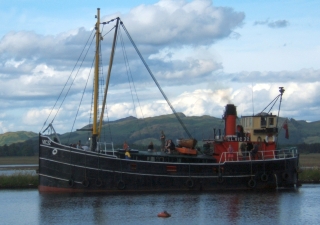
But like the Clyde Puffer, VIC32, which has been repaired and made to run smoothly after 66 years then, I too can be fixed up. The vital part of me will soon be operated on and once 'run-in' I expect to be as good as new, if not better.
At first this seemed something of a disaster to us as our trip is very much predicated on us both remaining fit and healthy but on reflection, and Kate and I have done a lot of this, we have come to a different viewpoint. It has always been in our minds that we might just stop somewhere along the way and leave the boat in Scotland for the winter. This is something we can do because the boat is our home and we have no base anywhere else nor any timetable to get there. So now that we may be forced, by circumstance, to stay here longer than we originally planned, it merely becomes a question of adjusting our mental maps to this new scenario and getting on and enjoying life.

For the moment, Cirrus Cat remains on the Crinan Canal, still our floating home but now a base from which we can explore the country around us in more detail, experience being settled in an area we love, with plenty of time to enjoy and get to know the land and the people. The fact that this course has been thrust upon us is only relevant if there was some particular reason for a 'round Britain' ending elsewhere. And there isn't. If, as now seems likely, Cirrus Cat were to spend her first winter in Argyll & Bute she will be just as happy here as anywhere else.


At least we have a warm home to protect us, unlike this tiny wee shrew who went a-hunting without his good luck charms and fell foul of the beasties of the night, one of whom then dropped him on the path for us to find.

Monday, July 27, 2009

Health & Safety

The tip of the Mull of Kintyre points south towards the Irish Sea like a swollen finger. In doing so it constricts the powerful tidal streams which have squeezed through the narrow North Channel between Northern Ireland and the Scottish mainland. The accelerated water squirts along past the chain of islands, Islay and Jura, Scarba and Lunga, producing ripples and eddies, whirls and waves which for centuries have played havoc with sea navigation in this area.

You only have to say the word 'Corryvreckan' to conjure up terror in the minds of generations of sailors but the renowned whirlpool there is no more scary than the Dorus Mor passage off Craignish point, the so called 'Big Door' through which two opposing currents rush at speeds faster than most sailing boats can move. Our own passage through this was timed precisely as the tide was turning, thus avoiding the worst of the rough stuff.
Clearly this is not a healthy area to spend much time in a boat during stormy weather. So health and safety must clearly have been on someone's mind two hundred years ago (even if the expression itself was not in everyday use at that time) as it was in 1801 that construction of the Crinan Canal was completed.

The sole purpose of this 9 mile waterway is to create a safe passage through from the Western Isles to the Clyde, in doing so avoiding the terrifying turbulence off the end of Kintyre and considerably shortening the sailing distance as well.
For the next 150 or so years the canal flourished as a trade route to the Isles and it was only by the 1960s that road transport finally became a more viable option and the canal fell into disuse. Today we can thank the canal builders and be grateful for the health and safety concerns of our forefathers who have left us with this remarkable working historic monument, now maintained for and used entirely by yachts and pleasure craft such as ours. It is narrow and tree-lined for most of its length, quaintly out of step with the modern world with its manually operated lock gates and tiny bridges operated by wires and weights and levers, but it has become our home for a while as we pause here on our travels.

From a distance, boats using the Crinan Canal appear to hover between the trees as if suspended in mid air and drawn along by invisible string. The place has a strange fairy-tale atmosphere which we share with the many swallows who skim acrobatically over the water, with herons and ducks, with voles and no doubt with the owls who depend on them, with Canada and pink-footed geese and with soaring hen harriers whose screams shatter the peace and echo around the treetops. Also here are the bones of long-gone inhabitants whose 5000 year-old standing stones are still pointing skywards in the place they now call Moine Mhor, the Great Moss. Up to 5 metres of peat has formed since these people roamed here and the land has risen, is still rising, from the crush of the last ice age so it is hard to imagine what their world was like, how they lived and what they lived on. The fact that there are traces at all is just amazing.

Today the area is sparsely populated and the local bus to our nearest town, Lochgilphead, is driven every day by the same man who remembers each passenger, thus obviating the need to issue tickets for a return journey. His bus is always on time although his weather forecasts have proved less reliable, indeed woefully wrong on one occasion, resulting in a good soaking for us on what he predicted to be a dry day. It is a poor show when you can't rely on the bus driver for an accurate weather forecast.

Monday, June 22, 2009

Loch Solitude

The eight-day licence which permits us to transit the Caledonian Canal has almost expired as we approach the final spectacular flight of eight locks at Banavie, close by Fort William. Soon we'll once again have to contend with tides, currents and salt water and maybe we also need to prepare for sailing boats in greater numbers as the holiday season is nearly upon us.
One of the most striking features of the canal for us has been the absence of other boats. It was not uncommon for us to have a Scottish loch all to ourselves for the whole day, miles of water stretching out to the east and to the west, and we rarely shared a lock passage with another vessel. All this was unexpected. Indeed we had established emergency procedures for repelling wayward hire boats which might threaten our paintwork in the confines of the canal, knowing that there is nothing more dangerous than the tired driver who steps out of his car and slips behind the wheel of a boat, then expects it to line up with the pontoon as if he were parking at the kerbside. Kate was to rush forward with a roving fender to protect the impact site whilst I had practised a stony-faced glare guaranteed to keep anyone at bay. But in the end none of this expertise was needed simply because there were too few hire boaters about to bother us.

True, Urquhart Castle did seem to be getting its fair share of foreign tourists if the coach park was anything to go by but the view from the Loch in the sunshine, the aspect the tourists never see, was ours alone.

Thomas Telford would be a disappointed man were he alive today, disappointed because worldwide celebrity status around here goes not to his engineering masterpiece in the massive stone works of the canal but instead to the elusive creature living beneath the waters of its longest loch. So naturally I have to report on our own experiences after having now spent several midsummer nights afloat on its surface. Did Nessie put in an appearance?
The waters of Loch Ness are deep brown in colour as indeed is all the water throughout the length of the canal. Steep waves form easily here (steeper in fresh water than in salt) and the mountains which drop precipitously into the loch throw long shadows which reflect back inverted summits, distorted by any surface disturbance. No matter who first gave birth to the magical monster it is easy to see how it is perpetuated and who can blame the Scots for the monster replicas in purple plastic or wickerwork which are as much a part of the culture as scotch whisky. So maybe, just maybe, that flickering shadow far away across the loch was Nessie flicking her tail for us, who knows. None of this can take away the magic or the beauty of the place. It is just too big and too overwhelming for that.