Saturday, August 29, 2009

Rain and wind

The last 24 hour period, and particularly last night, was particularly scary here in the Western Isles. Or to be more accurate it would have been a scary one for anyone not confident in their anchoring skills or caught in an exposed position.

During the day this cruise ship which normally would have anchored out in deeper water, came into Oban Bay for shelter from the elements. With nightfall the weather came in hard. It was just so noisy. Cirrus was blown this way and that, straining and jerking at her mooring ropes with the wind screaming through the rigging and few in the marina here would have slept soundly.
We have been chatting today with a couple, another set of early-retirees, who went through and survived a terrifying ordeal in their yacht at anchor just south of us in Pulldobhrain. This is normally one of the safest and most secure anchorages and it is very popular for just this reason. We visited the place ourselves some weeks back in more pacific weather and found ourselves in a beautifully sheltered pool, just large enough to take about 12 yachts at anchor.
But changes in wind direction can easily create problems when one boat drifts too close to another and the anchorage is open to the north, that is to say a northerly wind will blow waves into the anchorage rather like water blown into a bottle. For a while last night the wind did howl in from the north before veering suddenly and dramatically through 90 degrees and this would have been enough to turn a safe spot into something of a nightmare. The wind strengthened, veered alarmingly then gusted and whirled about at close to gale force. Some yachts can start to swerve about from side to side under these conditions and the strain this puts on ground tackle can become just too much. Several yachts inside the anchorage began to drag their anchors, one being blown sideways until it actually came into contact with the surrounding rocks and became stuck there.

The skipper calmly put in a radio call to the coastguard to say his crew were abandoning the boat before they made the short step, via the dinghy, to the shore and safety but we have yet to hear the sequel on what damage the boat sustained. This picture was taken at low tide the following morning.
Crews on those boats that did come through the night unscathed would have slept little, watching and listening for the scraping sound transmitted along a taught anchor chain that might foretell a slight movement of the anchor through the mud or sand in which it is embedded. Nights like this are what every yachtsman does his best to avoid. It is the secret dread of all of us and gives rise to smug satisfaction when such a night is endured safely.

Monday, August 24, 2009

Island life


The evening clouds boil over distant Mull, all of which augers rain and wind for the days ahead. Well it is August, statistically the wettest month, and I guess the rain has to fall somewhere.

Oban marina is, as everyone should know, not in Oban itself but is attached to the island one looks out at from the Oban shore, across the bay - the Isle of Kerrera. Few marinas have such beautiful surroundings (unless of course they are also located in the Western Isles) but island life brings its complications. There was a time, for instance, when Kerrera was a transit station between the Island of Mull and the mainland and cattle made the final leg of their journey to the mainland from Rhu Cruidh (Cow Point) at Ardantrive - the place of the swimming. Oh for a good boat then! Many a cow would have been surprised to discover for the first time in its life that it had an innate ability to swim, something it shares with most other animals, although sadly not with humans.

Goods delivered to the marina today are placed in the blue box on the north pier in Oban. (I felt a picture was rather wasted but imagine a roadside sandbox in navy blue and you have it.) The ferryman picks up any package placed in or near the box then acts as postman, a system that relies on honesty and local knowledge and now having put it to the test, I can confirm that it does actually work. Since pulling on ropes of any sort is now forbidden to me, something I have in common, incidentally, with one seventh of the seamen in Nelson's navy who would have been found wearing support trusses to provide comfort from their own hernias, I am engaged in some refurbishment work inside Cirrus, removing moribund plastic headlining and replacing with cork tiles. It was the tiles that found their way here via the blue box.

Marina life is endlessly fascinating, watching boats come and go - berthing attempts are always entertaining, newcomers staggering about on sea legs after many days on board, chatting with our new neighbours across the pontoon or else on the ferry to the shops on the mainland. We slowly come to be regarded as fixtures in a world of transients, something permanent, always there when you come by.


Just three boats along on our pontoon lies Shafa, Dave's modest craft. Dave lives aboard with his cat, Sukie, and uses his cameras to take dramatic pictures of some of the boats sailing around these waters. This is one of his. He has a good eye for a shot.


When he insisted on pointing his lens my way, then suggested that a bucket of cold water thrown my way would add to the drama I felt things might have gone too far. Fortunately I managed to dissuade him.

Like our fellow marina dwellers, tonight we batten the hatches securely as there is a gale coming our way. The weather whisks in rapidly from the Atlantic, touches us briefly then moves on. When there is rain, which is often, it never seems to linger and no matter how heavy it falls it always runs away safely. The sea we float on never seems to overflow, which is nice.

Sunday, August 16, 2009

When first considering writing about our lives through the medium of a blog it is fair to say that I had other things in mind than the state of our health, or lack of health, at any particular time. However to remain true to my philosophy of describing 'the most interesting things happening to us' I find myself faced with either having to write about these things or else not write at all.
More will be revealed below but first of all I make a sideways swerve as 'The Rut' is always worth a mention, especially as it is currently engaging some creatures' full attention up here.

I confess, of course, that this is not deer stags bellowing across the forest (which happens later in the year) but a rather quieter event carried out by craneflies like these two copulating on our canvas sail cover. Remembering from my own childhood, great plagues of craneflies used to occur in the summer when the air was filled with their clumsy flight and those impossibly-long, dangling legs.

On this occasion I chose not to cool the ardour of these two with a cold spray, and by now, it is to be hoped, the next generation will be planted safely until next spring brings them to life. I still wonder where did all those craneflies go.

Knapdale Forest, at the northern root of Kintyre is the location, just minutes walk from where we are staying, of Scotland's experimental re-introduction of beavers into the wild.

It also supports some of the UK's top predators. Buzzards and golden eagles are a common sight and are heard even more frequently. On a smaller scale, but no less worthy a predator, this golden banded dragonfly stood its ground on the path at my feet, utterly fearless and confident in its ability to take me on if I didn't back off. Its eyes seem grossly over-developed for a day-flying creature but they must give it a terrific edge and make it a terrifying thing to meet if you are on its menu.
A few weeks ago I came into contact with an even smaller 'creature', now common throughout the UK, whilst I returned on public transport, train then bus, from a visit to family in the south of England. For this introduction I have to thank one or more of my fellow passengers, upon whom I would wish nothing more than... a worse experience than mine. The 'creature' I speak of is the swine flu virus.
The symptoms raged their way through my body for four days, during which time each of those described on the DirectGov website came and went in rapid succession. I lost the ability to regulate body temperature, to such an extent I had no idea whether I was too hot or too cold, and sleep ceased to have any purpose or meaning as I struggled to breathe through lungs ravaged by violent coughing. The experience was worse than unpleasant, it was horrible, although if I were truthful at no stage did I ever feel that recovery would never occur. Such was the speed with which this disease rampaged through every organ that it was surprising in the end to find that my body was fighting back, finally, with something rapidly concocted in the antibody department.
Thankfully Kate was not with me at the onset and she has not succumbed to the disease at all, although to make up for this she is now nursing a slightly sprained ankle caused by an unfortunate slip on surface wetted by some of Scotland's purest nectar, its rain.
We are sad to depart the natural Knapdale beauty but to be practical I must be closer to Oban where, in few week's time, my hernia will be operated on. Our three-week sojourn on the Crinan Canal is at an end and new horizons and sunsets await.

Sunday, August 9, 2009

Aims and ambitions

Before starting to sail the length of Britain way back in April this year there seemed to be a clear plan to follow, a route around these islands, with maybe some detours on the way - a beginning and an end, even if the middle was a little fuzzy. We had no signposts to follow, although clearly there are many who have been this way before, and if there had been, those signs would have been new and strange to us such that we might have ignored them anyway.

This is a sign I thought I knew well but it appears hereabouts slightly transformed, although the meaning is obvious when you consider the rough forest tracks beside which it appears. For me, in some strange way, this represents the way our original conception of 'sailing around Britain' has shifted as we have moved on; we are still on the bike but we may have gone off-road, just a little.
I blame the Scottish mountains for this. They have enticed us and captivated us, the land has drawn us in to itself, until the signposts of our clearly stated plan have changed into something else. This change of plan may have happened anyway but it is the recent failure of one very vital piece of equipment which has acted as a trigger, that equipment being part of my own body, and this is preventing us sailing south to our original timetable. (Too much medical detail here would not be appropriate but for those interested, follow this link. Warning: this is pretty explicit!)

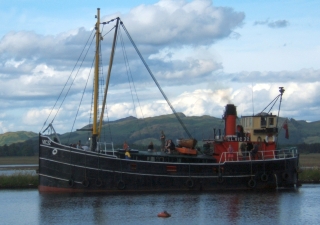
But like the Clyde Puffer, VIC32, which has been repaired and made to run smoothly after 66 years then, I too can be fixed up. The vital part of me will soon be operated on and once 'run-in' I expect to be as good as new, if not better.
At first this seemed something of a disaster to us as our trip is very much predicated on us both remaining fit and healthy but on reflection, and Kate and I have done a lot of this, we have come to a different viewpoint. It has always been in our minds that we might just stop somewhere along the way and leave the boat in Scotland for the winter. This is something we can do because the boat is our home and we have no base anywhere else nor any timetable to get there. So now that we may be forced, by circumstance, to stay here longer than we originally planned, it merely becomes a question of adjusting our mental maps to this new scenario and getting on and enjoying life.

For the moment, Cirrus Cat remains on the Crinan Canal, still our floating home but now a base from which we can explore the country around us in more detail, experience being settled in an area we love, with plenty of time to enjoy and get to know the land and the people. The fact that this course has been thrust upon us is only relevant if there was some particular reason for a 'round Britain' ending elsewhere. And there isn't. If, as now seems likely, Cirrus Cat were to spend her first winter in Argyll & Bute she will be just as happy here as anywhere else.


At least we have a warm home to protect us, unlike this tiny wee shrew who went a-hunting without his good luck charms and fell foul of the beasties of the night, one of whom then dropped him on the path for us to find.

Monday, July 27, 2009

Health & Safety

The tip of the Mull of Kintyre points south towards the Irish Sea like a swollen finger. In doing so it constricts the powerful tidal streams which have squeezed through the narrow North Channel between Northern Ireland and the Scottish mainland. The accelerated water squirts along past the chain of islands, Islay and Jura, Scarba and Lunga, producing ripples and eddies, whirls and waves which for centuries have played havoc with sea navigation in this area.

You only have to say the word 'Corryvreckan' to conjure up terror in the minds of generations of sailors but the renowned whirlpool there is no more scary than the Dorus Mor passage off Craignish point, the so called 'Big Door' through which two opposing currents rush at speeds faster than most sailing boats can move. Our own passage through this was timed precisely as the tide was turning, thus avoiding the worst of the rough stuff.
Clearly this is not a healthy area to spend much time in a boat during stormy weather. So health and safety must clearly have been on someone's mind two hundred years ago (even if the expression itself was not in everyday use at that time) as it was in 1801 that construction of the Crinan Canal was completed.

The sole purpose of this 9 mile waterway is to create a safe passage through from the Western Isles to the Clyde, in doing so avoiding the terrifying turbulence off the end of Kintyre and considerably shortening the sailing distance as well.
For the next 150 or so years the canal flourished as a trade route to the Isles and it was only by the 1960s that road transport finally became a more viable option and the canal fell into disuse. Today we can thank the canal builders and be grateful for the health and safety concerns of our forefathers who have left us with this remarkable working historic monument, now maintained for and used entirely by yachts and pleasure craft such as ours. It is narrow and tree-lined for most of its length, quaintly out of step with the modern world with its manually operated lock gates and tiny bridges operated by wires and weights and levers, but it has become our home for a while as we pause here on our travels.

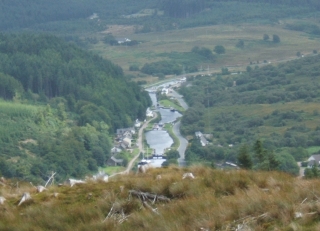
From a distance, boats using the Crinan Canal appear to hover between the trees as if suspended in mid air and drawn along by invisible string. The place has a strange fairy-tale atmosphere which we share with the many swallows who skim acrobatically over the water, with herons and ducks, with voles and no doubt with the owls who depend on them, with Canada and pink-footed geese and with soaring hen harriers whose screams shatter the peace and echo around the treetops. Also here are the bones of long-gone inhabitants whose 5000 year-old standing stones are still pointing skywards in the place they now call Moine Mhor, the Great Moss. Up to 5 metres of peat has formed since these people roamed here and the land has risen, is still rising, from the crush of the last ice age so it is hard to imagine what their world was like, how they lived and what they lived on. The fact that there are traces at all is just amazing.

Today the area is sparsely populated and the local bus to our nearest town, Lochgilphead, is driven every day by the same man who remembers each passenger, thus obviating the need to issue tickets for a return journey. His bus is always on time although his weather forecasts have proved less reliable, indeed woefully wrong on one occasion, resulting in a good soaking for us on what he predicted to be a dry day. It is a poor show when you can't rely on the bus driver for an accurate weather forecast.

Saturday, July 18, 2009

Mull

Rather surprisingly, to us at least, we have discovered we love the island of Mull.

This feeling has sneaked up on us unexpectedly, catching us unprepared for such strength of emotion. On first sight it is a powerfully wild place, its unkempt rock-bound shores backed by massive mountains whose slopes turn from green to grey as the eye ascends, houses scattered about randomly, each one representing a life so different from anything we have ever known, and of course the climate which arrives salt-laden straight off the North Atlantic.

So what is is about this island that has grabbed us?

Maybe it is the untrammelled acres of untrampled wild flowers that I struggle to resist taking countless photographs of. They lie in wait beside every road and path, little splashes of blue or pink giving their all to be more technicoloured than their neighbours so as to catch the eye of a passing pollinator.

Pink is also the colour of the land out in the west where the Ross of Mull stretches its long finger towards Iona. Seen up close, a small piece of this rock is revealed as a randomly chequered patchwork of orange granite and white quartz crystals all bonded together forever by some volcanic magic. Fire and ice has shaped this land and much of the exposed rock in the deep valleys on Mull still bears the signature of long-gone glaciers which scraped and smoothed to leave crests of rounded rock peeping out from the sea of heather and grass. Even the moraines left behind by the receding ice are still visible as vegetated hillocks; it is as if the glacial thaw has only just finished.


The Island's charms don't stop with the land itself and the nature on it. I simply could not resist this picture of Loch Don Post Office, located not in the cottage but in the shed peeping out from the shrubbery beside it. The main A road (Mull only has one) passes close by and a bus will stop and pick up anyone brave enough to cope with the single track roads which force drivers to swerve alarmingly into the passing places when meeting another vehicle. Bus drivers on Mull must have nerves of steel.


Ben More, Mull's highest peak, rises 966 metres from the sea although its domination of the landscape is tempered by so many other summits close by of similar stature. Mull is so replete with steep-sided summits that its roads have to make devious detours along the winding valleys the glaciers have left behind, a delight for the tourists craning their necks out of car windows but a nightmare for the drivers.


The one thing we have found to dislike here is the absence of coverage by our mobile internet provider so our leaving the island today will be our first opportunity for some days to pick up messages and update this blog. But surely this is a small price to pay when matched against the sunsets that Mull has on offer.

Monday, July 13, 2009

Scottish wildlife

It has occurred to us that having now lived here for some months we might have some useful advice to give on a couple of the smaller denizens of Scotland, creatures whose very abundance keeps them well away from any travel brochure, but who nevertheless will be well known to anyone who has visited these parts. There are really just two worthy of note so I'll deal with them in alphabetical order.

Culicoides Impunctatus
is most likely to appear in the cool indirect light of dusk, especially when the air is not moving above a gentle breeze. They are especially fond of sheltered valleys, woodland and forest areas. They are quite small, are competent but not strong flyers, dislike strong sunlight and prefer dark coloured clothing to light (although I have seen them completed naked so don't take this too seriously). If you have a choice, give the ladies of the species a wide berth as they seem to be heavily into motherhood and with this in mind will single-mindedly seek all the nourishment they can get wherever they can get it. The chaps don't go in for that sort of thing at all, being far too preoccupied with courting and dating the ladies - so to speak - which makes them generally OK to have around, if a little distracted.

For the connoisseur who just can't wait to get these little charmers in their sights there is a useful website which will provide up to the minute information on where to see the best ones in the biggest numbers, anywhere in Scotland.

Ixodes Ricinus is an altogether more sedentary beast.
These little dears are related to spiders and have never learnt to fly but strangely neither do they run or jump about much either, even when they are young. This might cast them as being over-weight or unfit, but as it happens they are invariably very slim (flat) and as difficult to spot without your reading glasses as any young money spider. The best way to observe them is get them to hitch a ride on your skin, something they are perfectly happy to do as they have harpoon-like mouth parts to help them stay there, these also helping them to suck up any fluid they find beneath their little feet, like blood. Once there, no matter how much you scratch their tiny bottoms, they just hang on and never seem to mind.

Here is one of the chaps (the girls always wear red shorts) with its little barbed head fully embedded in the skin of a willing volunteer. (Don't ostriches do this in sand?)
To be sure of not missing these delightful little creatures just take a stroll through some tall vegetation, bracken for example, preferably with bare legs, arms or better still, tummy and I promise you they will soon make themselves at home on you.

Oh and they can infect you with Lyme disease which is not a very nice thing to have.

OK so perhaps these little darlin's are not everyone's cup of tea so maybe you'd be happier with something bigger, like the dolphins which seem to have made Oban Bay their home. The regular comings and goings of the CalMac ferries, the many trip boats, the dozens of moored or anchored boats with dinghies coming and going at all times, none of this seems to bother them as they frolic about, sometimes breaking clear of the sea but generally more restrained, each one showing only a glimpse of black fin before diving again. Difficult to observe (they reserve their best jumps for when you glance away), frustrating to photograph and impossible to cuddle, they are the very essence of animal freedom, choosing to engage with our world on their terms, or not at all.

Thursday, July 9, 2009

Natural phenomena

On one of our most exciting sailing days yet, Cirrus has completed a circumnavigation of the island of Mull, all 87,794 hectares of it, all in one hit. I just had to state this as I'm not yet sure I believe it myself.


Our route took us past the heavily indented west coast of Mull and thus past the island of Staffa, one of the more curious natural phenomena on this earth. Fingal's Cave, well known largely thanks to Felix Mendelssohn's visit back in 1829, is but one feature on this rugged rocky outcrop, but the whole island shares a similar geology. For me, just as startling as the straight lines of the basalt columns which appear to support the island (Nature doesn't often do straight lines on this scale) is the amorphous volcanic topping which sits above this like cake icing, glued so firmly in place that centuries of pounding from the Atlantic haven't dislodged it. Even today, with all we now know about the strangeness of the world we live in, it is difficult to believe that this formation has occurred naturally, so what early man might have thought when they first passed this way is even harder to fathom. Would they have treated the place with reverence or with fear. For me the experience of sailing there and having Staffa to ourselves for just a short while was an incredible one.

The southern coast of Mull, the Ross, is a long, west-pointing finger of land tipped with a sprinkling of islands, Iona being the most well known. The Ross has some of the highest summits on Mull so to pass along this coast means sailing close to mountains sliced off by the sea, the land dropping vertically over 300 metres to sea level then carrying on again for another 100 metres or so below the sea.

The vast scale of all this rock is difficult to get to grips with and photos cannot really give much of an impression. Similarly, the phenomenon we were soon to experience here, wind, did not lend itself to photographs either as it is, after all, invisible. As we sailed into the lea of the first of these mighty monoliths there was a sudden lull, then ahead of us we could see streaks of mist over the water starting right at the base of the cliff and extending out across our path. This was something we had read about in books but had never before experienced. This was katabatic wind.
In simple terms, what happens is that warm air at high level, as on the mountain top heated by the sun, starts to cool down and becomes heavier, more dense. Where it can, and in this case helped by the offshore breeze, the dense air begins to fall down towards the sea 300 metres below. By the time the air has reached sea level it is moving fast, as you might expect from anything falling this distance unimpeded. It hits the surface of the sea and immediately tears this into spray which is picked up and thrown at anything close to the cliff or even some distance away.
We immediately took all sail down and motored past as best we could as the impossible seemed to be happening; we were right beneath the cliff yet the 42 knot wind appeared to be coming directly out of the rock itself. It is no consolation to me that the cliff here is known as Malcolm's Point.
Tonight, by contrast, we are moored in Oban Bay where the waves from a light north-westerly wind keep Cirrus gently dancing about. Kate is weighing ingredients for some exotic pie she is cooking but the scales are being affected by the little bouncy movements of the boat and she can't get an accurate measurement. Gravity is misbehaving.

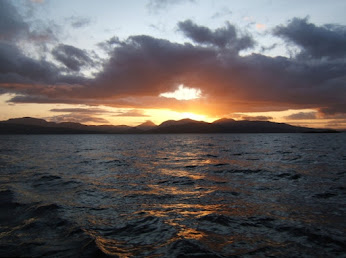
Still, the sunsets over Mull are good.