Sunday, March 15, 2009

Final days in London

Only a few weekends left to us now before we leave London, our home for the last 3 years, the last 6 months of which have been afloat on Cirrus. So on what was the warmest day of the year to date we dug our bikes out of the 'shed' (our name for the starboard rear cabin), unfolded them and set off downstream. Our plan was to make a double crossing of the river at two different points, by land and sea.

There is a riverside sign-posted route for cyclists and pedestrians which encircles the Isle of Dogs so our first destination was to the southernmost tip of this peninsular where we would take the ancient and famous foot tunnel under the river to Greenwich. A descent by lift on one side of the river is followed by a walk through a straight and echo-ey tunnel where there is another lift up to ground level again. Or at least there should be if it is working. It is not uncommon for one or other lift to be out of order so the trick here is to choose a direction of travel, north or south, where we can descend the spiral staircase at one end and rise in the working lift at the other, thus avoiding carrying our bikes up 60 or so steps. Since today it was the south lift that was out of commission we made a quick change of plan and turned away east for our next crossing point, the Woolwich ferry.

London east of Canary Wharf cannot be described as pretty and many would use much stronger language for an industrial wasteland criss-crossed by flyovers carrying cars or trains and overflown by roaring jets taking off steeply from the City airport. But there are attractions. Nestling on a meander of the River Lee is a tiny man made paradise of wildflower meadow and freshwater ponds full of life which ignores the Docklands railway passing directly overhead. Pausing here for a while in the sunshine we too find it easy to forget, as the creatures do, that a giant city throbs and roars about us.

After battling with more dual carriageways than was healthy for us we eventually escaped past the acre or so of sugar factory which dominates the north bank of the Thames here. It was sugar, of course, that gave London much of the accumulated wealth it has today and also brought slavery to our shores but a golden syrup tin now adorns one end of this massive industrial plant telling us that at least someone still has a sense of humour.

Onwards then to our sea voyage, made with the tide just starting its flood, and Kate seen here having just taken her Kwells in preparation for the passage. The tannoy announces "All passengers must leave the vessel after docking", clearly intended to prevent all those who might choose to drift backwards and forwards across the river all day from doing so and one can see, on a day like today, how tempted one might be to do just that.


As cyclists we disembark first, making our escape before we can be mown down by the the all-too-eager motorists behind us, then we drift over to an ice-cream van for much needed sustenance.


Gazing west towards the capital now we see many of the landmarks we will soon be leaving behind. Canary Wharf's towers gaze down on the dome of the O2 arena while the ferry in the foreground flashes its funnels at the sugar factory opposite. The Thames Barrier strides across the river here too and it is through these arches we'll be sailing soon. Come Easter this will be our gateway to a new life.

Sunday, February 15, 2009

The last holiday, ever

We don't do cars very well any more. When we sit inside one now the stress levels immediately start to rise. Kate is nervous of my driving and I am the same with hers. Add to this the difficulties of navigating unfamiliar roads, whilst trying to read an inadequate map (1994 vintage) and translate this into road signs and landmarks, all the while checking to see where the next lorry is coming from and worrying about what the idiot driver is behind us trying to do - getting close enough so he can reach out and touch the boot of our car, I think - and very quickly the human has been frazzled out of us and the horns have come out. We reach a compromise of sorts by agreeing not to impinge on the other's domain - I try not to lean over and map read and Kate has to ignore my driving - and thus we get ourselves along the road to our destination. But for me I was wanting to be elsewhere, anywhere but on the road.
This was a meticulously planned week starting with a train journey north then a day visiting Ursula, Kate's nun of an aunt, then taking to the road in a tiny hired car so we could drop in on Kate's niece Jeannie, her brother Andrew, then finally our son Tony in Newcastle. We had special deals booked at motels dotted here and there and to break the tragic monotony of this had arranged two nights in a Youth Hostel at Robin Hoods Bay in Yorkshire where we knew we would be able to walk our legs off no matter what the weather. The plan meant many miles driving through the conurbations of Sheffield and then Manchester, picking our way through countless motorway junctions and sets of traffic lights.

Tuesday and it was Ashton under Lyne (shortened to 'AUL' on road lane markings for obvious reasons) where Kate was given a trim by her niece before we dropped in for a cup of tea with her oldest brother who lives nearby. Next day we were driving north again and, arriving too early to meet with Tony, we took to the cold, windswept beach at Tynemouth where we watched long legged curlew sandpipers scuttling across the surfline to our great amusement. They always seem to be playing with the incoming waves, daringly leaving it to the last moment to run away across the sand. I seem to remember doing this as a child, sometimes failing to avoid a rogue wave and ending up with wet shoes. 
Somewhere along the way we paid an emotional visit to the very house where Kate spent much of her childhood, a schoolhouse then, now a privately owned property but still stuck out in remote Yorkshire farmland. Snow earlier in the week had melted on most roads but the tiny lane here was almost untouched and a skating rink for our hire car to get to grips with. Fortunately the steep descent from the main road was not matched by a similar ascent otherwise I'm sure we would still be there now. Externally the only change here is that the trees are bigger, so Kate tells me. But then they would be, wouldn't they. To get to her school she had to travel first to Otley, the nearest substantial town, which boasts an imposing statue of Thomas Chippendale (the cabinet maker, not the exotic dancer) and a café which can produce, without effort, what must have been the longest potato chip in the world. Maybe there is a connection of some sort here.

Wednesday found us navigating tiny lanes around Robin Hoods Bay on the North Yorkshire coast, trying to find the Boggle Hole Youth Hostel where we had two nights booked. Lacking basic common sense we were using insight and a rather suspicious looking wooden signpost which very nearly took us up to our wheel arches in a muddy brown river, jokingly referred to as a ford, until a helpful local man pointed us on our way. The hostel was almost deserted, few being crazy enough to brave the cold and snow of recent days to stay there, but we were made welcome and soon had the lie of the land. Eating out in the evening involved a trek up the steep cliff path, a mile walk along the crumbling cliff edge then a hair-raisingly steep descent down wooden steps to the village pub and later, full of good food and ale, a similar passage in total darkness. By the second evening we had this pretty well sorted, however, so even the driving snow failed to deter us.

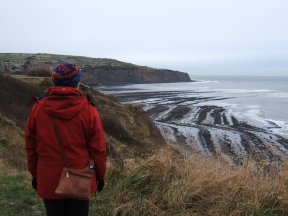
The curving slabs of rock at the cliff base (this is still referred to as a beach) are a classic feature of the area, and the Jurassic fossils within these sediments attract many hopefuls in search of new discoveries or simply bigger and better examples of what others have discovered already. But venture too near the cliffs and you'll soon realise how fast the sea is making inroads here. Falls from the tops are happening continuously as more and more soil slips quietly away, Britain disappearing from view to be carried away by the sea. The beach is actually a mixture of bed rock and sand with sea-rounded pebbles in a variety of colours, suggesting great efforts of transportation from far and wide. Lumps of boulder clay, some round shaped by the action of the sea and looking like dinosaur eggs, litter the beach. The clay is topsoil from the cliffs and falls are both regular and frequent so it is wise not to venture too close.

But the bay can also be stunningly beautiful, particularly with the winter sun catching snow on the cliff tops and the wind waterfall whisking to produce a fine mist, like steam on the water.

By one definition, 'taking a holiday' presupposes being at work in the first place. Thus on ceasing to work it must no longer be possible to take a 'holiday' at all. In a little over six weeks time we will have retired and will need new words to describe what we have just done. Paid work as we now understand it will cease for us both so this week away from home will not be forgotten quickly. Soon our home will move along with us and as we pass the Yorkshire coast again our viewpoint will be different, from on sea to a distant shore.

Sunday, January 11, 2009

The family reunion

Train tickets all booked, a change of clothes, a few essentials for the journey, enough warm clothing to enable us to survive the wait for the Ticehurst bus and off we set on Friday evening, out into one of the coldest nights of the year. We stepped from the train into the white-encrusted world of the Sussex countryside, wending our way through clouds of exhaust smoke coming from the waiting cars so we could stand by the bus stop and stamp our feet to fend off the cold till our bus arrived. Our breath misted thickly in front of us as we peered at the timetable faintly illuminated by lights from the station - maybe 20 minutes or so till the bus arrived. Survivable, then. Just. 
From Ticehurst village we walked the quarter-mile to our night's bed & breakfast down a quiet hedgerow-lined lane bathed in the most eerie light imaginable. The searchlight brightness of a full moon shone onto the frozen landscape, darkness being turned into a transparent in-between world of strange shapes, blanched of colour and form, all the while the cold eating at our faces, our nostrils pinched with ice, lungs burning with the chill. 
Such a magical experience for us city dwellers, even with the cold we were reluctant to leave this world for the warmth of our accommodation. So in the morning we just had to trek around the frozen fields before visiting our family gathered waiting for us nearby. This weekend has been the family Christmas we missed this year. Lots of food and chat, lots of laughter, some presents, some drinking and some general lounging about.

Here we all are at The Bull, waiting to be fed, the two Trott lads looking scarily alike as we joked and reminisced. That's me on the left with the bull picture behind my head.

Much of the weekend was spent tackling the Times crossword, some of us being better equipped for this sort of mental nonsense than others. By the end of the weekend my brother, Graham, had succumbed to the cold germs he brought with him into the UK from his home in Italy. We are now all hoping we have some natural immunity and remain unaffected.

Monday, January 5, 2009

Strange noises

A new noise greeted us a few mornings ago as we lay warm and snug in our berth on board Cirrus.

The day before there was a fresh breeze coming in from the north east, very cold and piercing. Then after dark the clouds which had been hanging round for the last few days blew away leaving a clear, open sky. No stars are visible from central London (too much street-light pollution) but the moon shone from the black sky like there was someone up there with a spotlight shining it through a crescent-shaped slot. We just knew that every last smidgen of residual daytime heat was escaping skywards as we tucked ourselves in for the night.

Dawn came with the sound of a boat engine starting up, a sound which carried through the water into our hull. Then came the scraping sound, more than a rustle and less than a grind, of ice against the hull as somewhere, the boat began to move.

Although less than 2 millimetres thick, the ice was nevertheless continuous right across the marina, an unbroken skin to which every boat in the marina was connected. The moment one started to move, so did the skin, and each one of us felt and heard it as the skin broke up and became instead a set of icebergs bobbing about independently, right across the basin.

Thankfully this is, as yet, only very thin ice and our waterline antifouling paint is safe for the moment. But the weather pattern we have now is very static; there's no warmth in sight for some days yet. Our lockkeeper tells us that this is the first time in at least 5 years that the basin has frozen over. Aren't we the lucky ones then!


More noises

Kate and I were busy on board yesterday evening, minding our own business and preparing a feast of a dinner for ourselves when there came a sudden raw noise from outside that neither of us could place. The best description I can come up with is to imagine a classroom of small children all scraping the fingernails of both hands down a large, resonating blackboard. And then some. So not a pleasant noise then.

Rushing to the hatch we were confronted with the sight of an elegant yacht coming into the basin from the lock, nothing unusual in that, until you realise that it was acting as an icebreaker on the thin skin we now have across the basin, ploughing a furrow just wide enough for its own delicate hull and making this bizarre and unworldly noise which was being amplified as it bounced off the apartment blocks around us. I felt sorry for the skipper, who must have been imagining all sorts of damage to his boat as he slowly came to a halt mid way across the open space, then picked up courage again and pressed on to the nearest pontoon, amid more screeching and crunching.

To anyone who has sailed in the far north inside the Arctic Circle this sound must be as common as muck but in central London I hazard a guess that it is quite rare. To be savoured, perhaps, if you like that sort of thing. Although the cold weather is set to stay with us for a while yet, last night did see a slight warming as often happens when there is snowfall. Although seen settled on the ice here in this early morning picture it has a wet, slushy look to it and didn't survive the day. Instead we now have a fresh wind again, biting cold to be out in and no doubt putting another layer on the ice for tomorrow.

Wednesday, December 31, 2008

Christmas as it should be


Here is the cosy scene on board Cirrus this Christmas.

We had arranged to visit Mike at his Yeovil home, to spend a few days over Christmas then return at the weekend to prepare for work on Monday. Little preparation was needed for this and we set off fairly empty handed with just the clothes we thought we'd need, some presents, and little more. Travelling down by train and negotiating the London underground is not the same as having a car of your own and being able to load the boot with everything including the kitchen sink, whether it is needed or not. Train travel needs a little more planning but we are used to this and enjoy the freedom it gives us. There are at least two things you can do on a train that are not possible when driving: reading a book and having a drink. As it happens we did both.

It was only a short visit, two nights, and given that we carried little food with us I suppose we sort of expected to find something we would be able to eat when we got there. But knowing this would be our son's first Christmas in his own place we did not place any great hopes on this. It was not, after all, why we were going.

We arrived late on Christmas Eve, about 10 pm having taken a taxi from the station, to find Mike in a similar state of unpreparedness to us. He had been working right up to Christmas, somehow losing track of the days in the week, and with living just over a small supermarket which gives him everything he needs, any day of the week and through into the evening as well, he tends to live day by day and buy what he needs when he needs it. He has never before been in the situation of having to "do" a Christmas himself as a sole householder with family visiting him so had not succumbed to the panic many families fall victim to. He had food in, enough so that we would not starve, but not what many might call enough to make a Christmas.

We had brought two bananas with us and might have had a few odds and ends, leftovers we did not want to leave on board Cirrus, but thinking it was rubbish, Kate had neatly disposed of the plastic bag containing these back in London. The local Asda supermarket, Mike's last resort for food, has always been open for him in the time he has lived alone but this time it let us all down; like everywhere else it had closed for the Christmas period. So here were three people with a box of breakfast cereal, some rice, a packet of cheese paninis and some pasta. Clearly this was gong to be an unusual Christmas although we did, to be fair, have a TV to watch.

But then we thought, well what had we come to Yeovil for? Was it the food and drink? No. We had come to be a family together and to enjoy our own company, plus maybe the odd Christmas movie. We were warm and we were dry, we had water and enough food to sustain us for the next 36 hours or more at least, by which time some enterprising local shopkeeper was bound to open their doors again. So for our Christmas we missed the overstuffed belly feeling, the drunken aftermath with the Christmas hangover all afternoon, the party hats, the false jollity and the chestnut stuffing and it felt good. I woke up the morning after suddenly realising what we had achieved. We had broken completely with tradition, with convention, broken the pattern of a lifetime, enjoyed ourselves and Kate woke up with her knitted hat almost finished.


Mike is, on his own admission, not a Christmas person, which maybe explains his lack of preparation (if not ours). Anyone else might have felt greatly discomforted by the situation but to all present the lack of a traditional Christmas dinner meant nothing. The lesson for us all here was that there need be no rules about how to behave when you are with those you love and cherish. Take away all the props of convention and habit and somewhere beyond there is life as it should be lived. The simple uncomplicated pleasures are what really counts.

By the time we left Yeovil the climate across southern Britain had gone from rather mild to colder-than-the-Arctic. An easterly wind coming to us from Europe lowered the temperatures by some 10 degrees and the clear night air brought a vicious frost to the ground. Just standing for 5 minutes waiting for the train brought tears to the eyes and we were beginning to be concerned for our unheated boat in London which we had left unprepared for this level of cold. Our water heater is most at risk as it has a water jacket that would be destroyed if it froze up.

We needn't have worried. Central London has its own micro-climate anyway and then there was cloud cover at night so the temperature had not dropped as it had across most of the rest of southern Britain. The cold wind does not have anything like the edge here that it did in Yeovil, something that we were rather grateful for.

Curiously, this cold weather has made us start thinking about where we might be next winter, and where Cirrus might be. We now feel we need to make some loose arrangement for a winter berth for Cirrus as a fall-back plan in case we get to the end of the sailing season and find it too late to get her in somewhere. We have a couple of options up our sleeves now and this sort of forward planning gives us more freedom to go with the wind or to stay put as we please. We now have only three more months left in our jobs.

Saturday, November 29, 2008

Weekend Britain

This weekend Britain is what everybody expects Britain to be - cold and damp, the drizzle dripping off every tree and blade of grass and a cold that seeps right into the bones. We have deserted our London nest to visit East Sussex where my mother normally lives although at present she will be striding the decks of a luxury cruise ship on its final approach to Rio de Janeiro.

We took the train down from London yesterday evening after work and the bus from Wadhurst station. It was a cold and rainy evening, so arriving in the dark meant a struggle to read the station bus timetable to work out whether the bus turned round at the station or went on somewhere else. It turns out the station is a terminus so all we had to do was wait but even the driver seemed a bit perplexed when he did finally arrive. Instead of opening the doors we could see him struggling with some sort of control panel inside as he attempted to get the display at the front of the bus to change from 'Wadhurst' to 'Ticehurst'. Clearly he wasn't going to succeed and finally he gave up so we could climb on board. Barely had the doors closed when the bus shot off like a rocket, blasting long dark roads we could see nothing of from our brightly lit interior.

Somewhere along the way we figured out that the driver was foreign, Polish maybe, and it was his first day on the route. Maybe this was also his first time driving in this country, maybe he had high-jacked the bus, we thought, as he blasted down the winding country lanes.

We escaped at Tickhurst, as he pronounced it (which we rather thought was a better name for this place), beside The Bell pub in the village centre. Sadly, however, this was guarded by a wooden hoarding, as if being refurbished, so our hopes for a warming drink and a meal were thwarted. Not knowing about other pubs nearby we trudged off in the dark towards mum's cottage until Kate spotted an Indian take-away. All was not lost and the food turned out to be well cooked and tasty, if rather lacking in 'edge'. Once again my theory on Indian food is proven - the smaller the town, the less spicy is the food.


Finally, the Cruising Association's home beside Limehouse basin (and Cirrus Cat) is featured in December's Yachting monthly magazine, in case anyone is interested.

Tuesday, November 25, 2008

Life with Brian

Living aboard a fibreglass yacht in winter has its pros and cons, most of which represent a new experience for us. But we are learning, every day, how to cope with things, some of which are expected or predictable and some less so.

Over the first few weeks when the British climate was moving slowly from late summer to autumn then into winter we had such variations of temperature, sun, wind and rain that it was difficult to do much apart from react to whatever was thrown at us. In the course of one week we would have a sudden cold spell, a few days of rain then warmth with daytime sunshine warming the boat and drying things out. But we are so sheltered by the surrounding buildings here in the centre of London that only rarely is there sufficient wind to air the boat in the way that we have become used to in other marinas and mooring locations. We miss the wind's drying effect which normally, over time, will keep the air fresh and regulate the moisture level of everything inside the boat.

Of course we have our Taylor stove with its impressively shiny chimney drawing air in at the bottom and taking it up and away above decks but even with this going steadily most evenings, after a month or so we began to notice that the interior of the boat was gradually absorbing moisture from our bodies, principally from our breath, and from daily cooking, washing, and so on. The drying effect needed to achieve the usual moisture balance just wasn't happening; it needed to be significantly greater and clearly just airing the boat when we could wasn't going to achieve this. The moisture in the air inside our boat was condensing on any cool surface it could find and there are plenty of these when the temperature plunges 10 degrees Celsius in the space of 12 hours or so.

Fortunately man's ingenuity with machines and our salary-laden bank account came to our rescue in the form of Brian (the name just seemed to work for us) who sits in one or other of the hulls humming away to himself, making our lives happier. He is sort of short and dumpy (although I wouldn't tell him this directly) with a plastic reservoir for catching the moisture he keeps busily extracting from the air around him. For Brian is a de-humidifier, a machine built to serve but one purpose, to make things dry. It is hard to believe where all the water comes from but he just keeps producing more of the stuff and we have to empty him out regularly to keep him happy. He even has a smart accessory which we use occasionally, a clear piece of pipe to take his extracted water directly into our bilges from where the float activated pump can squirt it overboard. Brian has transformed our lives. Suddenly the windows, which used to drip moisture every morning, are clear again and even the ends of the hulls, those awkward to reach bits where air circulation is negligible, are smelling sweet again.

We suspect that being on a relatively poorly insulated fibreglass boat we might be experiencing more condensation than one might get, for example, on a wooden boat but now we have the situation under control, thanks to Brian, we don't let this bother us. We come home from work and step inside to find the air as sweet and dry as if it were summer and we can get on with the routine of life on board. Tonight is washing night, which means a trip to the facilities block armed with our machine tokens and powder. Just another day really.

Monday, November 24, 2008

Families and young children

We have had a weekend of delightful family visits, us to them in different parts of London.

Saturday we met with Adrian and Lucy who celebrate their return from a recent adventure sailing around Britain in their 30 foot sailing boat, Moondance. We take much inspiration from this with our own plans for 2009 being much the same. Setting off from the West Country they passed along the west coast of Ireland then Scotland, rounded Cape Wrath before coming south to the Caledonian Canal. For some reason that I still can't quite make sense of they passed through the canal twice so that they could come south down the east coast of Scotland, then England, to meet their own friends who live somewhere on the Essex coast. Finally they navigated to Southampton where Adrian's brother, himself a part owner of Moondance, lives. Although slightly less ambitious than this, our own plans for next year will take us through much of the same water so we were keen to hear of their experiences.

We met the pair in Islington, close to where they had been staying with family, with whom we spent a delightful afternoon chatting over a pub lunch. Stealing the show, of course, was Ava who at the age of 8 months totally captivated us all as she was passed around the table. We all had a turn at amusing this wriggling bundle of baby who calmly accepted our attention with complete insouciance. It was an honour to earn the trust of both Ava and her parents to be allowed to do this; for us it was an experience to be treasured.

Then on Sunday we met with more friends, another family about to depart on their own adventure. 
Adrian (another one) and Jill are emigrating to New Zealand with their young children and as I write this will be taking off from Heathrow. Adrian is a work colleague but we had not previously met his wife or any of his three children so once again we found ourselves spending time with smaller people. To gain the trust of strangers, particularly children, can take time and patience. It needs to find its own speed and cannot be hurried along but once again we were delighted to be taken into the confidence of this young family. Of course it was Dan, at 3 years old, who was particular captivating as he first exhausted himself trying to keep pace with his older sisters then recovered his energy again during the day. We had travelled across London to Kew Gardens to see our friends, arriving in a torrential downpour which soon cleared to give us glimpses of sunshine for the rest of the day.

It was a cold day which started with a layer of snow on Cirrus' decks so we left ourselves open and vulnerable by planning a day outside in these conditions. In hindsight I suppose it could easily have been a disaster if we had been caught in a heavy downpour but somehow we managed to keep everyone happy and arrived at the warmth of Kew's hothouse just before hypothermia might have started to be a possibility. Adrian's three delightful children hardly know what lies ahead as they leave Britain to take up a new life on the opposite side of the earth. We treated them in the Kew Gardens shop so that Ellie, aged about 7, could examine the ground through her plastic binoculars looking at where New Zealand would be if the earth wasn't in the way.
Finally we all refreshed ourselves in the 'Greenhouse', a cafe serving mountainous cake slices with tea or fruit juice and located en route to the underground station.
Dan, as 3 year-olds are wont to do, liberally covered himself with cream from his cake but we knew from bringing up our own children that this would soon be absorbed into his body by some kind of osmosis and give him just enough energy to keep going for the rest of the day. It was late when we left them alone for their journey back to the hotel where they would spend their last night in this country.