Saturday, July 28, 2012

Journeys

I take a weekend off to visit friends Rich and Gerry and help them celebrate Rich’s retirement from full-time work. Joining us is the other Richard whose retirement last year we tried to celebrate in a weekend of sailing on the sheltered waters of the River Swale in Kent, and when due to atrocious weather we were forced indoors.
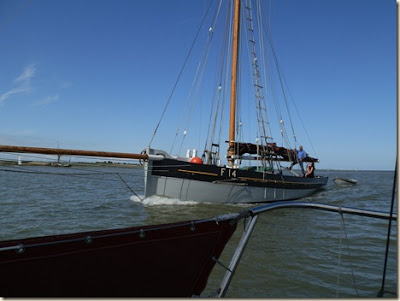
This time around the weather looks far more favourably upon us and in the middle of a brief heat-wave, we all take to the water on board Waxywoo II and Courageous, respectively a yacht and a sailing dinghy. The silt-laden waters of the Swale and the River Medway are places where traditional sailing boats are plentiful so it is far from unusual to pass by some beautifully restored piece of floating wooden history like this ancient fishing smack. Our own craft are a little more modern but over two days on the water we manage to sail, swim, potter around a few creeks on the Isle of Sheppey and generally have a ‘Swallows & Amazons’ type adventure with plenty of scrapes and jolly fun. Just what I need to take my mind off the madness of house removals.

Rich and Gerry generously feed and water me at their Dungate home where we find that in our absence, Wendy, one of the badger-faced ewes who live in the orchard behind their house, has given us a real treat by producing two fine lambs. She manages the whole business entirely on her own, with no human help, so we are very proud of her, although she does look a little sheepish in this picture.
Hovering expectantly around the comfortable barn where Wendy had installed herself was our old friend Hot Horns, a ram who loves having his thick coat tickled just behind his head.
In fact he is tolerant of almost any human attention he can get and although he wasn’t saying much one has to wonder whether he was an active participant in Wendy’s big event.
My mother is now finally re-locating, making the long journey north, and will stay in our home until she can take up residence in the house next door which she is buying for herself. She has great plans, naturally, to add new features here and there, to decorate the place to her own taste throughout, to tame the wilderness that is the garden, and no doubt there will be a long list of other jobs in the months to come. Once again a member of our family plunges into a house renovation project. Mere age alone cannot stop this – it is in our genes, I fear. At least it will take Mum’s mind off of the fact that she has left behind the over-crowded warmth of south-eastern Britain with its tame hedgerows and tightly clipped lawns as she struggles to adjust her eyes to the rather less kempt surroundings of the scenic Highlands with its dramatic views and rugged mountains.

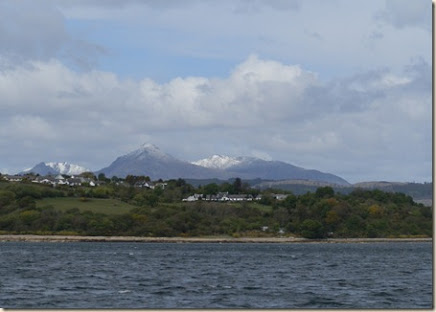
The final part of her journey is inside the fuselage of a twin-engine Otter aircraft piloted by a lady we all assume is the air hostess… until she takes her position in the driving seat. Flying in a plane this size is flying in the raw, intimate and noisy, unlike the insulated, flying-above-the-clouds Airbus 319 that brought us as far as Glasgow. Propellers whirling we pick up speed then spring into the air and level off just high enough to clear the chimney pots then head towards the Isle of Arran whose mountains loom at us on the horizon. This being a new experience for me my camera is shooting in every direction, sometimes capturing part of the plane in shot (oops, is that the wheel!) or sometimes a yacht sailing not far below us.

At times we are so close to the ground that it feels like we might just bounce off it and a power station chimney we pass over looks almost close enough to touch. But we do clear the peaks of Arran then soon we are starting our descent to Campbeltown Airport where we make a gentle landing then taxi towards the tiny terminal building just as a fire engine rushes towards us – normal procedure, apparently.
Kate has driven out to meet us to complete this lengthy journey, the finish for me but the start line of a brand new journey for my mother.
My leisure-time reading has just taken me to a book by Mike Carter, a man who cycled around Britain a few years ago, coincidentally going the same way around the country as we did on Cirrus Cat, anticlockwise. As it happens his journey took place during the same summer as well, which may account for the fact that the conclusions he draws on the state of the country, and the welcoming attitude of its people, were very similar to our own. But of all those he met and wrote about I was most struck by his account of Steve, the ferryman who takes passengers across Salcombe Harbour in Devon. Himself a well-travelled cyclist, the simple wisdom of this man almost took my breath away. His view of life and of how he feels we should view life’s many challenges, made me re-read this section of the book several times until I had committed to memory something I felt I should take away with me. “Finishing lines are good”, the author quotes, “but their most important role is to get you over the start line in the first place.” How true this rings today when too often we are focussed upon goals and achievements, so many of which are meaningless in their own right, when it is the journey itself that is important.

Our son Mike’s journey is now complete and whilst Kate is supervising his introduction to Carradale life, something he seems to be taking to rather well, I am wrestling with the estate agents dealing with the sale of my mother’s house down south here in England. I feel as though I am having to push through treacle to get anyone, solicitors included, to even attempt to speed things up. It is as if the whole English sale and purchase system is geared towards sloth and even to suggest that things could be done quicker is met with surprise and alarm, horror even. Small wonder the housing market is in recession at the moment. The contrast with the more efficient Scottish house buying and selling process, where much of the work is done up front by the seller, is self evident and I know which I prefer. Estate agents, however, are of the same mettle all over the universe.
Grumbling over.

Tuesday, July 10, 2012

Family on the move

Our eldest son, Tony, has paid us a visit for the first time.

With a bit of reasonable weather, with all our first time visitors we like to show off a few of the treasures of Kintyre and seem to end up at Skipness Castle, a place with a fascinating story to tell despite barely having experienced combat. Far from being a ruin today, this place was inhabited until the seventeenth century, lived in by the favoured few with their servants no doubt, but the place is now said to be haunted by a Green Lady, although we did not see her on this occasion. Within the castle walls today the light seeps through small window openings casting shadows on the quiet world within.

But the stones used to build this castle glow with colour. A pink sandstone etches the corners of the structure, surrounds the windows and the fireplaces and picks out other details in a way that would not be out of place in a modern dwelling. Built by ‘Sven the Red’ when the Western Isles were part of Norway, he clearly had an eye for colour and wanted to create an impression on anyone approaching its walls. The roof balcony, created for the more liberated to wave from, was however a later addition.
Of all the new sights around him on his visit, Tony seems to be most impressed by the green lushness of the undergrowth that surrounds us, this being such a contrast with what he is used to seeing deep in the south of England. Frequent and persistent rain over recent weeks has promoted accelerated growth of everything with roots to suck it up and leaves to wave about. Bracken has been shooting up out of the ground, uncurling its long fronds, roadside verges have grown hairy, encroaching on the space available for cars, and trees now full of sap are bowing under the weight of their leaves. Everything is rushing, it seems, to get from flowers to seeds in the shortest possible time before the summer is over.

It is this point in the year, when the land and the sea are finally beginning to warm up, that Kate and I might have expected to find ourselves exploring the Highlands and Islands under sail aboard Cirrus Cat. Instead of castles, this blog would have been dotted with pictures of island wildlife, perhaps of tidal shores, of windblown spray and seaweed strewn beaches. Instead, I must report that these plans have yet to come to fruition, and may yet stay on hold until next year the way things are going for us. And the explanation for this starts with a journey south that will end when we have radically changed the lives of two members of our immediate family, and our own too.
Our first port of call is Yeovil in Somerset where we arrive to help our middle son, Mike, move from a place that has been his home for many years. He is coming to stay with us in Carradale. Moving to the Highlands of Scotland can be a life-changing experience, but living back with Mum and Dad can be even more of a culture shock - Mike thought he had left home for good over fifteen years ago - and his presence in our home promises to turn our own lives around as much as his own. In the intervening years we have each changed a lot so we are eagerly looking forward to having this older person around us and getting to know him better.

Closely following him on the journey north, as soon as the sale of her house in Sussex allows, will be my mother, her arrival establishing a three generation family set here in Carradale village. Neither of these moves are part of a long established plan; this is not how our family does things, it seems. For example our own decision to move to Scotland, although based upon solid reasoning, was implemented ruthlessly quickly as soon as we had reached our decision. House hunting via the Internet got under way then, almost before we had told anyone else, we found ourselves moving in. The whole process from deciding where we wanted to set up our home to re-locating lasted no more than three or four months, a remarkably short period of time in which to be turning your life around. Surely other people don’t do things this way. But yes! I had not previously appreciated that this was a family trait, something I should find comforting. But in some strange way I find it rather disconcerting that all of us move around so readily, following the advice of Albert Einstein who once said ‘Life is like a bicycle. In order to keep your balance you must keep moving’.

Friday, June 29, 2012

Midsummer snaps

Observing the wildlife, rabbits and birds large and small, as we sit eating a meal in our living room is like having a widescreen TV tuned to a wildlife programme. Naturally, without the breathy Attenborough commentary we don’t get the detailed explanations of what each animal is doing but this just means that we have to make our own interpretations of the behaviour we are witnessing.
Why do the rabbit’s ears point to the rear when it is head down feeding? Our explanation is that like us, it has a blind spot behind its head where it cannot see. So having large eyes covering the front and ears ‘keeping watch’ at the rear saves continuously head turning.
Why would a rabbit feel comfortable sitting on the pavement or in middle of the road? We assume that tarmac absorbs heat from the sun and probably feels warmer underfoot than damp grass.
We note that they seem to prefer sitting away from cover, presumably because a clear all round view enables them to see predators approaching. The road is ideal in this respect since motorised traffic past our house is rare.
Rabbits are now such regulars around the house that we are beginning to think of them as pets. They tolerate our presence at the window and are slow to move even when we emerge from the house so we have to remind ourselves that these are wild animals and their choosing to feed and spend time with us is driven by some advantage the place has for them and not by a desire to be friendly towards us. Perhaps our washing lines over the garden deter aerial predators and the large mesh boundary fence through which they routinely hop may be small enough to discourage cats and foxes.
The only piece of land we protect from their increasing numbers is our small front garden where we are growing a few herbs.
Parsley seems to be a favourite of theirs and it would not last long if they were able to get at it. Some low reed fencing surrounds what we would rather the rabbits not devour and to date this has been successful in keeping them out. I speculate that as well as forming a barrier over which they cannot easily leap, the fencing prevents them from seeing what is beyond. Sooner or later they might decide to eat their way through and I hazard a guess that if food were scarce then holes would begin to appear in the fence. But so far, with a plentiful supply of grass and weeds in our neighbouring garden, our herbs are growing well. I did read that a single female rabbit can become 800 rabbits in one season, given the right conditions and in the absence of predation. This number might be more of a challenge for our fencing.

‘Old Scarface’  (formerly known as ‘Flopsy’ until we spotted the mark just above his/her nose) appears to nod off on the grass just outside our living room window, perhaps meditating upon which particular blade of grass or clover leaf to nibble next. Choices like this must be tough for a rabbit, tiring, exhausting even. This one found it all too much on a summer’s day.
Midsummer’s day, in fact. A day when the sun sets later than at any other day in the year. In Scotland it sets far into the north-west, barely leaving us long enough for the sky to darken before it rises again in the north-east a few hours later. A wander down to the harbour gave us a real treat, a sunset with a sense of calm and peacefulness. I took a few photos, which seemed to turn out fine, then I decided that the mood could only be re-captured with a bit of music. This is the result:
So Carradale Harbour does have its attractions (and its own website) after all. And since gentle strolls about the village are all I am permitted for the next few weeks while I am recovering from my operation, I find myself steering a course to the harbour more frequently now, by some devious path or other. One of these leads over the golf course, a place where there is grass trimmed to within an inch of its life on the fairways which exist side by side with untamed wildflower meadows. These are loosely kept in check by the feral goats which seem to have little interest in playing on the greens.

For reasons I cannot fathom (without Sir David’s help) the goats seem to ignore the Heath-Spotted Orchids whose flowers are dotted around everywhere right now. The flower stems stand around bravely, each one displaying the most delicate of patterns etched on each petal by someone using the finest of paint brushes. I have always thought of orchids as exotic and rare things and it seems odd to see them growing so plentifully.
The rain we have had of late has made the vegetation lush and green. Bracken has reached shoulder height in places and the bramble stems seem to get noticeably longer each day, lengthening almost at walking speed.

One damp morning at home we look out and spy our first deer, just beyond the garden fence. I can see she is heading for a patch of fresh undergrowth and manage to press the shutter just as she sticks her tongue out. But tempted as I am to think of her licking her lips in anticipation of the next juicy mouthful I fancy this human interpretation is not appropriate. I am aware that this deer is easily capable of hurdling our fence in one bound, were there something attractive for her to nibble on. Perhaps our herbs are less safe than they might think.
As it happens in our part of the world, young deer have their own natural predators and later in the same day I spotted one of them, Aquila chrysaetos, gliding on the breeze as I drove north to Tarbert.

Although not our first sighting, this was the first time one had come remotely close enough to take a photograph (eventually). Flying with wings held flat and the body hanging below like the fuselage of a plane, this distinguishes golden eagles from other raptors when their enormous size is difficult to judge. Their long primary feathers stick out beyond the end of each wing like thin fingers and when they are hunting, little is safe from them that lives out on the hills.


Sunday, June 17, 2012

Around the village


Pictured here, the Carradale beach-clean team having just spent the morning cleaning up what had collected in and around the bay over the last few months. Most of us were there to pick up litter but Rupert the horse was there for a gallop along the beach and then to eat some of the juicy grass growing on the dunes which is very much to his particular taste.

There was excitement in the village this week as various local groups had meetings with an architect engaged by the Harbour Group to come up with a plan to develop the harbour area. Carradale Harbour was once busy with fishing and even as recently as ten years ago it was very much the place for anyone living nearby to go and spend some time on a fine evening. There was always some activity going on, fishermen arriving back in port, tying up and unloading their catch, so it was the place to go for a blether, a natter. It was the place to be, a place to stroll down to for a promenade beside the sea, the harbour being the centre and focus of village life.

Over time all this has changed. The fishing fleet has declined due to over-fishing (and some would say over-regulation) and as the village population has changed (and become older), the strong bond that the village had with its harbour is being put to the test. Usage of the harbour declined to the point where it is now no longer the centre of the village and sadly it has now taken on an appearance which reflects this.
No longer is it an interesting and attractive place to promenade about at the end of the day. More usually now it is quiet and comparatively empty of life. When viewed from the sea this is hardly surprising as part of the private land beside the harbour has become an eyesore, a rubbish dump, due to the untidy lifestyle of just one owner.

Time cannot, of course, be made to run backwards so the harbour can never be re-created exactly as it once was. The world we live in is forever changing and on our travels Kate and I have seen the effects of this in old fishing harbours all around Britain. Some have remained unchanged, stuck in the past, but there are many that have adapted successfully, bringing in people and life once more. Who would have thought, though, that one day we might find ourselves participating in efforts to re-vitalise a small village harbour, to breathe new life into the place? We certainly didn't. Yet here we are right at the sharp end doing what we can to improve our home. Not everyone in the village is involved, of course, but there are enough here who feel like us and will try to make a difference, who will keep on pushing to make better things happen, to make this a better place for the community and for visitors alike.

Medical update: Once again I find myself under the surgeon’s knife in Oban Hospital with Kate anxiously waiting for me nearby. For the second time an inguinal hernia has popped up and I need patching up. As I lie here writing this entry I am feeling sore and rather sorry for myself but I know this will soon pass and in a few days I will once again be leaping about, maybe gently at first.

To take my mind off the soreness in my groin we are planning for a couple of momentous and life-changing moves, not for us but for two members of our family. Carradale is sucking them in, just as it did for us. First is my mother who will buy the house next door to ours and, some time in the next month or so, move in. Then there is our middle son, Mike. He too is re-locating to Carradale. It makes me wonder whether I have painted too rosy a picture of this place in these pages. No, not possible.

Thursday, June 7, 2012

Time off on Cirrus

We start our wee break on Cirrus (not a holiday, of course, as retired people don’t get these) by having a close encounter with a paddle steamer, none other than the newly restored steamship, Waverley.

She was making a brief stop in Campbeltown, just as the steamers would have done a hundred years ago, and her departure, reversing away from the quay at speed, her decks lined with waving passengers, was exactly how it would have been on any of the Clyde steamers. Out in the centre of the loch she performs the nautical equivalent of a handbrake turn before steaming off south (forwards) around the Mull and heading off north to Oban. As it happens we time our own departure just before she got underway and thus we have the best view possible of this little slice of living history.

The rest of the day passes more gently as we drift north trying to persuade Cirrus’ sails that there is enough of a breeze to fill them. Unlike on our two previous encounters with Kilbrannan Sound, both in strong winds, we now have a chance to sail and then motor close by the shore, dipping our twin bows into each bay in turn. First we pass the ruins of Kildonan Dun, where we are surprised to note how the tiny Ross Island creates a good sheltered bay, an attractive place for the ancient people who settled here to build and set up their home. The relationship between land and sea is not evident from on shore – only from a boat does this place become a logical stopping point.

At Saddell Bay the castle peeps out from the corner in fine style as we creep in, as close as our echo sounder tells us is safe. The sun beats down on us as we cross Torrisdale Bay then finally we slip slowly to anchor in Carradale Bay, just a short distance from our home. Three and a half metres of water is all that separates us from the bottom but it feels like we are in a world of our own here, bobbling gently up and down on the slight swell. Those on land are no doubt suffering the midges, which are particularly troublesome just now whenever the wind falls light, but these little insects are poor flyers so we have every hope that they find it difficult to cross the short stretch of water that separates us from land; and so it proves.

After a peaceful night we wake early to find the motion of the boat has changed. Now Cirrus is wobbling from side to side as waves pass beneath her although the wind is still very light. Whatever is happening it is getting uncomfortable so we decide to leave, early though it is, but as soon as we leave the shelter of the bay the true wind hits us, a north-easterly blast at 15 to 20 knots, and the waves driven by this are rolling down Kilbrannan Sound. The nearest shelter from this wind is Lochranza on Arran, some 10 miles away, so we motor upwind as best we can and attach ourselves to a blue visitor buoy there. This place, which lies west of the most mountainous part of the Isle of Arran, has a reputation for ‘williwaws’, strong wind gusts which can occur to the lee of high ground, and these now sweep down on us throughout the rest of the day and through the night, creating much noise and fuss. Cirrus takes all this in her stride, however, so we feel safe and secure.

The following day is a Sunday, and to our surprise we notice buses running on their usual routes around the island. So after pumping up the dinghy we scuttle ashore and soon find ourselves on our way south to the settlement of Blackwaterfoot which lies in the Lowland part of the island. Like Bute, Arran is also bisected by the Highland/Lowland divide and the character of the south of each island is typical of the Lowlands in both places. There are steep cliffs of red sandstone here, identical in every way to the rocks we noticed just south of Rothesay on Bute only a few weeks ago yet the two islands are separated by the waters of the Clyde.

In both cases these are all old sea cliffs, formed before the land rose up above its present level and on Arran around 6,000 years ago the ancient sea cut massive caves, one of which was reputed to have been once used as a hiding place by Robert the Bruce. This would have been around the same time as he visited Port Righ (royal port) just across the Sound in Carradale. Of course Uamh an Righ, or King’s cave as it is locally known, is bound to have seen human habitation prior to King Robert’s time, it being such an obvious choice for someone needing shelter from the elements but lacking the time or the skills to build. This imbues the place with almost mystical significance, in my view. Of what other places of human habitation can it be said that so little has changed. The walls, the floor, the smoke-stained ceiling, are all exactly as our ancestors left them.
And as if to emphasise this quality just along the shore only a short distance from the cave there is a ‘grove’ of stone cairns, each stone magically balanced on the one beneath and somehow surviving despite the ravages of wind and rain. Created by some unknown artist, perhaps, or else by ancient man and lying undisturbed ever since. And maybe there is some critical alignment of the stones that I missed for out across the sea to the south lies Sanda Island off the tip of Kintyre and beyond this, Ireland, another country. Arran is full of mystery, it seems.

When the morning brings us lighter winds we motor off across Inchmarnock Water to the island of the same name. Uninhabited, unless you count the cattle, there is a small cove on the eastern shore in which a boat like ours can drop an anchor so the crew can eat their lunch. We take shelter from the powerful sun for a time then raise sail to float away northwards again up the West Kyle. White sails are now to be seen in most directions, although this place can never be called crowded, but as the Kyle narrows we begin to wonder whether our chosen anchorage at An Caladh will be full. Not to worry, of course, for there is always Wreck Bay on the ‘Buttock’ of Bute with space for us to drop the anchor, pause to ensure it is well dug in, then settle down for the night.

Come the morning, Cirrus is still in exactly the same place, which is always a comfort when you are attached to the land only by a slim length of chain. The day started cool so we light our diesel heater (the same troublesome stove we were swearing at only a few weeks ago but which now has a ‘New, Improved’ chimney attachment to carry the waste gases higher than ever before into less turbulent air) and just as it was supposed to, the temperature inside our boat begins to rise. A heron lands with perfect grace on the edge of the shore beside us then stands motionless waiting for fish to come its way. This is the most patient of birds and lives by proving the adage, ‘Dinner always comes to those who wait’ and is a treat to see at close quarters.

Our local weather forecast promises some south-easterlies so a plan is hatched that might give us some decent sailing a little later and we motor off down the East Kyle towards Rothesay.

Imagine our surprise on arrival, however, to find the substantial Victorian houses here dwarfed by a mighty cruise ship, the Ocean Countess, which has dropped its own anchor in the bay. I wonder whether the captain goes through the same procedure as us when anchoring – let the boat run back until jerked to a halt by the anchor biting into the sea bed, let out some more chain, check the boat has enough room to swing, set a depth alarm, light the anchor light – or does he just give orders and let someone else worry about these things. I rather fancy things might be dealt with rather differently on a ship of this scale.

After passing Rothesay, Bute’s principal harbour, there are two more islands, Great and Little Cumbrae which we motor past because the wind has not as yet performed as the forecaster promised. Indeed we soon begin to feel he was having a little joke with us for instead of a ‘south-easterly backing easterly’ the wind is set firmly in the south, exactly the direction we had decided we might like to head. Since beating upwind is not something we choose to do with any relish, and having the whole of the Clyde at our disposal from which to pick an alternative destination, we bear away (a nautical term for steering away from the direction from which the wind is coming) for Lochranza and soon find ourselves charging along at 7.5 knots with all our sails straining hard. Massive dark clouds blot out the horizon and are creeping ever closer so that by the time we pick up a mooring in Lochranza the rain has overtaken us.


Thus it continues throughout the night and early morning, to the disappointment of many, no doubt, who would have arisen early to try to catch sight of the transit of Venus across the face of sun. Our own position, with Arran’s biggest hills to the east of us, gives us no chance at all of seeing anything close to the horizon no matter how clear the sky.

So instead of Venus, here is a nice picture of a swan.

Tuesday, May 29, 2012

Old Gaffers

I proudly present here a slideshow of pictures taken at the visit of the Scottish Old Gaffers to Campbeltown. For those in any doubt, Old Gaffers are sailing boats of a type rarely seen today, which is why the sight of them under full sail in a fresh breeze is so eye-catching.

Wednesday, May 16, 2012

Remarkable nature

There is just something about dramatic orange and red sunrises and sunsets that makes a huge impression on the human psyche.

Whether it be the sun reflected on clouds in the western skyline, setting them on fire with complex mixtures of colour or simply an unlikely monochrome which spreads over the whole sky, such sights never quite satisfy us.


There is no such thing as the ultimate sunset, the next one we see is always that little bit more dramatic.


Sky-gazing has had another reward just recently as the moon has been on a close pass-by and the merest hint of a clear sky no doubt encouraged many to dust off their cameras to capture the sight. So naturally on a recent visit to Oban when the moon winked at me for a short while I could not resist pressing the shutter. 

Had I waited a night or two the moon might have been even bigger, had I been able to see it through the clouds, of course.

Our run of dry weather seems to have come to an end, at least temporarily. The Highlands will welcome the rain as water drains away rapidly from our hills and they were beginning to look a little wilted. There is an ecology here which needs moisture to sustain itself. Before the end of the dry, clear weather, however, my mother and her companion, George, manage to squeeze in a luxury cruise around the Western Isles on the Hebridean Princess, an ex-ferry ship now converted for comfortable cruising. They take up residence on board for a week in the same suite occupied by our very own Queen Elizabeth when she took a holiday here recently. 


It was this fact that prompted me to take a photo of mother sitting on her rather grand-looking bed, a picture worth sharing with the world not because it shows where royalty slept but more because it shows there really is nothing special about the room that would not be found in a small hotel bedroom anywhere in the world. The rich and famous have, after all, normal needs just like the rest of us. They must sleep, eat and do all the everyday things that I do using the same basic set of equipment that we all use, something that had not occurred to me before.

Meanwhile, as they say, Kate and I take a holiday from our ever-busier Carradale lives by the simple task of jumping in an inflatable dinghy and rowing out to where Cirrus lies on her mooring in Campbeltown Loch. After a shaky start while we wait for the wind to leave its north-east corner, not the ideal direction for leaving port, our sails are raised and we fly off downwind towards Pladda, a lump of rock just off the southern tip of the Isle of Arran.


 From here it is but a short distance to Holy Island (yet another volcanic plug, by the way) and Lamlash Bay where we pick up a mooring for the night. The cold air we have been experiencing of late has left its mark on the mountain summits just to the north of us and the snow-whitened peaks make me think of the Swiss Alps I used to climb many years ago instead of Scotland. On board Cirrus we struggle to keep warm once the sun leaves us and when our diesel heater fails to function properly we begin to think that perhaps we have made a rash decision in going away at this time. It is still early in the season and unreasonably cool, both the sea and the air being cold, and without added warmth during the evening on board we are distinctly uncomfortable. Our heater has let us down before in strong winds. It is a primitive device which relies upon hot exhaust gases rising up a chimney which passes through the deck and extends above. But when there are fierce gusts outside these blow back downwards choking out the flame and puffing smoke into the cabin so that we are left breathing unpleasant fumes before the stove can give us any benefit. This is not quite the state of happy marital bliss that we envisaged. We survive one night then set off towards Bute where there is a marina. Marinas come equipped with electric power sockets and we have on board a long orange cable which, with various trip switches, enables us to connect the boat safely to the mains supply and to deploy our backup strategy, an electric fan heater. The cost of the electricity is included in the overnight berthing charge so we make full use of it with a clear conscience and our comfort is restored.

The marina is in Rothesay, a town we have visited before in indifferent weather. It is a good port in which to take shelter and is a place with a Victorian feel to it, the age when most of the buildings were constructed. On arrival we cower away from the 40+ knot gusts and the torrential rain which drives us inside. By morning though things are a little better - the rain is interspersed with sunshine now – so we visit the Victorian toilets, one of Rothesay’s timeless attractions, to warm ourselves under their hot water showers.


The urinals, hand-basins and the original tiling may bring in the tourists but for me there is something just slightly more intriguing to be found tucked away in Rothesay. Hidden in a quieter corner of the town lies one of several disused churches, this one having features that caught our attention when we happened to pass by.

The structure still has a solid, tall, Victorian look to it but despite its towering height, nature is re-claiming the building from the bottom and from the top. The south wall of the church, from the roof down, is completely encased in delicate purple flowers, trees are encroaching from below and even the bell tower is home to sprouting plant life. 

Through the broken windows pigeons fly easily in and out, making a clear statement of ownership as the whole structure gradually disappears beneath a green tide. It is as if the building, whilst standing tall above the ground, is being returned to natural humus by the local greenery. It may yet be many years before it succumbs (unless man decides to intervene and spoils the game) but in the end it is nature that will triumph. It always does. This natural marvel is not, however, in any tourist guide. If asked, Rothesay would probably say it was ashamed of the place when in fact it should take pride in the healthiness of the environment that enables all this verdant growth to happen.

Tuesday, May 1, 2012

Two volcanoes in one day

I believe I may have mentioned Davaar Island before in this blog, about it being the only remaining part of a volcanic vent, sometimes referred to as a ‘plug’, which lies in the mouth of Campbeltown Loch.

It turned out to be a convenient piece of rock on which to erect a lighthouse, which no doubt saved David and Thomas Stevenson a lot of hard construction work back in 1894. They knew what they were doing because just eighteen nautical miles away to the south-east is another similar ‘plug’ on which this pair of engineers had erected a lighthouse eight years earlier. This rocky lump is known as Ailsa Craig and it rises steeply out of the Firth of Clyde to a height of 338 metres (1,110 feet), has an area of only one third of a square mile and although the human population is zero, it is home to around 36,000 pairs of gannets. Puffins too are staging a comeback here after being wiped out some years ago by rats arriving on ships servicing the stone quarrying activity. The rats themselves were subsequently exterminated (in an effort to try to put things back as they were) and now we once again have puffins burrowing into the thin topsoil of the island.

All interesting facts about 500 million year-old extinct volcanoes, or what is left of them. But I learnt recently that someone has discovered some bits of Ailsa Craig scattered about the English countryside, a long way away. The distinctive ‘blue hone’ granite which is found on the island and shaped to make the splendid curling stones used in the Winter Olympic Games, has such a unique quality that when chunks of it were found in a field in the English Midlands this led some keen geologists to investigate whence they came. Their amazing conclusion is that they (the stones, not the geologists) were brought there by a glacier which must have picked some bits up and carried them away southwards. All this happened a few years ago, of course, but I find this snippet of information quite fascinating, not simply because of the distance the rock has travelled. My mind goes into a spin at the thought of someone examining these few grubby bits of stone, found just lying about, in an effort to work out where they came from. Has every piece of the land we live in been similarly examined in this detail I wonder? Is there someone being paid to do this work? And if so, where can I apply for the job? Where does it all end? Surely every speck of rock and soil across the land has not been examined so thoroughly as this would seem to suggest. I feel fairly certain that the stones I dug up in our front garden whilst bedding in some herb plants the other day have never been examined before. But who knows what riches would be discovered if we did look at everything in this sort of detail?

What really prompted me to find out all these fascinating details was that last Saturday morning we sailed Cirrus out of Campbeltown Loch past Davaar Island and set a course for Ailsa Craig. A fresh north-easterly wind was blowing, forcing us to dress up warmly against the cold, but despite this we hardened the sheets and set a direct course for the island. As usual when at sea we switched on our GPS chartplotter, a small piece of electronics which removes all the cleverness and mystery from small boat navigation and which when connected to the tiller even steers a good course for us, then we settled back to keeping watch and admiring the guillemots in the water around us. They always seem to wait until the last second before panicking and diving out of sight. Today, however, we are thwarted by ‘War Games’ (more properly called ‘Joint Naval Exercises’) going on in the Clyde. It seems the Admiralty, in its wisdom, has the power to turn off GPS radio signals in any particular area whenever they want and they do this to make life more exciting for the officers on their ships regardless of whoever else they inconvenience.
GPS signals are used most heavily by navigation systems fitted in cars and telephones these days so we know we are not alone as we curse those who wield such power so recklessly. Fortunately the target of Ailsa Craig is almost unmissable – it is the highest thing around for many miles – and the few grey-painted navy ships we did see kept well clear of us. We pass just one other yacht, on the way out, then pass it again on the return journey where with the wind free, Cirrus takes off across the sea like a scalded rabbit, a white streak of foam streaming out from her stern.

When Kate takes her favourite spot on the bow she does so it because it is dry, comfortable and a rather fun place to be. The wind may be cold but it is deflected upwards by the hull so with feet dangling just above the water and the sound of our twin bows splashing beneath us we both enjoy sitting here and watching the scenery pass by. Some added pleasure may come when we are joined by dolphins riding the bow waves – but sadly not on this occasion. Davaar Island is ahead now and as we glide back home to our mooring the wind falls light at last and all is quiet. Somewhere out at sea the navy is still simulating World War Three or the D-Day landings with as much realism as they can create but we spend the night on board rocked asleep by gentle movements as the remaining breeze drifts across the loch. We decide that two volcanoes is quite enough for one day.