Tuesday, August 16, 2011

Cornwall to Scotland days 41 to 43

Day 41 – Summer has come to the Highlands.


The air is clear, the hills are all in sharp focus and Kate is trying out our inflatable dinghy. Bought last winter and carried all the way from Plymouth rolled up in a bag on Cirrus’ stern we finally get a chance to pump it up to see if it floats and also to find out how easy it is to row. Typically, small inflatables come with a pair of very short oars which are held captive in specially designed rowlocks. They are less like oars and more like a pair of spoons but ours do perform reasonably well despite this.

We had spent the morning motoring along the short section of canal that leads into the vastness of Loch Ness, avoiding the weir on the south side that feeds tons of excess water into the River Ness, and steering well clear of even greater hazards, the hire boats. Exhibitions of astonishing boat handling incompetence go hand in hand with these vessels as families whose only previous experience with anything that floats is a rubber duck in the bath tub are given the keys to a small ship in which they are expected to negotiate locks, moor to pontoons and then navigate across the small sea that is Loch Ness. We hear of an Italian family who take their hired motor cruiser under a swing-bridge without waiting for it to open and successfully shave off the top part of the boat – windscreen, aerials, navigation lights, etc. – without apparently coming to any harm themselves. Whatever short training the hire company gives them fails to include basic rope handling, how to steer in a straight line, what to do if the wind is blowing hard, when to use the bow-thruster and when not to, the list is endless. Any close encounter with a hire cruiser is potentially damaging to us so we make a point of staying well clear.

But maybe the incompetence is infectious for on our first night in Loch Ness we anchor on a sandy ledge in Urquhart Bay, close to the castle but far enough away to avoid the tourists. The wind cannons down the length of the loch from the south-west but we are sheltered here, just the occasional random gust finding us. There are, of course, no tides in the loch so we anchor in two metres with just enough chain paid out for this depth. Mid-way through a balmy afternoon on board we suddenly notice that Cirrus is drifting away from the shore and we rush outside to discover that our anchor had failed to pierce the layer of weed and on the first gentle tug it had slid across the bottom and dropped off the ledge into deep water. It is now hanging straight down beneath the boat, touching nothing as even this close to the shore the bottom is seventy metres below us – oops!

We gradually winch the weight of chain and anchor back on board then start the engine and motor back in to reset it, firmly this time, then we set a depth alarm on the echo sounder so we will not be caught out again.

Day 42 – We sail off in the morning, tacking up the loch against another fresh south-westerly breeze, as far as Foyers, famous for its spectacular waterfalls and on the agenda of most tourists, it seems. We moor here for our second night and go exploring around the lake shore where tiny patches of rounded pebbles nestle between the trees which lean out over the water as if the land is too crowded for them.


This knobbly old beech tree is so ancient that some of its branches have grown back into the tree again making a mockery of the standard pattern of tree growth. Back at the boat the wind has shifted slightly so our mooring is a little bumpy but by dusk it calms down as it does every evening here, the night becoming quiet and still.

Day 43 – Our time in the Caledonian Canal is limited by the eight-day licence issued to us at Clachnaharry so we get up early to do some serious motoring, to cover some more of the fifty nautical mile length and negotiate some more of the twenty-nine locks. For a change the wind is very light but it rains sporadically for most of the day so we stop for the night just before the Laggan Locks, one hundred and six feet above sea level and at the highest point on the passage. One very good reason for stopping here is the presence of the Eagle, a floating bar and restaurant which winks at us until we drop by to sample its wares.

Sunday, August 14, 2011

Cornwall to Scotland days 40 to 42

The gloaming in Burghead, a west facing
 harbour on the east coast of Scotland.

Day 40 – Burghead Harbour gives us a superb night’s sleep in total peace. No traffic noise, no grinding of fenders nor squeaking of warps, no wind to rattle the halliards, just peace until the gulls start laughing in the early hours. But this doesn’t matter as we are up at half past five and away by six before the sun has even got out of bed properly.

Six am also coincides with low water and, as every Burghead fisherman will know, there is not a great depth of water outside the harbour at this time. We had thought to creep out quietly so nobody would notice but there is one local man up and about and anxious for our safety even at this hour. “You’d be better leaving it a half oor as there’s nae much water ootside.” There is little we can do to reassure him other than to confess that catamarans don’t need more than a thimbleful of water to keep them afloat. Whether he believes this or not we cannot tell but he wishes us a safe journey anyway and we carry on regardless.

Of course he turns out to be correct about the lack of depth just outside the harbour but Cirrus takes all this in her stride and stylishly slides out with just inches under her keels. The man’s presence at such an early hour and his concern for us touches us deeply just the same, confirming our warm thoughts about Burghead.

Just outside the sails go up and we begin the final twenty seven mile passage to Clachnaharry lock, the start of the Caledonian Canal. The sea is as smooth as it gets, just a slight roll of swell left over from yesterday, and the sky surpasses itself providing us with an ever-changing drama that no camera can do justice to.

Lighter wind than expected means we have to use our engine for a time since our arrival at the Canal entrance must coincide with high tide but within a few hours we are moving into the narrow channel at the head of the Moray Firth, with Fort George on our left and Chanonry Point to the right. It is still early but standing on the beach here is a large group of people, dolphin watchers. This place is famous for its dolphins, big ones, hungry ones. They congregate here for the salmon which pass by en route to their spawning grounds upstream, the fish being forced to pass through the narrows right under the noses of their predators. The fish bring the dolphins, the dolphins bring the people.

We, of course, are just passing by but nevertheless our boat gives us a grandstand view. All around us in the water are these magnificent creatures, fins rising to the surface here and there, difficult to spot as so often we are looking the wrong way as they broach. A group of three beasts surface to breathe just feet away from us and then suddenly there is a big disturbance as one hurls itself out clean of the water, its whole body visible just for a second before diving cleanly, disappearing from view. The watchers on the shore go green with envy at us being so close to the action while we simply drift along serenely under sail, silent save for the ripples in our wake.

We pass beneath Kessock Bridge (and an ‘Independence Day’ sky) to arrive at Clachnaharry to find the lock open and a welcome from the same man as when we arrived here two years ago (he remembers the boat). In the interval he has charity-shaved both his beard and his head hair, he admits coyly, but he is as talkative as ever, keen to explain the workings of the canal we are about to pass through. Little changes here though. The canal water is fresh but still a rich brown colour as the whole system is fed from peat-enriched streams which drain the mountainous countryside. We berth to a pontoon after the first lock lifts us three metres above the sea. Tomorrow we will rise higher, locking up towards the level of Loch Ness.

Day 41 – Having made the transition from salt to fresh water there are several boat-related consequences that we need to bear in mind. 


Firstly, fresh water is less buoyant than salt, meaning that Cirrus now sits lower in the water. I am intrigued to see whether the difference is noticeable to the eye so I peer beneath the stern to check the water level against our nacelle, a known load line. The stern just kisses the water now whereas in salt it is just clear of the water. So that proves that theory then. It is always comforting when science and reality actually agree on something.

Floating lower in the water means that our keels will be closer to the bottom but we decide that once we reach Loch Ness tomorrow this will be of no significance. The chart shows that this loch has depths of two hundred metres, something even our new echo sounder won’t be able to tells us about as the numbers only go up to ninety-nine.

What is also happening down beneath us, I sincerely hope, is that any salt-dependent weed or crustacean living on Cirrus’ bottom will turn up its toes and die, leaving us lovely and clean again. We may well acquire some new wildlife before we reach Corpach at the western end of the canal but once we transition into salt again, this too will pass away. In theory.


As we move inland across the country the scenery becomes more dramatic and the vegetation more luxuriously green. Suddenly we are in the heart of the Highlands, a place we have sailed the length of the country for, the place where we have made our home. To our eyes it all just looks right, natural, big and beautiful.

So why did we choose to sail the long way around Britain from Cornwall to the west coast of Scotland? Familiarity is the main reason, familiarity with the harbours and anchorages on the east coast which has given us most of our sailing adventures in the past. This brings us a sense of comfort and also one of nostalgia. We started our retirement by exploring this side of the country and fell for the charm of its rugged little ports, the muddy creeks of the south and the cold clear waters further north. It has lost none of this charm since our first circumnavigation, indeed if anything we like it more than ever now.


Thursday, August 11, 2011

Cornwall to Scotland days 37 to 39

Day 37 – Far, far away from Cirrus, where she hunkers down in the corner of Peterhead marina so that the howling northerly wind sweeps above her decks, lies the toilet and shower block. The journey from boat to shower is an arduous and dangerous one, but nevertheless rewarding in the end. From the first step out from under the shelter of our sprayhood and onto the pontoon, balance is crucial as the wind is trying to gets its way, trying to flick the unwary off the edge and into the water. The journey starts with the rain on your back so you sort of float down the pontoon, an easy stroll, too easy perhaps, to the first corner where a right-angle turn puts the rain on the left cheek and immediately splatters the inside of one glasses’ lens with fine droplets. Blinded in one eye the journey continues and two turns later the rain is on the other cheek, the other lens, so that by the half way point vision is seriously impaired, a dangerous position to be in given that there are four more turns to come with mooring lines to trip the feet and that the wind has become more gusty, catching and pulling at the clothing. Finally the ramp to the shore arrives and providing the shoes don’t slip, beyond this is solid land and the ‘services’ block. The door opens inwards and with the force of the wind behind it the handle can barely be held but being sucked inside there at last is safety and warmth. Force the door closed and all is quiet, time now to pause for breath then to begin removing the layers of dripping clothing so that the warmth of an endless shower can penetrate the bones. This is not the time to dwell on the return journey when the rain will be full on the face, the body leaning against the wind. No, those thoughts are pushed aside for the moment. For later, much later.

Reality is not quite this bad. In any case for our third day here in Peterhead we have some sunshine at last, still with the north-westerly wind but the sun brings warmth and brightness too.

We set off walking along the shore, beating into the wind, towards the delights of the town and some shopping, anything to get ourselves away from being cooped up inside. Always heavily reliant on fishing, Peterhead has the appearance of a town in decline, but only on the surface. The port provides important facilities for the oil industry just offshore and the grey stone from which the town is built is misleading and no reflection on the real wealth of the place and the people.

After much searching we manage to find Park Lane and Kate sets off to explore, sure that if she looks hard she will find similarities with the Park Lane in London. The Hilton, perhaps, just behind that blue door.

Day 38 – Rugged and tough though we are when it comes to sailing (not really), Kate and I will not ordinarily put out to sea when it is raining hard and when the forecast promises a day with more of the same. But today we have made an exception partly because we feel we have spent more days than we care to in Peterhead and partly because although continuous rain is forecast, the wind is just about perfect for us to sail around Rattray Head and then west up the Moray Firth. Which is how we come to be berthed in the little village of Whitehills tonight sitting amongst all our dripping waterproofs listening to the rain still pattering against the windows. Our thirty five mile passage we did in record time with the wind behind us all the way so we shouldn’t complain really, but then this also happens to be the one wind direction where we get no shelter from Cirrus’ sprayhood. However even with five and a half hours of heavy rain falling on our backs we still both felt we had done the right thing. It is all a question of mind over matter, telling yourself that were it not for the rain we would enjoy being out on the sea sailing, enjoy the view, the wildlife, etc. We pass Troup Head, a wild looking lump of exposed cliff and even through the rain, cannot believe our eyes. The ledges are lined with equally spaced white blobs - nesting gannets, each one a precise distance from the other, the gap being determined by the distance a gannet can stretch its neck to annoy its neighbour. We love these beautiful birds, so streamlined, so powerful, so elegant.

Day 39 – Working our way step by step westward along the Moray Firth our next stop is Burghead. This is an uncomplicated working harbour now almost deserted but for a mixed assortment of boats lined along its walls. No pontoons here so we tie up to another yacht and let the afternoon sun stream in through the back of the boat. Yes, real warmth at last! The harbourmaster here is very laid back and will do anything for us, it seems, even giving us the key to the ‘executive’ toilet so that we don’t have to use the public one, and he charges us apologetically, far less than any other harbour we have visited to date.

We stopped here in 2009 and right behind us in the harbour is the very same boat, Catriona M, that we photographed in June that year. It is in exactly the same place, so naturally we take another picture. This gives a clue to the pace of change around these parts – but why would you change anything? The place is a hidden gem. It is about as far from the concept of a modern marina as you can get in terms of what facilities it offers but at the same time is is a peaceful haven that lets us come in from the sea and gives us shelter and makes us feel welcome.

Monday, August 8, 2011

Cornwall to Scotland days 33 to 36

Day 33 – As ever the weather keeps us guessing no matter whether we are in port or out at sea. Today started brilliantly – a fresh little south-westerly breeze, the air sparklingly clear and the sky full of stripes of cloud with pale blue gaps between them. After three days fogbound in Arbroath followed by some heavy rain yesterday evening, it feels like a new world order has been imposed, one that favours sailors on the east coast of Scotland.


So off we go, all the sails we can muster spread out to push Cirrus along as fast as possible.

The coastline is stunning, wave-worn natural arches in the red sandstone cliffs, the same cliffs that when we were here two years ago we happily walked along amid a spring flower display second to none, past the village of Auchmithie, the true birthplace of the Arbroath smoked fish known to the world as the ‘Smokie’, then onward across Montrose Bay. All is exciting, the boat is going well with her clean bottom, there are porpoises and possibly another whale sighting to keep us amused and we can visualise making great distances, perhaps even Peterhead, sixty miles in one hop. Then the wind dies. It just seems to evaporate. One moment it is there and the next we are left with vaporous whispers that do nothing towards pushing Cirrus through the water. Nothing else has changed, not the sky, not the clouds, just the wind.

So Stonehaven it is for the night, thirty miles further north along our way and a prettier harbour one could not ask for.


As the only visiting yacht we get pride of place tucked in alongside the harbour wall where we bounce gently in the slight swell. The harbourmaster strolls over to meet us with “Port Security”, his golden Labrador retriever, an animal that just wants to make friends with everyone, and we adjust our warps so that when the tide falls there is enough slack to allow the boat to descend and not be left hanging. Then it is off for a wee stroll around the town before settling down to our supper. The town is bigger than it looks from the harbour and it has shops which cater for a tourist trade as well as those for the locals. It has a bluff exterior which disguises its charm, not that different from the inhabitants themselves, in fact.

It has been a relatively short day at sea for us but for some reason we are both feeling more tired than usual, as if the previous foggy days have sapped something out of us. The sunset does not disappoint, however, and we hope that this bodes well for tomorrow when we are due to press on to Peterhead.

Day 34 – We sit and watch a lone heron standing on the Peterhead marina retaining wall being mobbed by gulls which have taken a strong dislike to it. As each gull swoops down the heron evades it by rotating its head and dipping its long neck, a strangely comical manoeuvre for what is normally such a statuesque bird. But despite having a powerful beak in its armoury the heron makes no attempt to use it for self defence. Then as the evening draws in, so does the weather – a light mist and then torrential rain – but we have completed our east coast journey, or so it feels, as beyond the next corner (another left turn) we will start moving west across Scotland and then on to the Western Isles.

It was an unexciting day at sea for us, motor-sailing into a light wind, often too far from the coast to see clearly what we were passing, and we were anxious to get tucked into Peterhead harbour before the weather became less benign. Iain and Richard were our ‘greeters’ on arrival at our marina berth (they were in fact waiting for Iain’s dinghy-sailing children to appear) and the kettle was soon on for a cuppa inside Cirrus’ comfortable saloon. An hour later, in the warmth of their company, we were still discussing everything from the merits of Scottish independence to the recession. Ahead of us now are several days of strong northerly winds. Or to put a different spin on it, ahead of us are a few days lounging about in port, exploring the town and making friends with the locals.

Day 35/36 – The first of these days we spend almost entirely inside Cirrus’ spacious interior listening to the rain as it lashes against the windows driven by a fresh northerly breeze. In June 2009 we waited in almost the same position on the same pontoon whilst the northerly wind blew itself out. We were waiting for the change in the weather that would signal a safe passage around the next big headland, Rattray Head, our most scary yet which loomed large in our imagination then, like a terrible ogre waiting to pounce on us should we try to pass. In the end it proved to be a gentle pussycat, barely showing us a ripple or a swirl. The trick, we now know, is to leave Peterhead Harbour at precisely the right moment, either at or just before the top of the tide, and this almost guarantees arrival off Rattray just when the sea has paused between its southward rush and its northward movement. Slack water means less waves across the shoals that extend out to sea from the low-lying headland. Slack water means a happy boat too.

From inside we gaze out at the youngsters in their Topper dinghies who swerve about under the watchful eye of the sailing club rescue boat. They are fully wetsuited so barely notice the rain and in any case they seem to be in and out of the sea on a regular basis as part of the fun of it all.

The wind has not diminished at all the next day and our ambitious plans to set off exploring Peterhead are dampened by more heavy rain slicing horizontally across the marina.


We become introspective and notice that the egg box which we bought in Lowestoft boasts a slightly raunchy comment, evidence of the sense of humour of some East Anglian farmer no doubt. We recognise that to have reached the point where we are reading the labels on egg boxes must mean that we are getting a little desperate. There may be nothing for it but to dress up in full waterproof gear and to venture forth regardless of the rain.

Thursday, August 4, 2011

Cornwall to Scotland days 31 and 32

Day 31 – A sizeable remnant of the colossal portion of chips from Marco’s chippy in Arbroath Harbour still lingers inside us as we emerge into the daylight. This morning, the harbour lock gate which is our portal to the sea, is opening late, giving us something of a lie-in compared with recent days. It occurs to us that for five days in succession we have been getting up early and sailing or motoring for six to eight hours on rolly seas then into a new port for the night. We are pleased with our progress northwards but the relentless sailing is beginning to tell on our bodies.

One thing we are relieved about is that last night, at the cost of coffee and carrot cake in a harbour-side café, we ‘found’ a good Wi-Fi signal and slaked our internet needs, updating the blog, getting a weather forecast for the days ahead, emailing friends and family and so on. This is an important issue for us when we are voyaging on Cirrus, our way of keeping in touch and keeping ourselves informed of family and other news. Along England’s south and east coasts the marinas often provided Wi-Fi connectivity as part of the nightly charge but as we proceed along the Scottish north-east coast with its small ex-fishing port harbours we anticipate things being more difficult. More often we will have to resort to the internet-in-the-café solution, which inevitably means eating even more delicious carrot cake, but we will just have to cope with this.

We peer out of the boat this morning but we can see little, barely further than the harbour wall. Arbroath sits under a dense fog blanket, devoid of any wind, with a bleating foghorn echoing back at us. Even if we set off motoring close inshore along the coast towards Aberdeen we would see nothing at all for visibility is less than a quarter of a mile. Our GPS chartplotter keeps us informed on where we are at sea but it cannot help us avoid the fishing buoys which are scattered like confetti on our path, each one with a rope underneath to tangle around our propeller. We would need some visibility to see ahead and steer around them. Our neighbours on the pontoon have also got up and are ready to leave (they are heading south) so we stand about with them until we each reach a decision. It is the safe decision. We are staying in port. We declare a rest day.

Once having made the decision we feel an immense sense of relief. The pressure to get up and go is off so we go into full lounge-about-the-boat mode, each of us devouring a good novel for the next few hours. Later we go exploring and discover that the mist lingers over the sea but just inland, no further away than Arbroath High Street, the sky is clear and a golden sun beams fiercely down. Maybe someone is trying to tell us something. Our wanderings around town lead us to discover treasure in the form of a Lidl store, a total rarity in the ports we have visited so far. This provides us with some new carpets for our cabin and a new doormat so, inspired by this, we set to and clean the boat inside and out, tidying and completing some of the little jobs I had been putting off whilst at sea.

Day 32 – Faced with a second day in Arbroath listening to the harbour fog siren hooting away - the visibility has not improved – we ponder upon what else we can usefully be doing and I come up with the idea of cleaning Cirrus’ bottom, this having become lightly fouled despite the expensive paint applied back at the beginning of July.


In Arbroath’s outer harbour there is a sandy beach which looks like a good spot so we motor very slowly towards it until our keels bump us gently to a halt. (This entirely intentional manoeuvre is misinterpreted by a local passer-by who asks “Who was driving then?”)

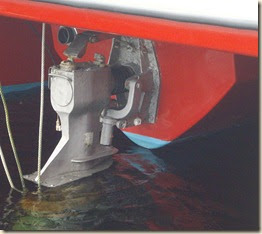
The tide is falling fast so within half an hour I am wading about, brush in hand, in knee-deep water beside the boat. The job doesn’t take long and since I can now reach the drain plug at the bottom of our outdrive leg it seems like a good opportunity to do an oil change. By mid afternoon the returning tide brings rain with it, curiously, so we float off and return to our berth on the inner harbour pontoon.

Our cleaning and tidying activity within Cirrus has revealed a rather disturbing leak of fresh water from one of the pipes feeding the galley sink. What confused us was that we had discovered and repaired a pipe joint leak here some weeks ago but unbeknown to us there was a second leak in a length of copper pipe which runs across the boat from one side to the other. This pipe passes over what we refer to as the ‘nacelle’, the between-the-hulls V-shaped section which is hidden beneath the boat. Inside the boat this shape gives us room we would not otherwise have and gives Cirrus’ hull its terrific strength. The nacelle is hollow, however, and there is no access to the void within it. Our discovery was that the internal leak had drained down into this empty chamber and over time it had filled up with, so we eventually discovered, about a hundred litres of fresh water, water pumped from Cirrus’ own fresh water tanks. Only some mysterious damp spots in our carpets gave us a clue to what was happening (I might add that there is no manual that comes with a boat) and pointed us to the right area to look to start fixing the problem. In order to clear the water from the nacelle a small hole had to be drilled in the internal floor so that a pipe attached to a pump could be inserted. Ten bucketful's later and the job is done, the boat is lighter and our carpets can start drying.

At least they would if it weren’t for the heavy rain outside, soaking us to the skin every time we venture out.

Tuesday, August 2, 2011

Cornwall to Scotland days 29 and 30

Days 29/30 – The imperative is movement, to travel northwards while the light winds last. We start from Amble and move across the border into Scotland, Eyemouth, then the next day on again to Arbroath. We are motoring mostly, the wind too light for sailing, and there is a haze about which degenerates visibility, sometimes to only a few miles.


We slip through a gap in the Farne Islands, between the inner and outer set, where the tide runs strongly, like two boulders placed in a stream between which the current rushes. Kate poses on the foredeck with Lindisfarne Castle just visible to on our port side but the sky is just shades of grey, lighter or darker, devoid of colour.

Eyemouth is rather fishy and humid. The harbour seals seem bored as they are teased by tourists for titbits of fish. Although we have visited this place several times before and normally enjoy the atmosphere, today we take to our beds early for in the morning is another early start to catch our tide. By six thirty the next day we are heading away from the land, St Abbs Head lighthouse receding into the low cloud and mist. The day is damp and lifeless and soon there is only sea, no land visible, just us and the birds which swoop in low across the sea, coming close and checking us out.

All is not as it seems, however, as beneath us there is much activity going on. These are deep waters now, sixty metres below our keels. The air is full of gannets from the colony on Bass Rock in the Firth of Forth. They glide across the sea just above the waves, flapping their wings just enough but no more than they need to. Then suddenly we see many of them swirling together just a short distance away from us with countless gulls and other birds too. The gannets are diving one after the other into one patch of sea which tells us there are fish to be had, many of them. But what brings such a shoal to this place? With our binoculars focused we wait, until sure enough there are black rounded bodies and a sharp fin broaches the surface. Dolphins, we know, round up shoals of fish and drive them to the surface where they are relentlessly captured but the fin is curved, the backs too large and dark. On reflection we feel certain this is a whale, or maybe more than one, a moment of true excitement for us. The birds, of course, see what is happening and swoop in to participate in the feast if they can. Far from being lifeless, the sea here is full, plentiful life and death is happening unseen beneath us while we plod on to our next safe haven.

Rain comes on and off all day but by three o’clock we are safely berthed in Arbroath, tucked in for the night.

Sunday, July 31, 2011

Cornwall to Scotland days 26 to 28

Day 26 – If there is one thing we are learning about on our travels around Britain it is the relative merits and demerits of marinas and harbours. You could almost call us expert, in fact, since inevitably we do compare facilities between one and another. We have a scale of merit, for example, for showers. To score ten points they must be hot, spacious, clean and of course free. We accept that it is unlikely we are ever going to find a ten-pointer but this is nevertheless something all showers should aspire to.

When is comes to the cost of berthing there is very much a north-south divide, the south coast of England being almost guaranteed to be the most costly. One might perhaps expect there to be some correlation between the price being charged and the quality of the facilities, whether these be showers or something as simple as the state of repair of the pontoons but this is not so at all. Many ports seem to base their charges more on the basis of what they can get away with and when you are coming in from a turbulent sea naturally the last thing on your mind is the price of a safe haven.

It is the practice of charging multihulls (catamarans and trimarans) more than other boats that we really take issue with. The justification always given is that these boats are wider than others and therefore they take up the space of one and a half or two other vessels. Very often this may be true but Cirrus Cat, whilst being a catamaran, is not a wide boat. At a little under four and a half metres she is less wide than many modern monohull sailing boats and certainly narrower than most large powerboats. Yet she is a multihull and many marinas will impose the additional charge regardless of this fact.

The most glaring example of this practice we find today in Scarborough Harbour where the list of charges makes it clear that any multihull wider than three metres must be charged at a higher rate. I look around the marina now and can see that most of the yachts are wider than this but having only one hull means they are paying less than we are. My attempts at arguing this point to the berthing master fall on deaf ears, however. We feel unwelcome in Scarborough, pariahs even. It is the most expensive harbour we have stayed at so far this year (charging more than anywhere on the south coast) and the shower and toilet facilities are the worst, by a significant margin. Even after finding a shower that delivered hot water I could only give it one point at best. I would recommend this harbour to no-one In fact I would advise yachtsman to stay away from this port if at all possible. Or maybe they already are - the visitor pontoon is after all nearly empty.

Day 27 – And so, at an early hour, and after pleasant dreams inspired by the delicious sweet potato pie Kate made for dinner the night before, we bid farewell to Scarborough and its hoards of holidaymakers with their needy children and their scruffy little dogs.


We turn left out of the port and head straight into some horrible steep waves which toss us around like a cork but the fierce current generating them carries us through quickly, though not before a few splashes of sea had found their way into one of our open hatches. Chastened, we plod on towards Hartlepool in rather more benign conditions. An early start always means a cool start, the day never really seems to get going before ten in the morning, but our arrival at Hartlepool around one in the afternoon was greeted by powerful sunshine making up for what we missed earlier. Motoring along in company with Paul Hardaker, who had a date to keep with the press covering his trip, made a pleasant change for us and gave us someone to chat with on the radio along the way. The wind was not unkind, being just another northerly, but we have had rather too much motoring than suits us. Our ever-reliable weather-forecasters promise that tomorrow will bring a big change, a wind from the south to blow us to Scotland.

Day 28 – Sooner or later this practice of getting up early in the morning to go sailing will seem like normal behaviour. On balance, though, I suspect it will be later.

Having locked out of Hartlepool we are determined to get our sails up and get along without the engine if we can.

The swelly sea does not make this easy, however, as it shakes the light southerly wind from the sails and at first we are making little progress. We persevere and after an hour or so there are some ripples on the water which tell us this will be a spinnaker day, and up it goes. By the time we pass Tynemouth, Cirrus is beginning to blast along and we coast through the ship anchorage, dodging left and right so as not to bump into anything big. These are car carriers, which bring new cars into the country by the deck-load, large floating steel boxes with few concessions to beauty.

We sail on with the wind increasing and the sea rising until just before Coquet Island when it is time to snuffle our brightly coloured sail, to control it before it tries to control us. These are like home waters to us, bringing back memories of our first sailing boat, Noggin The Nog, which we used to moor in the river at Amble. Many’s the time we sailed out with our three young children on board to face the enormous waves, maybe the same ones that we rolled through today. We were novices then, knowing no better than to go out when the mist hung over the island and there were breakers across the bar at the entrance to Amble Harbour. In many ways the place hasn’t changed at all – the puffins still wheel around us at sea, little wings flapping madly and feet paddling the sea frantically as they try to get out of our way -although now there is a fine marina at Amble where there was none before.

Paul arrives in port soon after us, tired out after enduring the wind and waves. His is a massive challenge to undertake, to sail alone around Britain, and we have great admiration for what he is doing. He has been great company for us too and Finley’s singing and whistling has been a delight.

Friday, July 29, 2011

Cornwall to Scotland days 24 and 25

Day 24 – There are no permanent staff in the Humber Cruising Association clubhouse bar so its opening hours depend on a member being around with time to spare and a key to open up. When it does open, as you would expect, the bar acts like a magnet to sailors whose boats are scattered around the No.2 Fish Dock on the long pontoons which make up the marina complex. These are connected to the shore at only one point, however, making it a long walk if you are berthed farthest away. But there is a collection of bikes on a rack near the shore ramp which can be used by anyone and can save a lot of walking. Some caution is clearly advised after a few drinks at the bar because if one wheel were to swerve off the pontoon edge in the dark then the water would swallow both the rider and the bike and nobody would be any the wiser.

It is here in Grimsby that we bump into two other round Britain sailors. Paul Hardaker started from Liverpool in May and like us is turning left at every corner. He and his pet parrot, ‘Finley’, are on a sponsored sail for Crohn’s and Colitis Charity and have experienced all sorts of adventures on their passage - they are only half way round! A week ago, Finley, who is quite talkative, bluffed his way out of his cage and flew off to explore Grimsby but his navigation (or his loyalty) did not equip him for finding his way home again. Paul is very attached to the bird and eventually had to offer a reward for Finley’s safe return so that they can continue their journey together. Paul keeps his own blog at which has video clips he makes as he sails along.

We also meet Jean-Pierre, once a harbourmaster at La Rochelle in France, who has sailed his yacht ‘St Kilda’ an incredible distance this year to Morocco, Madeira, the Azores, Ireland, Scotland, finally touching the East Coast of England. He has different crew join him along the way and is now in Grimsby waiting for parts to repair the gooseneck on his boom (technical language, but English) before sailing off to Ostend and eventually home again. Chatting with Jean-Pierre and the current crew on board, speaking French as best we can over drinks in the club bar, we are treated to the holiday snaps of André, whose family live on the Isle of Réunion in the Indian Ocean, and the feisty politics of Maryse who has a few sailing adventures of her own behind her.

Our own movements are, as ever, controlled by the weather and we spot a window of opportunity appearing tomorrow which should enable us to sail north again to Scarborough.

Day 25 – The River Humber has these cute little yellow ships which are forever chugging along…. but going nowhere....

...or so it seems. They are in fact buoys which mark the edges of the shipping lane but when you pass them by it looks just as if they are motoring upstream on their own. In reality we know they are anchored to the bottom of the river and it is the water that passes them by but somehow they have a sad and lonely look about them, forever on a voyage to nowhere.

It is a relief to be out of the river and away from any possibility of meeting a super-tanker or a massive car-carrier coming towards us and we turn north past Spurn Head towards another headland, Flamborough. Today, by contrast to previous days, there is almost no wind at all at six in the morning and the sea is a shining plate of silver jelly that wobbles only to a faint swell. It is hazy, however, and this thickens into a sea level mist which swallows us up and forces us to strain our eyes forward to pick up the randomly scattered floats of lobster pots which lie in our path. The one we miss is the one that will tangle in our propeller so we are constantly vigilant.

By midday the sun has burnt its way through to sea level and we can see Flamborough ahead but our favourable tide has now turned against us, the water now rushing back southwards past us. Progress becomes slow, like swimming through glue, and the hours tick by. We languish around the deck in the sunshine, a light cooling breeze making life pleasant on Cirrus’s foredeck while the cockpit becomes an oven. Gradually the miles pass by as Flamborough’s eroded white cliffs disappear behind us and at last Scarborough emerges from the haze ahead.

Quite quickly, however, a dark line of cloud rises from the northern horizon and just as we are closing the harbour entrance the wind arrives, as if from nowhere, and we quickly pull on our jackets for protection. We struggle the last few yards into harbour and tie up alongside the visitor pontoon, greatly relieved to be in port and out of the icy blast.

Berthed just ahead of us here is Paul Hardaker’s yacht which left Grimsby the day before us. He spends the evening with us on board bringing Finley with him so we can get to know this lovely bird.

At first Finley is a little shy but by the end of the night he shows us his best side as he poses for his own photograph.

The northerly wind howls in the rigging all night. This really was a small window which we have grabbed to move ourselves a few miles along our way.