Tuesday, July 5, 2011

From land to sea

Visiting a big city like Glasgow is always something of a culture shock for us. Earlier in the day we were staggering along the road to the bus stop in Carradale with our giant suitcases, greeting our neighbours with a friendly word here and there, explaining to those who didn’t already know that we would be away from a while, then before we know it we are stepping down from a bus meeting the noise and the rush of a big city full on. People are strangers here. Nobody stops for a chat and often will not even step aside to let us pass along the pavement, overburdened though we are. We feel like aliens, strangely uncomfortable with our fellow humans.

We spend the night at the Travelodge as we have business to conduct in the city and Glasgow has the nearest branch of our bank. After checking in at the hotel we rush off to arrive just before closing time and, business completed, then relax and celebrate a little, eating out at Dino’s in Sauchiehall Street. This is a little island of Italian-ness and once inside, seated before the red and white chequered plastic table cloth, we can pretend that we have just stepped off an Italian village street. We can even order our meal in Italian, if we dare. The Spaghetti Napoli is a delicious thing to behold and the owner exudes excessive Italian charm right through the meal – what more could you ask for.

Cities are noisy places at night (everywhere is noisy compared to Carradale)  but despite this we sleep well and by mid-afternoon the following day we are in Birmingham and setting off on the last leg of our long journey.


Puffy white clouds float about aimlessly above us as the day warms up and the fine weather continues; we are travelling south, towards the sun, and at each stop we notice a slight increase in warmth, degree by degree, until finally we arrive at our destination, Millbrook in Cornwall.
Here we have barely set off with our luggage to walk the last mile down the lane to the boatyard when the yard owners, Pip and Debbie, pass by and kindly stop their car to take our bags for us. We are expected and they have made us feel less like strangers here in this foreign land.

Millbrook Lake is actually a tidal inlet off of the River Tamar which itself forms the boundary between Devon and Cornwall. The word ‘lake’ does not do this place any justice at all because for most of the day the water is absent and a muddy desert shimmers in the heat, quietly leaking an ever ripening smell which drifts across the boatyard where we are working to bring Cirrus Cat alive again. Fortunately there is plenty to be done so we ignore our senses for the moment; launch day is a weekend away and the anti-fouling paint has to go on, sails bent on spars and the engine run up. Considering that she has been lying here since October last year, the air inside the boat is quite fresh (a tribute to the ventilation) and everything we need to live comfortably aboard is soon unpacked or re-fitted in its place. We begin stocking up with food, connecting the instruments and other electrical equipment and brushing away ten months of dust where this has accumulated, ready for the land to sea transformation that is about to take place.

The heat is now oppressive and by afternoon it is sapping our energy. Activity begins to slow down a little as, with so little breeze, the temperature inside the boat rises to 29 degrees Celsius in the shelter of the boatyard. The moment will soon arrive when there will be cooling water lapping against the hull making things rather more comfortable on board.

Sunday is the day our son Mike arrives for a visit, with Yeovil’s newest inhabitants, Kate’s brother Peter and his wife Liz, who are now living in our renovated house there.


We spend a hot but enjoyable day with them trying to deal with Liz’s apparent fears about whales rising up from the depths of the sea and tipping over our catamaran with one toss of the head (surely not!) then finally they return home to leave us alone to spend what will be our last night on land for many months.

Launch day finally arrives and a specially adapted trailer is slid between our hulls which jacks Cirrus clear of the ground. A tractor is hitched up and our home from home slowly trundles across the boatyard towards the slipway which leads… to the muddy expanse of Millbrook Lake.


Here we are deposited, gently, and abandoned for the rest of the day, forgotten by the world until the tide brings Cirrus’ natural element, water, to us. And before we know it we are floating away on a new adventure.

Monday, June 27, 2011

Soon Serious Sailing

Despite venturing onto the water on other people’s boats (thanks to Owen, Jim and Celia) we are sorely missing life aboard our own. Having spent so many months living aboard Cirrus Cat in recent years we just feel comfortable there, at home and relaxed. We can close ourselves in and feel cosy there whatever the weather is doing outside or we can up anchor and move somewhere else. We are starting to get excited now because very soon we will be back on board, sailing our boat away from her Cornish winter home.

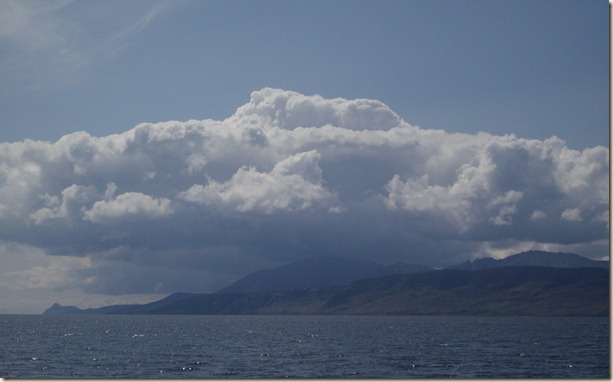
A big sky over the Isle of Arran

We hear tales of a heat-wave in the south of England and when we compare this with the weather these last few months have given us up here in the Highlands it is almost as if we are about to travel to some exotic far-away country. But no matter how pleasant this warmth may be we also know that we will miss the vast open views, the clarity of the air, the people, the sheer wild exuberance of our home…

…and the castles. This one is just along the road in Torrisdale, discreetly tucked away from view, believe it or not!

So once again we are making travel plans, packing our bags with essentials and with all the things we feel we might need over the month or so that we are planning to be away. It is now some ten months since we sailed on Cirrus. She was then ‘winterised’, her vulnerable bits wrapped up against the cold, and many of our belongings were unloaded (into a hired car) as part of those preparations. But after so many months, can we now remember what is on board and what is not? We will be returning only with what we are able to carry as luggage on the bus to the boatyard, a pretty limited amount, and when you consider that we will need an assortment of clothes, the computer stuff (to maintain the blog), and as many tools as we can carry to deal with all those boat-related repair and maintenance jobs, our suitcases are beginning to bulge. Somehow we have to prepare for this one-way trip based on what we can remember we left behind. Did I leave my shorts on board ready for the expected hot weather? What about the sun-block? Am I going to need a saw or a drill? Which shoes to take? Have we got the mobile phone chargers? Film for the camera? (No, I’m only kidding. This is some sort of a flashback.)

Finally we take our leave. We will know soon enough whether we have got it right or wrong.

Monday, June 20, 2011

Visitor action

A series of visitors during a period of less than perfect weather has left us feeling drained of our normal energy and joy at living here in Carradale. Many different strands of our lives seem to be shifting simultaneously so that there is much to think about and worry ourselves over. There is the leaking roof, for example, which is now finally being repaired by a local builder. Ever since we first moved in here, each time the rain really fell heavily we have had to place buckets on the floor of our guest bedroom to catch the water that seeped through the ceiling. At last our guests can be assured of a sound night’s sleep without the noise of constant dripping into a bucket beside them. Then there were telephone calls from our eldest son, Tony, who is reeling from the news of his best friend Ed who died recently. Tony had been close to Ed since they were at school together. We send our condolences to his family and friends. The sale of our London apartment takes place any day now, closing another chapter in our lives and providing us with some much needed capital. We may even soon be able to afford those roof repairs!

Meanwhile our next visitors, my mother and her nonagenarian companion, George, were splashing their way through the showers and the puddles on walks around our village, this despite my fervent praying for some sunshine and warmth for their visit. We did at last manage to take them over to the Isle of Gigha on the ferry so they could wander around the garden of the Achamore estate here. The Vikings, and later the Norse Kings, who made their home in the Western Isles, called this place ‘the good isle’ or maybe even ‘God’s isle’ depending upon how you translate it. The hundred-odd full time inhabitants would not argue with this as back in 2002 they all clubbed together as a community and bought the island from its then owner. Today you don’t have to chat for long with any local to become aware of how proud they feel of their home and of the strong sense of shared community that exists there.
It is a lovely place which exhibits humanity at its very best although 
I will admit that squelching around gardens on a damp day is not my favourite activity. I preferred the drive to the northern tip of the island from where you can sit and watch the whole of the Sound of Jura spread out before you like a map. This is all good sailing country standing ready for when we have our boat up here.

Our wild landscape produces some astonishing shapes and colours. On a plastic bucket cast up from the sea on the Atlantic-facing beach at Westport I found this collection of goose barnacles with their elephant-trunk appearance and brilliant yellow ‘lips’ around the shells. As soon as they sense water around them they send out feathery feelers which they wave about to catch their food. These ones may have picked the wrong floating object to latch on to as the incoming tide had pushed it just too far up the beach to be able to suck it back again when it receded. The weight of the bucket was too much for me to try to cast it back out and as a result these particular barnacles may well have been doomed.

Back to our visitors now and on one exceptionally rainy day it seemed sensible to take a tour of one of Campbeltown’s whisky distilleries.

Gone are the days when there were more than thirty of such establishments in the town to chose from. Today only three remain and Springbank offered us the temptation of a wee dram to dispel the chill of the damp day, so naturally we chose this. The sight of so many barrels of spirit resting untouched and quietly watching the years pass by is more than many men could bear. No wonder they keep their bonded warehouses under lock and key.

In better weather a few days earlier we drove our little car along one of the most exciting stretches of single track road that Scotland can offer, stopping above the lighthouse that guards the North Channel and winks its light at Ireland across twelve miles of sea.


This headland is the Mull of Kintyre and road traffic has to stop high up above the lighthouse from where a narrow track spirals downwards. Walking down this final mile is a bit like reverse mountaineering - going downhill before going up – but it has to be done. It is part of the magic of the place.

Monday, June 13, 2011

Sailing with Vela

Forecast checked, stores loaded, extra bedding brought on board for Kate and myself plus our Dutch guest Maartje, and after a discussion with Jim & Celia on where we would be heading to on the first night we cast off from the Campbeltown pontoon, raising the sails to the gentle southerly breeze. Far from being crowded with five on board, Vela proves to be a comfortable boat with plenty of space in the cockpit for us to flop around in the sun and watch the scenery drift slowly by.

Once the sails are set, the autohelm (which still needs to be christened as it is a valuable member of the crew) is set so we can relax and try to pick out the landmarks. “Isn’t that Carradale Bay over there?” “Yes, I can see our house nestling amongst the conifers”, replies Jim who is alarmed at the flowering rhododendrons which seem to be trying to take over his back garden. The view from the sea is not one he has seen before and this gives him and Celia a new perspective on their home.

Some hours later Lochranza came into view and Jim is soon engaging in the familiar (to us) task of trying to pass a rope through the ring on the top of a mooring buoy whilst lying prone on the foredeck. No matter how hard one may try to make this an elegant exercise, failure is inevitable. The bottom in the air posture just about guarantees this. Soon all is shipshape and all five of us pile into the inflatable for the short ride to shore. From this point onwards nothing on earth can prevent us heading for the hotel to slake our thirst.


Dave and Hilary, who set off from Campbeltown just before us, have landed from their pretty yacht, Foxcub, and seated round a large table in the bar we all pore over a large map of Arran as if we were planning a great campaign, David, to everyone’s amusement, producing the most authentic ‘major-general’ voice we have ever heard.

After we had eaten there was the compulsory visit to Lochranza Castle for a group Campbeltown Sailing Club photo in the late evening sunshine. The daisies were very pretty, I thought.

We all pile into dinghies again and head for Vela where we find Glenn has arrived on Jessica Lee so that there are eight of us crammed into the cabin for more socializing before turning in for the night.

The morning sky is streaked with cirrus while little puffs of white cumulus float aimlessly around. Foxcub is first away, heading north up the West Kyle to the proposed lunch-stop at Kames. The wind is light again, from behind us, so naturally I pose the question to Jim and Celia, ”Do we have a spinnaker on board?” They don’t know for sure but, “There is a spare sail in the forward cupboard. I don’t know what it is but it is a nice colour”. We dig around and pull the bag into the daylight. Yes, it is a spinnaker, so out come the sheets and up the mast it goes.


Soon its red, white and blue is billowing out ahead of us. (Surely this is not patriotically correct on a Scotsman’s boat!)

We leave Glenn behind at Kames as the weather changes, cloud taking over and a wind arriving which swirls unpredictably around making sailing an energetic affair. Celia takes the helm, tacking this way and that, leaving the rest of us grunts to do all the hard work of hauling ropes and winding winches. Fortunately, just before the crew rebel, there is a wind shift which gives us a clear run up the narrowest part of the passage and round the corner into the East Kyle. We squeeze past the Burnt Islands but the wind deserts us and the rain comes on with a vengeance. There is nothing for it but to motor on south into Rothesay for our second night away. We are all tired and somewhat damp as we plod about the town until we find a restaurant that can accommodate all of us. Curiously our wet clothing gradually dries out more quickly the more we wet our inner parts – a lesson to be learnt there, I think.

Rothesay is as charming as ever with its impressive harbourside and, of course, the spectacularly tiled Victorian toilets, but the forecast for our last day out was threatening some fresh easterlies and more rain later in the day. This meant an early start, well as early as we could manage, out of the marina, but nobody complained. David and Hillary chose to stay on in Rothesay, knowing better than to venture out, perhaps.


Arran sat brooding to the south under a heavy carpet of cloud but despite this no wind came our way. Our only choice was to start the engine and rumble on past the islands of Great and Little Cumbrae then on to Pladda which lies off the southern tip of Arran. All went well but for the engine needing an anastomosis in one of its various pipes (this being performed without anesthetic) before we could continue. Fortunately we were properly equipped for such an eventuality, as every good boat should be, and the day ended smoothly. As for the predicted wind and rain, this totally failed to come anywhere near Campbeltown until after we had safely berthed and unloaded. Such is the way of forecasts around here.

Our first outing with the Campbeltown Sailing Club took us past a scattering of the most spectacular islands in Scotland, even giving us glances of a distant Ireland on the return. We still have to nudge ourselves to believe that all this is on our doorstep.

Tuesday, June 7, 2011

Hot, wet and cold

For the benefit of those who do not live in the British Isles, the month of June can bring sun with an intensity that will burn exposed skin within minutes. Despite its northerly position Scotland is no exception to this rule; in fact due to the greater clarity of the air the threat may be greater still. Like so many others, of course, I should have known this, having lived in Britain all my life. So why is it that after a day on board Jim & Celia’s yacht my nose ended up a bright pink colour and my forehead glowing red like a stop light?


The explanation I like best is that we associate a strong sun with heat and the two do not, as one might suppose, necessarily go hand in hand. In fact there was such a chill in the air out at sea in the middle of Kilbrannan Sound that a jumper and a windproof jacket were needed to retain body warmth, despite the sunray lamp in the sky. The sun reflected off the sea and the deck of the boat as we drifted along in the light breeze but common sense precautions like wearing a hat or slapping on sun cream are soon forgotten when all about us is so peaceful and the only sound is that gurgling of the water past the hull and the occasional ‘burp’ from the autohelm as it applies a small correction.

Back on land, with temperatures rising into the mid twenties Celsius, we all thought that summer had at last arrived so naturally I dusted off my best shorts when we drove to Loch Lomond to meet up with our son Ben who had briefly joined the ‘Folk Trail’ on their trek from Land’s End to John O’ Groats. It took me only a moment outside in the breeze to realise that I had once again misjudged the weather, made a poor choice in the lower leg protection department. On went the trousers in a flash. My white legs are destined to last a little longer.


Our meeting with Clare, Cara the dog, and the other walkers took place on what must be the flattest part of the West Highland Way, the long distance footpath that begins somewhere north of Glasgow and wends its way north for ninety six miles to Fort William. We followed the leafy route of a disused railway line for five miles or so until we bumped into the group as they rounded a small hill, then we traipsed back with them to their campsite outside Drymen. Later the same day we joined them for a pub folk music session which went on enthusiastically until the very wee hours, by which time some serious rain was falling all across the area. With a timetable to keep to, a different place to visit every night, the walkers are committed to setting off each day whatever the weather is doing. That’s real dedication!

We could not travel further with them because we were expecting our first house-guest to arrive on the bus from Glasgow. Maartje has provided us with a list of things she would like to see and do on her visit – castles, horse riding, and owls being high on the agenda. The first two are pretty straightforward. The last is a bit more problematical but we tell her to keep quiet at night so she can hear them outside the house. (Maartje tells us that the Dutch word for owl is ‘uil’ but the way she says this is impossible to replicate.)

Carradale has produced some rain for the start of her visit, but we advise all visitors here to come equipped so all is well.

As ever here in Carradale, the weather being experienced at this moment will not be the same as the weather an hour or so later. We can expect the sun to burst through any time soon.

Monday, May 30, 2011

England for a while

Kate sits munching on a croissant, while waiting for the train which will transport us to London, the first visit for several years. We have business there, our home for three years prior to retirement is being sold and we have come to collect the remainder of our belongings, but we go there on sufferance only, not through choice. The pace of big city life does not attract us; in fact we cannot stand it for long at all!

The journey is a fast one, a bus ride from the Wee Toon into Glasgow (with entertainment provided by the driver’s commentary accompanied by some pretty bad jokes) then intercity train which zips along at amazing speed through the countryside, stations passing faster than we can read their names, the whole of a good novel being devoured before Euston. It is here that the pleasure ends, abruptly, as we descend the escalators into the crushing underworld of the underground. The Tube, an apt description that brings to mind lengths of toothpaste being squeezed through a narrow nozzle, is stuffed full of a million or so sweaty bodies most of whom have not just stepped out of the Kintyre countryside but instead have struggled through a day of work in the humidity of the city. We have to change trains onto the DLR but just before Bank station we decipher a garbled announcement which tells us that our train will not be stopping there – the station is over-crowded. We thrust our luggage-burdened bodies out of the carriage onto the platform to immediately hear, “Bank station is now open. I repeat: Bank station is now open”, so have to squeeze ourselves back on board the next train, which is equally full.


Fighting our way along miles of underground passages like termites the doors of the driverless Docklands Light Railway train finally appear in front of us and we haul our luggage on board. What a relief it is to arrive at Limehouse Basin, a place that was once our winter home on board Cirrus, a place where familiar boats still float quietly as we walk along pathways we remember so well and cross the lock gates to a welcome in the Cruising Association’s London HQ. This place is an island of peace in the mad city, a place where sanity rules once more.

We are not done yet though, for in the morning we venture forth for more craziness, this time on London’s roads in a brand new car hired from a dealership in the shadow of Tower Bridge.


Terrified of scratching this powerful beast’s shiny new paint we pilot through the stop-start maelstrom that is the capital’s full-time traffic jam. Buses loom over us, motorcycle messengers flick into view from behind, taxis U-turn directly in front of our bonnet and death-wish cyclists weave in and out of everything. The philosophy here is: To give an inch is to surrender – never surrender! There are rules here, but not those in any Highway Code. They are unwritten, hardwired into the genes of every Londoner but a terrifying mystery to all outsiders.

The London skyline triggers old memories but there is a newcomer here, a thousand foot shape is emerging from the ground, improbable and unfinished, it will soon dominate the skyline, taking over from lesser landmarks like the Gherkin and Big Ben.


This is The Shard – where do they think of these names? – still some way short of its full height but rising higher every day. This is just another hotel and office block really, and thank goodness someone had the sense to put it here and not on Kintyre!

The hired car has an acre of load space and twin turbochargers tucked away under the bonnet which give it the long legs we need to transport us and our belongings around the country. Once we have escaped London we begin to observe the finer points of the countryside we are passing through. To our eyes, which are accustomed to a lush green vista, the land seems impoverished and dry. The grass is pale brown where it is cropped close to the hard earth, trees are in full leaf but look tired from straining hard to find water and weeds have rushed through their lifecycle to produce seed quickly with what little energy they have left. The south-east of England which has seen little rain now for over a month. My mother grumbles about the state of her flower bed when we visit her down in Ticehurst. This corner of the country seems to have become more arid in recent years and her flower portfolio may need to change too if she wants to avoid constant watering to sustain life. But having said this, the colourful spread she does produce is still the envy of all her neighbours.

Our journey continued around the homes of some of our scattered family as we wrench our son Mike away from his computer to take him out for a birthday meal. It is also an opportunity to window-shop, to feast our eyes on exotic goods not found in shops close to home, to experience the novelty of being able to buy, well, anything we could possibly want and even more that we never will.

Our hire car takes the journey back to Scotland in its stride, only a deep rumble giving away the fact that the engine is even switched on. We run into showers somewhere north of Birmingham, strong winds across the Lake District then right on the Scottish border the sun pops out from behind a cloud and we know we are home. The ocean off the west of Kintyre sparkles for us, masses of white combed waves rolling up the golden beaches. Take away the million shades of green exhibited by the conifers and the bracken, the dazzling waterfalls bursting out of roadside crags, the sharp contrast of black rocks thrusting out of verdant mountainsides, remove the lochs and the mountain streams, wring out most of the water and take away all the road traffic and it could just be the southeast of England. Or maybe not.

Tuesday, May 24, 2011

Spring gale

From indoors the noise is the first thing we notice, a deep, machinery roaring that seems to be direction-less, like a far away aeroplane at first but then it rises in volume and there is a burst of sound as a gust tries to pick up the house and carry it away. Everything is in motion outside. The upper branches on the trees behind our garden fence thrash about in a frenzy, as if trying to shake off something unpleasant. Each leaf flashes its pale underside to the wind as it hangs on grimly; it is the first experience these leaves have had of this as they are not long unfolded. Now whole trees give before the blast, bending to an impossible angle, each young branch lining up downwind. The air is suddenly full of debris, green leaves, some still attached to twigs which have reached breaking point and been torn free.

There is a brief moment, a false calm where the gale seems to recede, to gather its strength, but it is momentary and the roaring comes again, hissing through the tree-tops, then flattening the grass, dropping down to ground level to pick up what it left before. The glass in the window through which we are watching creaks and gives slightly to the wind but holds firm. Leaf debris patters against it, a sprinkling of rain now, although the sun still shines down and warms us. Our garden birds have gone to cover, most of them, although there is one opportunistic blackbird pecking in the garden trying to ignore the indignity of having his flight feathers turned inside out by the wind. He flies off but remains low, picking his moment to dart into the shrubbery.

The sky darkens and more rain comes. It sweeps down from the hill in misty waves, moving rapidly along the conifer backdrop before it spatters angrily against our glass. The rain is there in the wind although we don’t see it as it moves too fast and hardly wets the ground. It comes in a squall which whines and screams under the eaves but the wind is invisible still, only its ghostly touch is felt and the clouds race by.

Although it is our first gale since moving here, we are not surprised to find ourselves in such an event. We are fully aware that we now live close to the usual track a depression tries to follow on this side of the Atlantic and a natural consequence of this will be periods of strong winds and heavy rain. There are many compensations to living here, too many to mention, but whilst we can see them, others may see only the worst. Strong winds can and frequently do cause havoc; we can expect them to disrupt our comfortable lives.

An hour ago I was speaking on the phone and just as the conversation ended our electricity supply was cut off, as if it was only waiting for the moment the receiver was replaced. Like many others in the village now we are without power and many of the things we take for granted are lost. We cannot heat ourselves nor cook. The kettle lies idle. The freezer is silent (now slowly warming) but daylight means we do not lack for light. So long as our mobile phone batteries last we can still communicate with the outside world but we assess our situation, making ready the candles and torches for later in the day. Our house is heavily reliant on electrical power, but no more so than those of many of our neighbours. Our plans to install a coal stove will eventually rectify this, so we are better able to cope with power cuts when they occur in winter, but this is some way down our list of priorities at the moment.

It is not just windy, it is exciting.


So unable to stand it any more, we pull on our coats, zippers are yanked up and we stride off to the beach just in time to catch a heavy shower which soaks everything that is not waterproof, drenching our legs and shoes. The cold water has barely time to penetrate though for within minutes the sun has popped out and we are drying again as we battle on against the gale, which now begins to taste salty from spray picked up in Carradale Bay and being blown ashore. The tide is high now, made higher with wind behind it, and the sandy beach has vanished beneath a veil of foam which comes streaming off the wave crests. Spume wobbles up against the turf of the dunes or rolls along the shore like big lumps of sponge. We struggle to stand, overawed by the sheer wildness of what we are seeing, thrilled as young children.

Returning home via the village shop and bakery we find that the electricity has been reconnected and our preparations for a cold, candlelit supper are put on hold. Perhaps the sense of excitement we feel is not shared by the whole of Carradale, it is not an unusual occurrence after all, but this does not mean we cannot enjoy it.

Saturday, May 21, 2011

On and over the water

Expecting at this point to be able to show on this blog a series of exciting pictures taken from the deck of ‘Jochr’, a sailing yacht on board which I hoped to be winning Campbeltown Sailing Club races, I regret to have to disappoint. So few skippers have been turning up on race nights that the season has so far been something of a let down. Skipper Owen and his wife Joanna generally make a showing, whatever the weather, as does his regular crew Glen, who is another Carradalian, but we find ourselves standing about in front of the clubhouse watching the fishing boats come in from the sea instead of cranking winches on the sloping deck of a boat. I suppose it does take a certain degree of dedication, some might say determination, to race regularly and perhaps the enthusiasm of those who previously found the time to go sailing has been eroded by these recessionary times we are living in.

Whatever the reason, it is disappointing for those like me who are suffering withdrawal by not having a boat to sail on. It will be many weeks before we are back on board Cirrus.

Campbeltown Loch did at least give us something more interesting to gaze at this week as we had a visit from the sail training ship, ‘Stavros S Niarchos’ which was on a week long tour of the Clyde starting in Greenock and finishing in Belfast. This is a modern Tall Ship, sixty metres long and forty five metres high, built in 2001 to take groups on training voyages around Britain and sometimes further afield. And not just youngsters either – the age limit seems to be seventy five… we’d better hurry and sign up!

This last week or so has seen some changes around the house as we rectify some of the more glaring eyesores and gradually put our stamp on the place. We have stripped and painted the ceilings in two rooms, installed a new stair carpet and plumbed in two new radiators, putting my plumbing skills to the test. Kate has transformed our bathroom by some simple but effective cleaning and me by installing the new light fitting we acquired in Oban last week, something we had not realised we needed until we switched it on and saw the tiled walls in their true colours for the first time. Our ‘guest’ bedroom however remains in a transitional state, the ceiling prepared and the walls now lined with paper but with the rain penetrating the dormer ceiling and dripping into a bucket on the floor it would be a waste of effort to decorate fully. Further progress must wait until the flat roof is repaired, hopefully within the next week or so.

The pile of rubble which was once neighbour Pat’s coal bunker is gradually resolving itself into the base for our new shed on a rectangle of ground adjoining our back boundary.


The sledgehammer is once again the basic tool for this work, a blunt instrument that strangely seems to get heavier with each blow, as if the head is absorbing mass from lumps it makes contact with. The trick here is not to beat the concrete lumps so far into the soft ground that they disappear from view but instead to try to break them into small pieces to form a platform covering the ground on which the shed will float. There is definitely a technique to this and I am sure I will have learnt it by the time the shed base is finished.

But rather than show a picture of the evolving shed base (which is far from being beautiful) I have chosen instead this shot of Crow Wood taken on one of our little strolls. Only five minutes from our back door, this is a delightful place where the light filters down through the tree tops and the trunks have a beautiful symmetry, bursting out of the bare ground like magnified strands of hair on a bald head.

The Village Hall, which sits on the other side of the road at the bottom of the wood, was a mill in some earlier incarnation and the stream which used to power it slices through the wood at the bottom of a deep gully, the noise of its passing echoing through the timber as it splashes its way down the hill. This wood is a magical place where out of the corner of the eye one might see fairies peeking out from behind the stumps or bathing in the old mill pond, or am I imagining things again?

Carradale Village Hall still straddles the old mill stream but today it provides space for an assortment of activities ranging from sewing to badminton. At last week’s management committee AGM Kate, rather to her surprise, was nominated for the post of secretary, a speedy way to get involved in village life if ever there was one. If the speed of this integration seems unseemly – we are still only into our second month here – then perhaps it is because the village needs something from us, just as we do from the village. It is a small community which needs people to contribute rather than just occupy its houses and well, we have nothing else on, so why not. In many ways we hoped that Carradale would suck us in, although we had no idea it would happen so quickly.