Tuesday, August 17, 2010

Wallpaper

Living aboard Cirrus, or indeed any boat, one comes to take for granted that many of the ordinary daily tasks we carry out, simple things like washing, getting water or shopping, either take longer or involve surmounting difficulties that simply do not arise when you live in a house. I know this may be a generalisation - those living in a cottage on a remote island where water has to be drawn from a well and the shops are a ferry ride away would say they have difficulties to surmount - but my point is that when we moved into a house located in a sizable town and we suddenly found ourselves with an endless stream of water emerging from every tap, supermarkets of all descriptions an easy walk away and our very own machine for washing clothes, we did not immediately take it for granted. In fact we were surprised and delighted. This is not to say that life is necessarily better though, it is just different. The extra time it used to take us to shower, for example (in the morning you get dressed at least twice - once when you get up to walk across to the marina shower block and once again when you exit the shower), this never seemed like time wasted; it is merely part of the live-aboard experience.

So, reveling in the live-in-a-house experience as we are, for the first week of our land-based life we hardly leave the property. Having for the past few months dwelled on and looked forward to getting started on the house renovation, we now throw ourselves at every job that needs to be done with no idea of pacing ourselves at all. In time we will adjust and find the right balance between work and leisure but it will probably take us weeks to learn how to do this properly.

Take the walls, for example.
 Many of our rooms have wallcoverings that we dislike (a stronger word is really needed) so the wallpaper stripper, a machine that generates enough steam to melt the entire wall if used carelessly, is deployed all over the house. What is revealed is an art form so little appreciated that I thought I would have a gallery of my own right here in this blog. Feel free to wander around.
I am convinced that in the right setting these images would be masterpieces of the WallArt genre which might sell for millions and hang in the most renowned galleries in the world.

OK, so maybe the time is not quite right for this at the moment but I'm sure their day will come.


This floral one is intriguing. Over a period of years the fleur-de-lis pattern has penetrated from the surface of the paper right through into the plaster, tattooing the wall to which it was fastened. One wonders whether this was what the wallpaper manufacturer intended to happen, to leave a permanent record etched in homes around the world.
Less artistic, perhaps, but no less intriguing is this message found hidden beneath the stripy covering in our hallway. We will forever ponder the fate of Deb, wondering who she was and what she had done to earn the epithet. Did she have a happy life? Was she aware that her life might be exposed in this way? We may never know the truth.

In reality WallArt is a transitory art form that lasts only until we have made and applied our own choices on decor. We find our tastes veering strongly towards the plain, pale colours always recommended in TV home improvement programmes and we swerve in horror away from the strident designs we have found around us here.

Thursday, August 12, 2010

Adjusting to life on land

Our Round Britain is complete and suddenly we are rocketed into a new world, one that is not continuously moving. We are so used to the movement - tiny shifts in stability in response to small, wind-blown ripples across the sea or occasionally significant lurches to one side then the other as Cirrus is lifted, first one hull then the other - that even after several days on dry land our legs are still responding to phantoms, muscle-memories of movements. We stagger about the streets. For those experiencing this the effect is quite bizarre but when it happens it is important to appreciate that those close by will not be experiencing the same phenomenon. To them, the floor is not bobbing up and down, randomly, and it is no use discussing the experience with them; sympathy will be lacking.

With Cirrus on her mooring we set off on heavily loaded bikes to catch the Cremyll ferry across the River Tamar to Plymouth and turn our heads to look back at her, our proud home since April this year, as she floats serenely in Millbrook Lake, an area of shallow water perfectly suited to catamarans and similar craft. As the tide ebbs away it will lower her hulls gently onto soft mud where she will sit upright waiting for our return. We have a complex journey to undertake now, one involving trains, bicycles and a boat which ends at the door of our new home in Yeovil. We are conscious that what we have achieved sailing-wise during 2009 and 2010 is something most people would not understand, let alone attempt. To sail our own boat around Britain's shoreline, unaided and for most of the time alone, is something we are now realising we can feel proud of. It is something we might never do again ourselves but nevertheless we know we could, if we so desired. We surmounted the challenges and lived through them. Timely it is, therefore, to thank all those who have encouraged and supported us on our travels by reading this blog and sailing with us in spirit.

It is dusk when we open the front door to our new home and roll the bikes inside. We can expect that these machines will be worked hard in the weeks ahead as we get to know our way around, popping into shops or just visiting our sons who live on the opposite side of town, for bikes are our sole means of private transport at the moment (discounting our legs, of course). 

We are soon to discover that Yeovil has a surprising secret. The route by road into the town centre or across town to our son Mike's apartment is heavily trafficked and an unpleasant ride on a bicycle. There are hills and potholes to negotiate and unforgiving drivers who care not for the lone cyclist. Our discovery of a traffic-free route, specifically constructed for pedestrians and cyclists who can use it to navigate along the River Yeo thus avoiding hills, cars and lorries alike has brought a whole new dimension to our lives. The route is only lightly used by cyclists, I suspect largely because it does not appear on any town or street maps. Yet it provides us with a pleasant ride which gives us access to the central shopping area as well as the larger out of town stores.
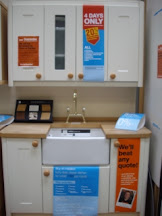
More importantly to us at the moment, the route passes close by Yeovil's B&Q hardware store which is a Mecca for collecting ideas and getting many of the essential bits for our home refurbishment project.

Simple, clean designs like this attract us so we stop and squint... yes, this might be fine for our proposed combined kitchen/living room, the room, I might add, that we have yet to create by demolishing an internal dividing wall. Having now started the 'destruction' phase of the renovation plan - stripping wallpaper, ripping apart cupboards and panelling - next comes the knocking down walls phase for which we shall need professional help. We expect that there is a long period of living with the untidiness, the dust and the dirt yet to come before the re-construction phase starts, the new flooring, the painting and decorating. 

Until then we find ourselves living in less comfort than that which we are used to from being on board Cirrus. The fridge and washing machine arrived yesterday yet we still have only a few basic pieces of furniture. What we do have is lots of plans to change almost everything we see around us but we are warm and dry, enjoying another challenge and getting to know the place which is to be our home for the foreseeable future.

Whilst living in Italy during last winter we did most of our shopping at a Ventimiglia supermarket which goes under the name of Lidl, this being conveniently close, the cheapest option around and it was also the shop which stocked items which were least 'foreign' to our tastes.
Now it has to be admitted that Lidl is not everybody's cup of tea but over the months we gradually became 'Lidl-ised' and used to some of their more strange offerings, not least because reasonable Italian wine could be purchased at 90 cents a bottle, something around 80 British pence at the time. Finding a Lidl store within walking distance of our new home, therefore, was a strangely exotic experience. Of course once we had explored the place and familiarised ourselves with the loaves of German black bread, the side-sleeper pillow and the jars of preserved cherries it began to feel quite homely to us. As a source of fresh produce it just cannot be beaten locally although sadly the duty imposed on wine in this country means that we cannot return to the drinking habits we acquired in Italy without bankrupting ourselves.

Wednesday, August 4, 2010

Long Ships

Much water has passed beneath our keels since I wrote for this blog although in reality it is only a few days. Time has stretched itself in our memories.

Milford Haven gave us a surprise when we visited the town's museum, housed in one of the old dock buildings and entry only costing £1 for 'concessions' (the current politically correct term for someone over sixty years of age).

Featured large in photos and stories relating to Milford Haven is the Brunel-designed ship, the Great Eastern, which was berthed and in fact ended its working life here just as the construction of the present dock was nearing completion around 1890. In its day this was the largest ship ever built so with its four tall funnels and enormous paddle wheels set on each side when it was sitting on the silt at Milford it must have dominated the entire town.
The Great Eastern spent most of her twenty-five year working life on Atlantic crossings, eventually as a cable-laying ship, but she was built on the Thames at Millwall in London, very close to where our journey started in April 2009. The ship is remembered there by the preservation of the wooden 'ways' down which she eventually slid and sections of the large chains which held her back still lie on the river bank. In some way, therefore, our own journey seems linked with the launch and with the repose of this massive ship.

Although it is in Milford that she will be remembered most, the Great Eastern was eventually towed to Liverpool to be broken up. We reckon Cirrus still has some life left in her yet so we turned south from Milford Haven to face the last two significant challenges before we can consider our circumnavigation complete - the Bristol Channel, a passage of over a hundred miles of sea exposed to the westerlies and with strong tidal currents, then Lands End, the ultimate headland.

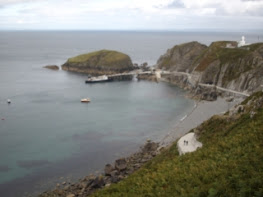
And it was whilst looking for a way to break the journey up into manageable chunks that we noticed a tiny sliver of land placed conveniently midway between Wales and Cornwall that might just give us shelter for a night. Which was how we ended up anchored off the island of Lundy.

Despite Lundy's isolated position there is an archeological record of settlement and land use here going back over four thousand years, partly due to the fact that it holds a strategic position too, a convenient mid-channel shelter for an invading fleet.

For us, however, Lundy is significant in another way - it can fly the flag of St George from its church tower. Rather surprisingly it dawns on us that Cirrus has not been in England since May 2009 when we sailed north from Northumberland's Holy Island. First Scotland then Northern Ireland, Isle of Man and Wales; there is just so much of the British Isles and so many of its people that are not English. Our chosen route has given us a new perspective on the country we live in.

In the end the Bristol Channel treated us quite well, light north-westerly breezes, although the long ocean swell we have been experiencing since leaving Northern Ireland still lies underneath any surface choppiness. 

Best of all though were the dolphins, a pod of thirty or so mobbing us off the coast of Newquay. Close under our bows swam beasts of all sizes, including some very small youngsters tucked under their mothers' tails, all clearly delighting in our twin hulls bouncing through the water above them. These were Common dolphins, smaller and markedly different from the lone Bottlenose dolphin who guided us into Padstow the day before. Whether or not these animals can experience human emotions is debatable so we can only hope that the encounter brought as much joy to them as it did to us.

Our evening arrival in Padstow was heralded by a brass band playing on the harbourside, just what we needed after a day at sea. But despite the tourist throng who watched our every move from above, all became quiet as night fell, the musicians departed and we spent a peaceful night at rest.

Lands End lay waiting for us the next day but by the time Longships lighthouse gave us its 10 second wink, as it does to all passing ships, we realised that we had finally rounded our most scary headland safely, in the rarest of weather, almost calm conditions. Our timing was not perfect and we motored hard against the tide for most of the way, but rather this than rough seas any day. It was evening when we finally dropped our anchor in perfect calm just outside Newlyn harbour, not even needing the shelter offered by this busy fishing port.

Wednesday, July 28, 2010

Welsh headlands

I start writing this well wrapped up as I listen to the rain beating against our windows. But although the weather outside is not conducive to putting forth to sea in a small sailing boat, nevertheless we go ahead with plans for the next leg(s) of our journey around Britain. In some strange way we are surprised to find ourselves here, bobbing about off the coast of Wales, as we always thought it more likely that we would sail south on the opposite side of the Irish Sea, down the coast of Ireland. Yet here we are. There is no 'right' or 'wrong' way of passage-making, of course, since the elements will always prevail. Even with the most thorough planning it is only hindsight that tells you that your decisions were correct, or not.

In hindsight the decision to sail south from the Isle of Man was a brilliant one as we were able to dig out our brightly coloured spinnaker and watch it expand above Cirrus' bows like a massive curved bubble, a sail that on a good day can pull us along faster than anything else in our wardrobe. It floated up there with scarcely a wobble for hour after hour and in the end it was the shipping lanes just north of the coast of Anglesey and the need to cross at right angles to the flow, that eventually forced us to bring it down. Not that there were many ships about to see us.

Holyhead marina gave us a safe overnight haven and a place to top up our diesel tank then a little excitement just as we were leaving the next day.

Yacht engines rely on sea water being pumped through them to prevent overheating, a cooling system which generally has only one moving part, the impeller. Made of rubber and spending its life tucked away inside the engine, ours had been spinning away happily for months until three of its little arms decided to break off just as we were hurrying to get out of port ahead of the Dublin ferry. How did we know? Well the steam pouring out of our exhaust was a clue. It is a fact of life that events like this will always chose inappropriate moments to occur so while Kate took charge of Cirrus as she drifted slowly across the harbour like a wounded animal, I dived head first into the engine compartment and ten minutes later, a spare had been fitted and we were on our way again, hearts still pounding after such a close shave with serious engine damage.

The light winds gave me an opportunity to do something I have dreamt about for many years. The cliffs on Holyhead were once, over 30 years ago, my playground as a young rock climber with plenty of daring and a solid, reliable climbing partner called Martin. This same cliff is home to a climb called 'Dream of White Horses' but when clinging to its tiny handholds, never did I really think that one day I would be sailing so close beneath and looking up.

The cliffs are an impressive spectacle as they drop sheer into the sea and continue far below. The rock strata is twisted and buckled and erosion has formed deep inlets, arches and caves over which many of the climbing routes progress. This is definitely only a place for the young and the brave... or maybe the foolish.

As the day progressed it became hot as the wind fell light. Protection from the sun was important now (although we are both well tanned in parts that are exposed regularly) as we motored southwards across Caernarvon Bay towards the tiny village of Porth Dinllaen where we hoped to find shelter from the next depression.

The summer continued as British summers do, reliably infinitely variable, so when next morning we awoke to rain and wind it was an easy decision to stay huddled inside while it lasted... which was most of the day. It was early on the following day that we set off sailing around the tip of the Lleyn Peninsula, the second of Wales' three big headlands. Where Holyhead had let us off lightly, calm seas, the Lleyn jostled us about a little more with a patch or two of well disturbed water but having passed through Bardsey Sound we once again set the spinnaker for a run across Cardigan Bay to Aberystwyth.

The marina here scored maximum points for friendliness and we were sad to leave the place behind the next day but a reasonable forecast beckoned us, so off we went again, ever southwards. Unfortunately the promised nice sailing breeze never quite made it so our engine had to pound away for eight hours as we motored on towards Fishguard in Pembrokshire, finally dropping our anchor beside the Seacat terminal. The harbour here is vast and empty, as if waiting for the marina developers to get started. Don't expect facilities, there are none, but there is shelter and good solid mud came up on the anchor next morning, always a good sign.

One headland to go, St David's, the biggest and most challenging of the three, was saved till last. As we were soon to find out, this is a place where even in light winds the sea can jump up and bite you. Timing is everything here. Only by pressing on against a three knot current past Strumble Head could we ensure we'd arrive in the notorious Ramsey Sound at the very moment the whole body of water starts to move south. But the change is sudden, like passing over a barrier in the sea or stepping off a kerb into the fast lane, the difference being that such tidal crossroads always generate turbulence, the scale of which is directly proportional to the speed of the current and/or the wind. The Sound spat us out into a wall of near vertical waves, holes in the sea opening up under our hull into which our three and a half tonnes of boat dropped like a stone. As she rose again our decks shrugged off the the green water and we soldiered on. Worse was to come. A few miles further on off Skomer Island the 'Wild Goose Race' was waiting and even though we avoided the worst of this, we met waves so steep and confused that we lost almost all control of the boat as were carried through them. This mass of water was moving at over ten knots past the Island's terrifying cliffs, washing us out towards the Bristol Channel, treating us like flotsam. If quiet weather and light winds can produce such waves, heaven only knows what St David's must be like to sail through on a bad day.

This last Welsh headland proved to be the worst by a long margin. We need to spend a few more days now in the peace of Milford Haven to restore our sanity and gird our loins before moving on. Chatting to a local yachtsman we are assured that the worst is over, smooth waters lie ahead. We listen and nod sagely.

Thursday, July 22, 2010

Viking Man

Our travels around these Isles have repeatedly put us in touch with both the lives of people who share them with us today and with those whose past lives have become our heritage, something we British often revere and respect even more. It has come as something of an unexpected pleasure to find our heritage exposed and on view almost everywhere we have travelled so that we have been able to indulge ourselves in discovering the historical context of the places we have been and the people who previously lived there. We have seen patterns emerging, migrations of people, for example, where we have visited both ends of the trail or else seeing similar influences occurring in different places. And by this time we were beginning to feel that we had much of the history of these Isles just about worked out, a sort of mental timeline in our heads which provides us with a reference point on which to hang new information from another part of the land, or another community.

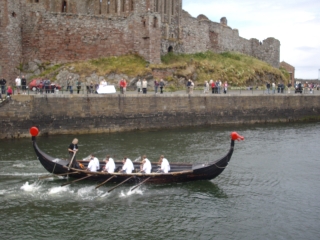
Take the Vikings, for instance. Like most people we thought we knew about them coming over from Scandinavia with their long ships and their well protected noses, how they beat up the locals wherever they landed, but brought some nice jewellery with them. Then in the end they settled down, became part of us and gave us our red hair but mostly we are indifferent to their legacy and if asked, most of us would probably regard their influence in our culture as no more important than, say, the Romans or the Irish or any other group of incomers.

Then suddenly we come to a part of our land which, despite having the same sets of incomers as elsewhere, has a totally different perspective on history.

We find ourselves on an island where the Viking influence predominates above all others and their culture is venerated as if they had arrived only yesterday. And the reason? It is from the Vikings that the Isle of Man gained its governance, a system which has been around longer than anything else in the world and something they are endlessly proud of.

This is a place which is strangely part of Britain yet at the same time it is fiercely separate, a state of mind that begins to rub off on those coming to live here almost from the minute they step ashore. Look around and you'll see a red letter box outside a Co-op store, cars with steering wheels to the right which stop at zebra crossings, all the trappings of Britishness yet somehow I find myself imagining I am in a foreign country, being almost surprised when I hear English spoken. The confusion is compounded by the police force here which has adopted the British police uniform, but only up as far as the neck (do not be tempted to think, as I did, that the white helmet is fancy dress). Only our mobile phone is certain as to where it is....abroad.

Independence of government, however, does not allow escape from the same weather that has dogged the rest of the northern part of Britain these last few weeks so when Peel Harbour finally provides us with an incredible sunset we once again find ourselves planning to put to sea, finding a narrow window of reasonable winds sandwiched between something much worse. Scotland, Northern Ireland, Isle of Man and finally we make an early morning departure from Port St Mary, which nestles down at the toe of the island, and many hours later, Wales is in sight.

We are country hopping and along with us, for reasons best known to themselves, a river of jellyfish wends its way across the Irish Sea. These are mostly a purple coloured variety which have been as plentiful this year as we have ever seen them. At times we have been literally ploughing through solid jellyfish pasture, which makes us wonder where the predators are, whatever creature it is that feeds on these defenceless blobs.

We are moving ever southwards now, no particular timetable in mind, but we are conscious that we'll eventually be sailing into the crowded waters of the south coast of England, a place many light-years removed from the Western Isles of Scotland where we started this year. We have frequently found ourselves alone on the sea, not another vessel or yacht in sight, but at the brink of the summer holiday period we imagine this is about to end. Soon we'll be jostling for the last harbour pontoon space like the rest.

Tuesday, July 13, 2010

On Northern Ireland

Having moved very definitely now into a period of strong winds and rain we find ourselves once again at sea in rough conditions, far rougher than we signed up for when we started out, I might add. We are fortunate indeed to have a boat that can handle this type of thing but it is our own comfort that invariably suffers. The best position to adopt when the cockpit is writhing about, tossing up and down violently in a turbulent sea, is a standing one since legs have built in springs and shock absorbers, something strangely missing from the human bottom. But many hours at sea take their toll on the leg springs. From a place where the currents collide just south of the Mull of Kintyre, in a stiff westerly breeze and horizontal rain there is little to choose anyway between sitting and standing in terms of comfort. Many hours later, landfall finally arrived in the shape of Carrickfergus marina, a place to which we were drawn by the magnetic promise of a 'Stay one night, second night free' offer. Well who can blame us.

We find we have timed our visit perfectly to coincide with my mother's eighty-eighth birthday (Hi Mum!) and also with the anniversary of something that happened a few centuries earlier, the Battle of the Boyne. But it is the latter of these events that has precipitated a countrywide incineration of rubbish on bonfires across the land. The air is full of soot which floats down on our decks and stains the sails, the smell of burning is everywhere and from out at sea columns of black smoke rise heavenwards. The intensity of these 'celebrations', if this is what they are, is startling to us. (In a similar vein some Dutch sailors we met here were surprised to find themselves face to face with a statue of King Willem III van Oranje who they regarded as their own.) Here is a country where we understand the language (just) but the historical perspective is alien. Whereas elsewhere in Britain national flags have become a commonplace sight, hung from houses, fluttering from boats, and sticking out of car windows - in England there is the cross of St George, in Scotland the Saltire (St Andrew), the Welsh have their dragon - many here in Northern Ireland think not of individuality but of unity and it is the flag of the union that flutters from every lamp post, covering the streets in red, white and blue. In the rest of our land this flag is largely reserved for public buildings and the queen's residence but history has given the people who live here a different outlook on the world.

Carrickfergus marina let us down badly in the end. Marine diesel was not to be had due to the public holiday then our berth close to the entrance out into Belfast Lough made us vulnerable in a southerly blow, waves charging in to toss boats and pontoons around like toys. We began to long for something that didn't move around quite so much, I think they call it 'land'. Our plans to sail for the Isle of Man are swiftly abandoned under a torrent of rain.

Which is how we find ourselves in Strangford Lough, a name derived from the Norse for Strong Fjord but which the Irish call Cuan, meaning calm. The Vikings were clearly more impressed by the fearsome current that runs through the narrow, five mile long, neck that connects to the sea, not a place to be tackled when the tide is running against you. A tidal generator planted on the bottom here can produce enough electricity for a small town.

This place provides us with the same calm that the Irish found, needed after so much rough. We may not be exactly where we intended to be but we are where we need to be.

We hear on the News of conflict just a few miles away in Belfast - it appears that there are people who still cannot live comfortably with each other even after so many years - but the evidence of our eyes tells us that such single-mindedness is by no means universal and there are many who have other priorities. The Lough fills with clouds of colourful sails as the Irish take to their boats and go sailing, racing about in competition or just drifting slowly like us. Then, gradually, the wind subsides as the sun sinks lower until we are almost alone, unless of course you include the flocks of noisy wildfowl and the seals, all of whom are here because of the life swimming around beneath our keels. For Strangford Lough is a nature reserve, a vast area of water and the land around it preserved and protected from human interference.

Wednesday, July 7, 2010

The Mull of Kintyre

One of the nice things about travelling slowly around Britain is being able to get to know the places we stop at on the way, places that start out as just a name on the map, or in this case on a record sleeve, and slowly fill in to become a series of memories, of people we meet or things we see and do. One of the curious things about the Mull of Kintyre is just how well known the name is, to anyone over the age of 20, as a result of a very famous song, yet how unknown is the place to most people. For me, Kintyre was just a thin finger of land jutting out southwards, a place one might imagine to be rocky, desolate and largely uninhabitable. The people who live here would certainly dispute this description and the rolling green hills around us here are clearly far from desolate. The city of Glasgow is, after all, a mere three hours away by road and only fifteen minutes by plane into Campbeltown's tiny airport. Also, interestingly, this place has its historical roots not in Scotland but in Ireland, a land within sight to the south just across the North Channel and it is easy to see how the Mull might have been regarded by those looking north as just another piece of their own land.

The broad sea loch into which we gratefully sailed on our arrival here provides good shelter from the worst of the elements, protected as it is by the large lump of Davaar Island which sits in the mouth, but even in the most secure anchorage the fiercest of gales will always test a boat, its crew and its equipment.

Campbeltown boasts a short pontoon where visiting boats can tie up and if no room exists, rafting up outside another boat is the accepted practice. Around midnight after our own arrival a solo Norwegian sailor aboard his thirty-three foot yacht made landfall here after his passage from Largs on the Firth of Clyde. We discovered later that he had been blessed with a gentle sail to Campbeltown Loch but he knew from the omens in the clouds (we had photographed this earlier) that later in the night a severe gale was forecast. However rather than wake anyone by bringing his own boat alongside another yacht, he chose to moor as best he could on his own off the end of the pontoon and away from other boats.

By six in the morning the rain was being driven across the harbour by a south-westerly gale and the surface of our sheltered loch was being whipped into a frenzy. Our Norwegian sailor's boat was being bounced about so much that he decided, reluctantly, he needed to move elsewhere, hopefully to somewhere more secure.

The difficulties of carrying out boat manoeuvres on his own in a strong wind and with the added unpleasantness of torrential rain must have been daunting but nevertheless he cast off from the pontoon and motored away.
The noise of the storm had woken us and we caught a glimpse of his boat as it faded into the mist then, with no apparent way we could help, we decided to leave him to it and return to our own bed to try to sleep some more. We have long since learnt the trick of being able to filter out wind noise, the sound of halyards rapping on masts, water lapping against the hull or heavy rain on our decks so we can sleep soundly. But strangely, from the inside of a boat, the vibration of a propeller is transmitted through the hull by the surrounding water and barely fifteen minutes after we had put our heads down this is what woke us again, even over the noise of the storm raging outside. Peering out we could see a yacht approaching our starboard side where we had left fenders swinging in case of late arrivals. Guessing that this was our lone sailor we knew that in these conditions he would not be able to moor alongside us without some assistance, someone to catch his lines. Quickly we got up, dressed, then dug out our waterproofs and pulled them on. The moment we stepped outside and away from the shelter of our cockpit we were both drenched from head to toe as the water ran in rivers off our backs, rushing off Cirrus' decks into the sea. A grateful head appeared from the yacht as we beckoned him in, quickly making his lines fast to our deck cleats then taking extra lines onto the pontoon behind us.

With a smile he waved his thanks before diving below to catch up on lost sleep, safe at last. We live in a community where giving such assistance is second nature to all its inhabitants; others have offered us help when we have needed it. It is usual and polite practice to take lines from an incoming boat's crew and secure them to a pontoon, no matter what the weather.

Campbeltown has been our home for a week now, giving us the chance to explore further afield. The name Mull of Kintyre refers to a headland at the extreme end of the Kintyre peninsula, a twenty minute bus ride away and a place where we can sit and admire the coast of Ireland just twelve nautical miles away. Some years ago, 563AD to be more accurate, a middle-aged Irishman stepped off a boat here, left his footprints in a lump of rock then very quickly went on to Iona to found a monastery and convert large parts of Scotland to Christianity.

Although one of these facts is certainly not true (the footprints were carved later) the name of this man, Columba, (later canonised) has followed us around Scotland for many months. We have passed islands named after him, churches bearing his name, hotels, restaurants and pubs galore which claim patronage and more particularly I have received my own name from this man, Malcolm meaning follower of 'Colm', which inevitably stimulates my interest when I find myself treading in the footsteps of such an important historical figure. It is strangely moving to be sitting right where his boat would first have touched the sand so he could step ashore. Did he have someone to take his lines, I wonder? While we meditated on these things a small creature that those not visiting this region will miss, the six-spotted Burnet Moth whose British range is now confined to Argyll, came and sat by us.

There is one fact about the Kintyre peninsula that appears in no tourist guide or pamphlet and I suspect does not figure in the education of most locals either. It is perhaps only known to those who monitor broadcasting standards that the shape of the land here was once considered appropriate to be used as an unofficial test for the propriety of images of naked men! Anyone wanting to know more on this should follow the link to find out about the Mull of Kintyre test.

Friday, July 2, 2010

Sunshine and Gales

Weather in the area of Scotland where we are now floating tends to follow a fairly typical pattern during the months of May or June in most years; in a typical year there will be a long period of dry, sunny days. This is just the way things tend to turn out and this year has been absolutely true to form with almost continuous daily sunshine, hardly a break, throughout the whole of June. Even May, looking back, was sunny even though a little too cool to encourage sunbathing. As if to prove the accuracy of this rule, on the evening of the last day of June this year the clouds began to form. Overnight some light rain fell and by early morning on the first day of July we were getting the first gusts of a full blown gale driving horizontal rain before it. Gone is the sultry heat; we are now in a different pattern, depressions forming over the Atlantic which follow time-honoured north-easterly tracks over Northern Ireland and Scotland.

These are important facts when your life is governed by the wind, its strength and direction, as ours is. Our intended direction of travel now is southwards - we are bound for Ireland - and from Troon this means we must wait for winds with a northerly component or else push on, against common sense, into headwinds.

Troon being on mainland Scotland, we berthed there for the express purpose of leaving Cirrus for a week so that we could journey the length of a very hot Britain to visit our English home in Yeovil, a brief visit to celebrate switching on our new central heating boiler. Such was the temperature there that we took no more than a few minutes to decide that we had a working system; we just didn't want the house to be any hotter than the sun was already making it, over twenty-five degrees Celsius. But this is an important milestone in the house renovation project we have set ourselves to complete before the end of this year (a target now driven by the scheduled increase in VAT due in January next year).

Even after dragging our hired car back to Scotland our heads are still full of construction plans and colour schemes - we have become avid readers of newspaper Lifestyle supplements - but back on Cirrus we must turn our minds to assessing the weather and making the mental adjustment to life on board again. Fortunately Troon Marina provides a spectacular shower room where we can stand and soak away to our hearts' content whilst contemplating isobars and thermal gradients.

Today the forecast gave us an opportunity to move very slightly closer to Ireland and we seized the day and sailed west for Campbeltown on Kintyre. It was a wild and uncomfortable sail, six hours of being tossed and shaken about although we sailed as fast as our salt-drenched decks could take us. But Cirrus didn't complain as twenty-five knots of wind screamed through her rigging and pushed against her tight sails. She just bashed her way through every wave making spray-rainbows in the sunshine. No gale this, but more wind than we like to be out sailing in. Campbeltown will have to put up with us for some days now while we wait for something better than this to come along.