Monday, May 11, 2009

Crossing zero

When men with boats started to cross oceans they very soon realised that a bigger hazard than the sea itself was coming into contact with land, this being so much harder than water. Thus it became important to know roughly where you were and to be able to navigate safely. Today we can thank such early navigators for the concepts of latitude and longitude, for meridians and rhumb lines and perhaps even for GPS.
Without these navigational concepts the line we crossed on our passage across The Wash would be meaningless. There was nothing to see except a heaving grey sea streaked with foam beneath an angry looking sky. Our own focus was more on the boat's wind speed indicator as we watched the numbers rise when a squall came in, 25 then 30 knots, and as we wrestled with sailcloth trying to give the wind less to grab hold of. Our thoughts were far from the achievements of famous historical navigators and why zero longitude is where it is. Nevertheless there was a moment, a single moment, on our passage from Wells to Hull when Cirrus crossed that line, thus moving from the Eastern to the Western hemisphere of the earth. Now having marked this moment we continue our travels, always west of Greenwich, taking it all for granted.

Wildlife moments
I have commented before in these pages on how, with her tinted acrylic windows, Cirrus Cat is ideally suited to watching wildlife; we can see out quite clearly but from the outside the windows just look black and shiny with no indication of anything beyond.

What I hadn't realised was that this feature could be useful not only for watching animal life intent on its business and venturing close but also for watching human life passing by. From our position in the marina here in Hull we have captured a couple of wildlife snaps, one yesterday evening, a time when these particular creatures come out in all their finery.
And then again this morning we snapped this one.


This picture probably requires some explanation. The men dressed in black are professional divers, dressed from head to foot in thick diving drysuits. They are working on a paved slope above the water using a strimmer to cut grass growing in the cracks which, so far as I am aware, is not a regular piece of diving equipment. The man on the slope also has a hard hat and protective mask and is roped from above by the other drysuit clad figure, anchorman. We thought that this seemed like a rather complex and expensive way to cut grass until we realised the role of the third man. He is not just a bystander, oh no. His role is the most important of all. He is Health & Safety.

So having arrived in Hull, sliding up the brown waters of the River Humber right into the heart of the city, we are spending some time visiting family and meeting with friends as we wait for the weather to decide to give us a nice gentle breeze to take us north again. This gives us the opportunity to explore and find out what makes the city tick and also to discover just how many of the city's many facilities we can experience without actually paying.

One such experience is just behind us in the marina, a wonderful piece of memorabilia in the shape of the Spurn Lightship, all freshly coated in matt black paint. Although some lightships do remain at sea, it is not uncommon to come across these tough vessels withdrawn from service and languishing in ports, usually converted to serve some alternative purpose - maybe a floating restaurant or a residence. Spurn (LV12) is preserved and maintained just as she was so that visitors can come aboard and marvel at the cramped conditions the keepers once enjoyed at sea. 
A stint on a lightship would last a month, but poor weather might make it too dangerous to leave which meant that the crew had to stay longer at times. Sadly all our lightship mariners become redundant in the 1970s, going the same way as lighthouse keepers, with automation taking the place of human control. Where lightships were once anchored at sea you may now find a Lanby (Large Automatic Navigation BuoY) bobbing about, serving the same function but minus the romance of course.

Wednesday, May 6, 2009

Next, the sea

I'd be prepared to agree with anyone who felt like arguing that to date our passages on this round Britain voyage on Cirrus have been relatively modest affairs. We have had so much sunshine whilst at sea that Kate and I are beginning to look distinctly cooked and the winds have generally either favoured us or been absent altogether. Our passage from Lowestoft to Wells has changed all that. This time we had wind, more than we wanted, we had waves, bigger than we wanted, and for much of the trip the wind was trying to blow us back instead of helping us along. Then by some serious miscalculation on my part we managed to arrive at Wells as the tide was going out instead of coming in, forcing us to spend most of the night outside resting on a sandy piece of Norfolk instead of tucked up snug in port.
At this point I could regale the reader with a moment by moment account of each large wave that Cirrus' broad bows bashed into, each 25 knot gust that whistled through the rigging, each groan from the straining sheet winches, but I won't. Instead it seems appropriate to write about the delights of this port of Wells that we eventually made it into.

Close to the sea, beside the channel that leads to the town of Wells, seals disport themselves. We think that the light brown may be an adult and most of the others juvenile versions of the common seal, here on the north Norfolk coast in considerable numbers. Someone reading this will be more expert on the local mammalian wildlife than me in which case they can pass comment if they wish. The next beast, however. might be more difficult to place.
We came across this tank whilst wandering off for a short walk along the beach, strangely strategically positioned close to a line of huts. Kate couldn't resist going up to it and patting its flanks and the tank didn't seem to mind so why not.

If I were asked to guess a reason for the full name of this town being 'Wells-next-the-Sea' I would have said that it might be due to the fact the for most of the day the sea is in fact notably absent from the port. Visitors need to be reminded that this is a seaside town when most of the boats in the harbour lie about on their bottoms for hour upon hour. It is only when, all of a rush, water suddenly emerges from the winding channel leading north from the quayside that the seaside illusion becomes real. To be fair though, there are other things here which sort of give the game away. Like the black-headed gulls, for example, who enjoy nothing more than standing around in mid air waiting for someone to throw them a piece of bread.

The recession that most of the world seems to be living through at present seems to have entirely missed the town of Wells. Shops around here are well stocked and have a prosperous feel to them (Wells never had a Woolworths). The houses are tidy, a tasteful mix of modern and very old and the port itself has none of the sad, tired fishing boat debris lying about; it is clean and well managed. Best of all, the town has no less than two chandleries, places where they sell spare parts for boats, these shops being noticeably absent from other places we have visited, one of the many victims of internet purchasing. The Wells harbourmaster so wants to encourage visiting boats into his port that he takes his own launch out and is waiting offshore for you on arrival, to escort you back along the winding channel into to where new pontoons and shower facilities are waiting for you. So long as your boat can 'take the ground', a nautical expression meaning to stand upright without the benefit of supporting liquid, then this is a really nice place to put into.
Catamarans like Cirrus are made for this kind of port. There is, however, a slight slope to the firm sand onto which we gently settle twice a day as the tide goes out and this puts our normally level world inside the boat at the same slight angle. Curiously this tends to affect our sense of balance and we find ourselves staggering about inside as if inebriated. But this is a small price to pay for being safe inside a good harbour.

Having spent a few days here looking around, cycling out to Blakeney beside the marsh checking out the bird life, then browsing the art galleries in the town, we are moving on north again early tomorrow morming, taking advantage of a few days of fair wind. We have a simple plan to get Cirrus up to Yorkshire where who knows, we may stay awhile to give our land legs some exercise.


Sunday, May 3, 2009

Marina life

Here on board Cirrus we are pretty much self-sufficient and carry everything we need with us for day to day living. Food and water we carry and stock up with when we need to, we carry gas for cooking, diesel for heating and for making the engine go, sails to suit most conditions, all the clothes we need and I even have a pair of nice fluffy slippers for padding around inside the cabin when the weather is like it is now, not as warm as it might be. We also have gadgets with us to enable us to send and receive emails, check various websites for weather information and keep the blog up to date. All electrical equipment on board has to run on 12 volts, powered from two large batteries which are charged both from the engine, when it runs, and from the wind-powered generator which lives atop its own mast at the stern. If other voltages are needed then we carry various devices for converting up or down and the usual assortment of plugs to cope with universal non-standardisation. In fact we want for little, it has to be said, but it is having all this that enables us to anchor in remote locations far away from modern facilities. Electrical power on board does need to be regarded as a limited resource, however, and must be used with care most of the time. It is never taken for granted.

As we move around the coast, anchoring out is not always possible so we find ourselves coming into marinas where, for a fee, we are provided with another set of facilities, toilets and showers, fresh water (through a hose pipe), and usually these days electrical power as well. Most marinas charge by the night and the cost of this will vary depending on the location (and whatever the market will stand). Generally marina berths in the UK cost less as you move further north but there are exceptions to this rule and again there may be 'add-ons' to the basic charge. Electrical power often comes as an extra but with marinas being, by their very nature, quite sheltered from the wind our ability to make our own electricity from the windmill on the stern is usually seriously impaired so when we stay for more than a few days we may have to pay whatever it costs. Usually this will be a fixed amount irrespective of use, so it can be expensive if all we need is to charge up a phone battery.

Lowestoft is the first marina we have stayed at for a while where electricity and free wifi access to the internet is included in the nightly charge, all this for less than we paid, for example, for a basic night in Woodbridge. The effect on us since we arrived here has been a bit like having new toys to play with. When our waterproofed orange lead is plugged in to the socket on the pontoon beside us then things start to come out of lockers that we can only use when we have mains power. The boat gets a good vacuum clean, for example. And then there is the breadmaker. Just like on Desert Island Discs we have allowed ourselves one luxury item to take with us and this is it. There is, of course, no smell more tantalising than that of bread just when it emerges from the oven and begins to cool. We know this and we know the effect this smell will have on those on board boats all around us.

So we have the breadmaker.


Late one afternoon a large motor yacht rumbled in to the marina looking for a berthing space. We lay alongside a long pontoon which could (just) accommodate his 55 foot length provided we were prepared to shuffle Cirrus along a little. But this presented a small problem. Our mains lead was plugged into a socket quite close to us and if we moved along we might have to disconnect it then re-attach it again closer to our new position. Normally this would not be a problem but at this very moment it so happened that we were using the breadmaker and to disconnect would interrupt the program, almost certainly causing the loaf to fail. Explaining this to the motor yacht owner and the marina manager was met with some amusement although, being nice understanding people, they did agree that the bread was far too important to put at risk. As it happened our dilemma soon attracted a small crowd of volunteers who graciously assisted with ropes and paid out more of the all important power cable so we could take up our new position. Perhaps I should go round offering them all a slice to show my gratitude for their assistance, after all they will get the fresh bread smell soon enough.

Friday, May 1, 2009

Northward again

In total contrast to the River Deben, we are now safely tucked into a yacht marina in Lowestoft, some 35 miles further north. This is a busy port, all bustle and businesslike and

with a marina just inside the entrance run by the Royal Norfolk & Suffolk Yacht Club, an august body rich in tradition where the dark blue blazer is almost certainly mandatory at the bar. How we got in I'll never know but they certainly regret it now as their rooftop webcam has captured us two loonies standing on Cirrus Cat waving madly (Click the picture for a larger one. Cirrus is on the far left.).

Before leaving the Deben we popped over to the Sutton Hoo viking ship burial site. 

This picture shows how they buried King Raedwald back in 625, himself probably from a family of a European immigrants, a curious link with today as many Dutch sailors still come to this area, particularly at this time when their queen's birthday is a public holiday for them. As I write I hear Dutch spoken on the boat next to us and yesterday evening we participated in a mild adventure when another Dutch boat came to anchor where it was too shallow, just as the tide was dropping. For anyone who doesn't know, a yacht with a single keel simply falls over when you take away the water, not a nice thing to happen. Some last minute pulling on ropes sorted him out eventually but at the expense of some national pride, I fear.


It was with some sadness that we left the Deben early this morning, creeping out to sea in the mist when nobody else was awake. Us sailors must always have tides and currents in mind when putting to sea so 5am it was, just in time to catch the shipping forecast then away down river. Turning north (our first left turn) we caught the express-train of a tidal current which sucked us on past Orford Ness, another slight left turn,
and past Aldburgh where the colours of the sea facing houses, visible even in the mist, led me to speculate that they might have become energised by radioactivity from the nearby Sizewell B power station. Foolish thought. This was not a good sailing day, however. The promised wind failed to materialise leaving us no option but to motor most of the distance. The sea heaved gently under us with scarcely a ripple on the surface although beneath the water the silt disturbed from the bottom swirled and churned like milk poured into tea. Rarely does the water drop clear here. It is quite shallow some distance off, no good for ships, but deep enough for our shallow draft to pass close to the shore so we could peer at remote villages perched vulnerably close to the sea and beach fishermen braving the early morning chill. No exciting wildlife here on view; just a few gulls chasing a fishing boat trawling nets across our path, but we are a little further on our way none the less.

Monday, April 27, 2009

Oops, we missed Essex

Sailing passages always start with a plan, much of which depends upon assumptions made about what the weather will do. There are a lot of other variables - tide, fuel, fitness of the crew and so on - but most of these are pretty predictable.

But even the Met Office (working flat out as they do just for our benefit) cannot always get the weather right. So at the point when this picture was taken, our last view back at the Thames with a ship at anchor and the low hills of Sheppey just visible in the haze, our sailing plan included stopping for one night attached to Essex (by anchor) before we moved on north into Suffolk. Then the wind freshened and Cirrus started to move faster... and then faster... until our plans changed. So if it was ever our plan to sail around Britain stopping at each county bordering the sea, which it wasn't, then it isn't now, if you see what I mean.

Most sailing boats, and catamarans are no exception, go best on a 'beam reach', that is when the wind is blowing at right angles to the direction of travel. Somewhere off the Maplin Sands with the low-lying coastline of Essex barely visible on the horizon, we picked up a fresh south-easterly and Cirrus began to blast along so fast that we could consider sailing much further than planned that day. 

Twice, in fact, the plan changed until many hours later our bows pointed north into the River Deben in Suffolk, a favourite of ours from many years ago when we lived in a village nearby. All that was left was to negotiate the Deben bar, a shallow sill in the mouth of the river over which the sea boiled and foamed. Cirrus undertook the passage through this lot, marked by tiny buoys, at around 7.30pm with daylight fading, the incentive being one of the most beautiful anchorages imaginable just up river. Here we lie with not a boat in sight, remote enough from urbanism that the night is truly dark, the sky full of stars and the only sound is of water lapping our hulls.

Well that was yesterday.


Today we set off exploring to find yet another 11th century church overlooking the river, very plain inside, stained glass looking more like you might expect in the front door of your house, but a cool and quiet place. The round tower has an even earlier history as apparently our Saxon ancestors used this as a vantage point to check for Viking invaders sailing up the river. How anyone alive today can say this with so much certainty is a mystery to me but the position of the tower certainly gives a good view down river and out to sea.

The whole river is steeped in history, most of which has been lost by the draining of the surrounding marshland which made the river narrower and less suitable for larger craft. We did find one remnant of an earlier time however, a small model speedboat perched in the crook of a tree just on the high water line, badly damaged and no doubt once treasured, its last voyage long forgotten.

We are conscious of the fact that it is still very early in the year and many boats are still laid up, yachties only dreaming about sailing them. Many of the moorings we pass are empty, waiting for their boats to arrive, and at sea the sight of a sail is something to be remarked on, a rarity even.

At the weekend, however, with the sun shining, the boats do emerge. The Deben is host to many sailing clubs whose members all want to blow the winter's dust off their dinghies and try their hand at a race, or maybe just fly about in the fresh breeze blowing up the river. They come in all colours and shapes, even this one which bears the same name as us, minus the 'Cat', of course until the river is flecked by clouds of sails all bending to the breeze.

Now for some wildlife bits.

We are anchored at a bend in the river known as The Rocks, named after some loose bolder-y bits lying on the bottom below the water. There is a steep sandy bank on the shore with a copse of tall trees which break the wind's strength making it a good spot to anchor providing you are not scared by weird noises. For the trees here provide nesting sites for herons, who seem to prefer tall conifers, and with the river right by giving them a sort of MacDonalds on their doorstep. Herons have a strange vocabulary. All day long the nest-bound chicks emit a repetitive deep clacking sound, continuous and boring (unless you happen to be a heron, of course) and only varying when a parent arrives at the nest. The best way to describe the noise they then make is to imagine someone being violently sick; yes, that noise, very loud and disconcerting.

The final noise coming from these woods is a really scary one, especially since we have only heard this at night. For this you have to imagine a small creature being killed in the most gruesome way imaginable so that their shriek of pain pierces the night. That's the noise.

One final tip on herons: Don't walk beneath their nests. With a creature this size the droppings are dinner-plate sized.

Wednesday, April 22, 2009

Venturing North

Sunday
We are in the middle of a 'pause for chores', these largely consisting of removal of personal (land-based) effects from a store in London to another in Devon.

Here I am in white-van-man mode concentrating on the road ahead. There is nothing as scary to most car drivers as a white van with scratches down one side approaching at speed so the driving experience for us over the last few days was not a bad one, despite the miles covered. It gave us the opportunity to drop in on a few friends and also to cadge some Scottish charts, part of our round Britain preparations. All we have to do now is sail there to use them, of course.

For that we would like some wind, preferably not blowing directly from the direction we intend to to travel and looking ahead, Thursday looks like being suitable for setting off.

Wednesday
In anticipation of a decent and kindly wind we have moved Cirrus into Sharfleet Creek, one of a series of quiet backwaters fringeing lower reaches of the River Medway. At the time of our arrival, just as the tide was starting to ebb, the water so smooth that the few white clouds were reflected as if in a slightly distorted mirror. The day was warm, our best yet, and as the temperature nudged 25 degrees C inside our cabin, lethargy overcame us.
Only partly was this tiredness due to the heat, however. Yesterday, a similarly hot day, we chose to give our folding bikes an airing by cycling along the coast to Faversham, a straight line distance of some 15 miles. The journey was along part of the 'M1' of cycle paths - National Cycle Route 1 - a single path connecting Dover to Inverness for those who have the stamina. For those not familiar with the concept of an NCR let me say right away that there is absolutely no resemblance to a motorway. I suppose the route might have been as straight as an arrow had we built cycle paths in this country before we needed roads for cars but with the cyclist being considered only as a Johnny-come-lately the routes have to slip between houses, to deviate along narrow shared footpaths, to pick disused railway lines and use quiet meandering lanes where motor traffic is almost non-existent. A beetle trundling across the road in front of my wheels could be confident of making it to the other side here, especially after I'd swerved to avoid him.


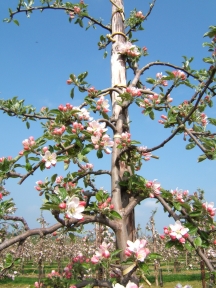
The one thing these routes don't do is take you along busy roads, a serious challenge around the more industrial parts of Sittingbourne and shortage of the tiny red signposts here made this bit rather difficult to follow. But we soon got ourselves back on track and a haze of bluebells in a roadside wood signified that here at least Spring was in full flood. There was apple blossom everywhere and I even spotted a brown lizard sunning himself before he saw me and darted away.

Sadly our legs were not entirely up to the challenge and today we are suffering the consequences so this quiet anchorage suits our mood entirely.

In the last hour the wind has filled in and changed; at last a fair wind for us to sail north tomorrow. Our plan is, over the next 2 days, to sail to Suffolk, maybe as far as the River Deben, a favourite haunt of ours from many years ago when our family home was in a village less than half a mile away. We have enough food on board to last us for some days, maybe a week or more if we are prepared to eat the 'boring stuff' we always resort to when the fresh veg runs out. This means we can use quiet sheltered anchorages, far from civilisation, if we can find them, with only the wildlife for company.

Wednesday, April 15, 2009


The last four nights we have spent quietly at anchor at Harty Ferry, which many years ago would have been a crossing point to the eastern end of Sheppey as well as a place to fill a ship with fresh water from the natural spring on the mainland side of the crossing.
Here is Cirrus with her anchoring equipment - the round shape for daylight and the solar-recharging garden light for the night.
Many years ago, maybe about the time that Henry the Eighth took Anne Boleyn here for her honeymoon, we would have been anchored behind the Isles of Sheppey because there is actually a main island and two others, Elmley and Harty, although silting up of the channels and man's interventions have now blurred the distinctions between them. Sheppey itself is a corruption of Sheepy which tells us what a large part of the island might have been known for. At the western end, however, close to the Port of Sheerness there is now a car park of stupendous dimensions where imported cars are stored in their thousands before being distributed across Britain. Even Googlemaps struggles with the size of this feature.

Fortunately most of the rest of Sheppey is rural and to the east and all along the southern shore there are natural saltings and marshland which have status as wildlife reserves and provide homes for thousands of birds and plenty of other creatures too. During a short walk yesterday I came close to infanticide when I just missed stepping on this little clutch. Mum and Dad had been flying above us for some time making all sorts of strange noises to lure us away but since neither of us speak Lapwing I'm afraid the message wasn't getting through. This whole area is a birdwatcher's bonanza and at this time of year one regularly sees hawks over-flying looking for easy pickings of young fledglings - a nerve-wracking time for their parents. Whilst out on a nearby sandbank members of the permanent seal colony loll about taking a much more relaxed approach to life.

One feature about Sheppey that has always struck me is that it is insular and unwelcoming. Everywhere you look there are scores of 'Private - no entry' or 'No footpath' signs, don't go here or there, always emphasising the negative, never the positive. But fortunately Sheppey has at least one haven of sanity on the 'Isle' of Harty where, just a short walk from the ancient and broken slipway leading into the water from the Harty Ferry Inn, lies St Thomas' church, a place renowned for being the most remote church in Kent. Built in the 11th or 12th century then hacked about or added to many times since, it welcomes visitors through its always open door into the sanctuary of its dark, cool interior. Here a stained glass depiction of St Thomas, for the spiritual, gazes across at a rather beautiful owl, for the secular, and at the rear of the church one can pick up a good novel or a toy racing car as well as an ornamental china pig tattooed with church logo represented here, all sale proceeds trustfully posted through a slot in the wall.

Far and away the best feature at St Thomas', however, is the jam table. This is not just any jam nor is it jam for the faint-hearted or the narrow-minded. Here, if you come on the right day, you'll find such exotics as banana and date, strawberry and apple, marrow and blackcurrant or if you're a real risk taker you may be tempted by the 'Mixed Fruit'. It all stands quietly just inside the door, plain little jars tempting all comers, with an apologetic sign explaining how the price has had to rise to £1.75 to cover the cost of the jars customers never think to bring back. In this place the negativity expressed elsewhere on Sheppey is replaced with trust. For me this place is worth a return visit any day.
This morning we pulled up our mud laden anchor and sailed east to Gillingham on the River Medway where we'll leave Cirrus to carry out some domestic removals - re-locating our stored effects to somewhere less expensive than London. Looking ahead for the next five to seven days we can see a run of northeasterly winds forecast, these coming straight off the cold North Sea and from exactly the direction we want to travel, a perfect justification for pausing here until something better comes along.


Sunday, April 12, 2009

Destination retirement

Quickly, before the events of the last few days slips into memory, I must make a record so that they are not forgotten. Never again will we pass this way and just as starting one's first job is an event that sticks in the mind, so equally is the end of that job, the end of all paid work. But for those who have yet to come this way let me warn you that it may not be what you expect, it may feel more like a beginning than an end. You just have to decide what it is that is beginning. But first we have to thank so many who have wished us on our way, for all the wonderful greetings and comments we have been pouring over on cards and messages we received and for the retirement gifts given to send us on our way. Thank you, thank you, thank you, we'll miss you all.

And thank you to those of you who wished us on our way out of Central London, especially to Alison and Nathalie, our neighbours on Loch Invar for the colder months of this last winter and who were our official 'waver-offers' on the day Cirrus Cat left fresh water and emerged from the marina lock out into the salty brown waters of the Thames. The general sentiment from you all seems to be envy but you may have felt differently had you been on board as we motored down river later in light rain, fully clothed in our warmest hats and gloves with darkness closing in and miles yet to go. The passage was not without its excitement, however. Woolwich Reach on the Thames is perhaps best known for its free car ferry crossing the river many times each day rather than its wildlife. But nobody told the two small porpoises we saw frolicking in the water just by the ferry.... yes, porpoises in the Thames! No pictures, I'm afraid (a porpoise doesn't exactly hang around with a smile on its face waiting for the camera flash), so you'll just have to believe they were there, but they certainly put a smile on Kate's face that lasted for miles.
By 9pm we were turning into the Swale, the thread of water that separates the Isle of Sheppey residents from the rest of Britain, the rising tide sucking us in till the water shoaled and the anchor plopped to the sea bed. With the engine off, finally, the quietness surrounded us and took us into its shell so we could sleep at last, almost alone in peace with just the birds for company. So today we awoke for the first day of our new life. The air was completely still and so was the water when it paused between the tide rushing out and returning again, Cirrus floating effortlessly between the two. The sky was cloudy and the light had an unreal silvery sheen to it, obscuring the air/water divide in the distanceWe emerged slowly from the cabin, savouring the silence, keeping our own movements quiet in response.


Later we were boarded by noisy pirates in the guise of friends larking about and joining us out on the water. Here are just two of them caught in the act of boarding. We plan to spend the Bank Holiday weekend here just drifting about at anchor or maybe sailing a little further west towards Queenborough in a few days time when we run out of food on board. The weather has been kind all day, just the lightest of winds with the sun warming the boat nicely and giving us a chance to take stock and make the mental adjustment from our life on a stationary boat to our new life of travel.