Thursday, June 1, 2023

Free house

Our garden delivers surprises every day. Things emerge from below ground in unexpected places. We've had a swathe (or should it be a host) of daffodils pop up right across the back garden, appearing from nowhere. Maybe some of these were deliberately planted but so many suggests that they have been multiplying on their own for many years.

Then from the bare, brown, stick-like branches of a small tree growing beside the house, spring has brought out a spread of white flowers which later gave way to tiny green blobs, nascent cherries. Elsewhere the grass we expected by now to be long overdue for a trim has barely appeared at all. Instead in many places there is a carpet of moss, a mix of different species, all of which is beautifully soft to walk on. Just about anywhere around the garden there are now green fronds of bracken popping up, an indicator back to what the land once was, a wet woodland habitat. The rotting stumps of the long gone trees are still dotted about, almost hidden from view by the moss and now finally by the tall stems of wild grasses and dandelion flowers which are starting to give us the wild look we love.
Then another surprise. For our dinner one night Kate makes us a rhubarb crumble, the stalks having miraculously sprouted up from the ground in several places we hadn't expected. Perhaps it was all this plant life that we really paid for, the house being thrown in for free.

Now we can see what is already growing we can get a better idea of what new planting we would like to add into the mix and also what we do not want to encourage. Having trimmed back the bramble jungle when we first moved in, we know that their sturdy roots will likely always be with us. But perhaps we can let them flourish in one or two corners, albeit in a managed way, whilst trying to snip off the new growth elsewhere as soon as it appears. Bramble does, after all, have one agreeable habit; it produces rather tasty berries.
What we have discovered is probably a close relative of the hated bramble, masses of it cover the steeper, rocky areas of the garden. It is wild strawberry. The berries that are now appearing are tiny, like small red peas, and most will probably end up as bird food but these small plants provide ground cover and this in turn will help to exclude the bramble beast.

Rhododendron, however, particularly Rhododendron Ponticum, is not welcome. This plant is not native to Scotland so it doesn't belong in our country and we have no qualms about showing these shrubs just how brutal we can be although, as it has some remarkable survival strategies, it may take years to eliminate it completely. It can send branches horizontally along the ground then put down new roots and create a whole new plant some distance away which will survive even if the parent is cut down. It also creates so much shade beneath its evergreen leaves that nothing else can grow. So it's chop, chop, chop to the Rhodies.

Our small and rather battered greenhouse is already providing a home for some tomato plants and soon, we hope, will house a variety of edible plants that would struggle outdoors in our climate and would certainly be gobbled up by the hungry slugs that share the garden with us. 

Then, of course, there is the pond. All we did was dig a hole, line it with plastic and fill it with water but very quickly this has become home to a mass of insect life, creatures that have made their own way there, by air we assume. First to arrive were the pond skaters, creatures that live on top of the water's surface, catching and eating any other insect that is unfortunate enough to fall in and get stuck in the surface tension. The skaters seem to spend the whole day fighting each other (unless I am misinterpreting this) so perhaps they find our pond rather too boring. Meanwhile beneath the water we have countless beetles who skull themselves around like tiny oarsmen and clinging just under the surface are gnat larvae, breathing air through the tiny hole they have made in the surface skin. We are probably responsible for adding to the Scottish midge population too but this is how the wild world works, it is not our place to interfere. The pond is gradually becoming more cloudy with algae, food for something no doubt, and we did import a few clumps of weed from another pond which are surviving as floating rafts from which fresh stalks are now appearing. It seems the roots of these plants take nourishment from the water itself which must mean we have created a reasonably healthy environment.

We find the process of natural rewilding so fascinating that we have a little seat arranged close by so we can sit and watch the changes from day to day and observe the behaviour of the wild things that have chosen to live with us. We take pleasure from giving them a home but try not to interfere. We know that in the current dry spell the water level will drop but it would be wrong to top up with tap water as this risks poisoning one or other of our little friends. So we leave it alone and let nature do what it's good at.

Wednesday, April 26, 2023

Last wisps of gas

We have now been living in our new home for a little over six months... so perhaps we should no longer refer to it this way. But part of the reason it still feels new is that there is so much we want to change about the place to make it feel like it is ours. Decoratively we have stripped the paper from a few walls, opened up some internal spaces we had no need for and of course we have completed The Bathroom Project. Redecorating the whole house to our own taste is definitely going to happen at some point but  something prevents us doing more at this juncture. It is the heating system, the LPG gas boiler, which we want to change to an air source heat exchanger. Having been through this process in our previous house (in that case discarding an oil boiler) we know that this will mean some serious disruption as the new pipework and radiators are installed so it would be premature to decorate any rooms before this is done.

The tank of gas that came with the house has served us well by providing hot water and central heating for over six months. But then one day, inevitably (25th March to be precise), we drew off the very last gasp of propane. We had already decided, believing that the long process of getting a new heating system would soon deliver, that we would not top up the tank with more gas when this happened so that was the moment our taps ran cold. No more hot showers and with cold radiators our house became one in which we suffered chilly mornings until our small multi-fuel stove could be lit and our tiny electric fan heater started blowing warm air. Getting out of bed from under our warm duvet became a challenge as this was winter, spring was weeks away, and whilst our high-on-the-hill position might give us the best view for miles around it is also a windy spot, heat being sucked quickly away when the wind blows. So we developed coping mechanisms to get us through. We apologised to our visitors for the lack of comfort, we threw more logs on the fire and when a hot shower opportunity elsewhere did come our way we grabbed it with both hands. Fortunately there were sunny days and we discovered the house had a bonus feature, the south facing conservatory, which traps the sun's rays and converts them into heat. Open the connecting door into the house and some of this warmth changes places with the colder air inside, bringing relief for a few hours until the sun drops behind the hill for the night.

April brought the first traces of spring and longer days brought warmth too, not every day, but often enough for us to carry on. Thermal vests and thick jumpers do work, so we discovered. Then finally we had a visit from our heating installer, something we'd been pushing for, and the words that came out of his mouth caught us completely by surprise.
"We can do you next Tuesday," he said. "Would that be ok?"
At first we thought we might have misheard him but then we realised he was serious. Perhaps our sorry state had rang his sympathy bell but whatever it was we could hardly believe that in just a few days our lives would be changing, for the better.

So it was that exactly one month after the last wisp of gas squeezed its way out of the tank in our front garden there was a line up of vans outside from which emerged more plumbers and electricians than you could shake a stick at. Large white packages (our new radiators) were carried up the steps through our front door and lengths of shiny new copper pipe disappeared into the space beneath the house. Before we knew it our present heating system was disappearing out the door, the boiler included (I didn't even get the chance to wave it farewell) and rumbling noises from beneath the house pointed to the old pipes being cut out. 

We tried to keep out of the way; it was a cool and breezy day so with the house doors open to allow access we hunkered down in front of our stove to preserve our body heat.

It took four strong men to lift the new air source heating unit up from the road and onto the prepared base at the rear of the house but once this was connected up it did at least look like we might have heat by the end of the day. However it was then we were told that the wrong cylinder had been ordered, too big to fit in our kitchen cupboard space, so by close of play we had new (bigger) radiators in every room, loads of shiny new copper plumbing but still no hot water. For this we would have to be more patient. 

Two days later the plumber returned, and he brought with him a fresh set of muscles.
 These were soon deployed to lift the water cylinder up from road level.
It is hard to believe that this is the smaller, slimline model, but when we see it installed in our kitchen cupboard an hour or so later we realise why the bigger one would not fit.
The cupboard that was once home to a nice looking gas central heating boiler now has a tall insulated cylinder, a couple of expansion vessels (squashed into the top) and a control panel that looks like it could run a starship. There are also several interesting looking white boxes, one of which seems able to talk to my phone using the house wi-fi. Naturally this is the first gadget I am keen to get working as soon as the new heating system is up and running and couple of hours later, after we say farewell our workmen, I am communicating electronically with the new beast.

More importantly though, for the first time in over a month we have heat in the house and a bathroom shower that delivers hot water. We can't wait to get under it.

Monday, April 24, 2023

Boat delivery

The previous entry here might have suggested that we felt it was a little too early in the year, a little too cool and unsettled to be going sailing. But then something unlikely happened.

After our successful launch I was walking back from our pontoon berth when I found my passage blocked by the contents of someone's boat, an assortment of boaty bits, scattered about in an untidy heap in front of me. They were mostly rather old things, dirty looking fenders, coils of rope, pieces of wood and other mysterious objects but inevitably I stopped for a chat with the young couple who were clearing out the boat moored alongside. I discovered they had just bought her, an elderly but heavily built sailing yacht, for very little money. They are sailing novices, having very limited experience, but plan to take the boat to Whitehaven in Cumbria, over a hundred miles to the south but closer to where they live. Doing this alone was clearly going to be a challenge so someone with greater sailing experience would be useful as crew on the passage. I was sort of drawn in and almost before I knew it found myself agreeing to accompany them. Thinking back I was as surprised as anyone by this decision. What was I thinking! But there again, why not. 

March is, of course, rather early in the year to go sailing in Scotland. This, together with the untried and untested nature of the boat itself will certainly raise a few eyebrows. James, the boat owner, had already lined up an uncle, Darren, to come along so we have a crew of three. Does this make it less crazy? I don't know.

With a fair wind the passage might be done in two days, avoiding overnight sailing, and a logical stopping point just short of half way is Campbeltown where there is a sheltered loch and a good marina. But will the weather be kind to us so we can make the passage in two consecutive days? Forecasts are studied closely and disappointingly they change each day, the wind direction for the latter part of the voyage starting to come in from the south, just the direction we need to go. Strong headwinds are not what we need.
In the end we decide to do only the first leg, then leave the boat in Campbeltown until the gods give us a fair wind.

So off we go. We meet a cold easterly wind at the start but once we turn south along Kilbrannan Sound it warms up a little and with the sails up we are making good progress, the boat's elderly bow cutting smoothly through the water. The mountainous Isle of Arran blocks our wind for a time so the engine goes on but overall the passage goes smoothly and by 4 pm we are safely docked.

For the next leg, however, we really need a gentle westerly, ideally with some north in it, as this part of will take us around the Mull of Galloway then eastwards towards Whitehaven. Timing this passage right also means having both the wind and the tide going our way and whilst the tide and the tidal currents are reliably predictable, the wind is less so.

James has bought the boat with the idea of living aboard, close to where he works, then travelling back home at weekends. This will give him the opportunity to fix her up in his spare time and to sort out some of the things on board that are not currently working. One of those is the sea toilet, pretty essential one would have thought, but of course in a marina there are always facilities on hand. In all the boat is solidly built but has suffered somewhat from years of neglect. The sails are tired but serviceable - they would certainly get the boat to Whitehaven - and the small but powerful engine is one of the few things that does seem to have been looked after properly; it starts easily and runs well. There are, however, a few minor but rather annoying deck leaks to sort out as these have resulted in soggy boat cushions and as a result sleeping on board something of a trial. James is undaunted by this but his enthusiasm to complete the passage must be balanced against safety for what will be open sea, first across to Galloway and then across the Solway Firth.

Our first weekend passage plan came to nought as the forecast changed constantly and the presence nearby of deep depressions with strong winds brought us to the conclusion that it would be too risky. In the end it turned out to be cold and very wet with winds filling in from the south, exactly the direction we want to go. We need two days of favourable winds and all the gods seem to want to send us are contrary ones.

Then a few weeks later the forecast shows a run of north-easterly winds, some of which conveniently coincide with a weekend. Fresh plans are made with much studying of charts and tide tables. These are particularly important because our passage will take us around the Mull of Galloway, a place which boasts a notoriously rough patch of sea. But forecasts change, each day, so is this one going to stay good for us?

The day arrives and we are all up early to catch the tide (me sleeping on a soggy cushion on board and the other two sleeping in their car) although a little later than planned. There was a fresh breeze blowing into Campbeltown Loch all night long so on getting up I donned as many clothing layers as I could, the result being that after a few minutes sorting out mooring lines and other preparatory jobs I was sweating profusely. 
Here I am just starting to manoeuvre the boat backwards out of its berth into the most spectacular sunrise you can imagine. It is cold and breezy but although the water looks flat this turned out to be the calmest part of the whole day. 

To leave the Loch we had to motor out along the entrance passage which took us directly into the cold north-easterly wind and this was our first encounter with the rough water we were to experience all day. The heavy boat plunged headfirst into each wave, spray coming up and hitting us right in the face, covering us with salt.

Eventually the ebbing tide carried us out into deeper water where we turned south east and raised a small sail to begin our six hour journey across to the Galloway coast. Now the waves came at us from the side, rolling the boat about violently so that holding on to something solid at all times was essential. Most of my earlier body heat was gone and every jet of spray coming across the boat snatched away more and more heat from our bodies as we stared ahead towards our destination some twenty miles away. The hours ahead would be grim, all three of us soon succumbing to sea sickness and shivering in the cold. We clung on, gritting our teeth and hardly speaking as the boat romped along merrily, taking it all in her stride as if she was actually enjoying it. But in these conditions the crew are by far the weakest part of any boat.

Many hours later a decision had to be made on whether we should carry on to our planned destination, Portpatrick, which would have involved many more hours of suffering, or whether we should go instead into the safety of Loch Ryan and Stranraer harbour. The wind strength, force 6, had propelled us along and the cold and the rough seas had taken us to the limit of endurance so Stranraer it had to be. Although this was not the ultimate destination for James it is at  least closer to his home and therefore easier for him to visit, a place where he can fix a few boaty issues whilst waiting for a fair wind to carry him on the last leg home. Once safely in and warmed up we all agreed that despite the hardship we would not have missed the experience as it had given us a good appreciation of how much the tough little boat could take. Safety must always stand above everything else though.

Tuesday, April 4, 2023

Sailing soon

All those house projects taking up our days has inevitably meant that our other interests, touring the country in Martin and sailing, have been on hold. But then it is winter and although we are crazy enough to contemplate campervan adventures at this time of year, when it comes to sailing, we do prefer to be laid up ashore. Since moving house we no longer have an accessible garden where she can be stored on her trailer so Eun na Mara has spent the winter months tucked into a corner of the marina car park, a few streets away from our home.

She is close by, safe and secure, and needs little attention other than a periodic check up. In fact she is totally boxed in by other much larger vessels. But there is a deadline coming soon, a day when all these boats will be lifted back into the water, the timetable for this being determined by the marina and thus being beyond our control.

So this explains why, contrary to my better judgment, I find myself lying on my back beneath the hull on a freezing cold day getting spattered with blue antifouling paint from the roller I am swishing about with one hand. No matter how carefully this job is carried out it is inevitable that some paint ends up on the painter and at the end of the day I just know I'll be discovering the impressive adhesive properties of the expensive product I am applying. Its purpose is to inhibit the growth of marine organisms (a posh phrase for barnacles) and in order to do this it is described as 'self polishing', another way of saying it wears off. Which explains why all boat owners have to go through this procedure every year and why marine paint manufacturers make so much money from us.

Phew! It feels so good to have got all that off my chest.

Our rather elderly sailing vessel is a tough little beauty but the hull is showing its age, rather weathered, a faded version of its original.

So out comes the T-Cut and after several hours of polishing we have a new boat, a darker green... until it fades once again in the sun. Next jobs will be to raise the mast, to restore all the cushions and other things stowed ashore then stock up the boat with some victuals. (For the benefit of landlubbers this is the sailor's word for food.) Launch day is not far away now.

When it comes to getting our boat from shore to sea we have a choice, one that owners of larger boats do not have. They must have the services of a crane, a crane driver and a couple of helpers to assist with positioning the slings as well as a close enough stretch of deep water. The availability of all these things ties them to a day, an hour, and even then to their place in the launch day queue. But we have a trailer on which our boat rests quite happily all winter and then, tied to the rear of our van, both boat and trailer will follow wherever we decide to go. To move from land to sea we need just one more thing, a gently sloping ramp, the lower end of which is beneath the water we wish to sail in - a slipway. Such things exist in many different places and whilst they may not all be suitable - too steep, too shallow, weed covered, too narrow, too short - when we are out and about we are always on the lookout for one that might one day serve us. It is, however, more than a little stressful launching this way; there is so much that can go wrong and the internet is full of videos of boat launch fails which highlight this. The objective is to get the boat into the water by sliding it smoothly off the back of the trailer which is then pulled back up the ramp and driven away. But there's a lot to think about. For instance, at the rear of the trailer there is a lighting board which is connected by an electrical wire to the vehicle. Should this enter the water, especially salt water, the lights are guaranteed never to work again. The board and its long electrical cable must be removed completely before starting to reverse down the slip. Similarly any straps which secure the boat whilst it is on the trailer must be removed and, of course, the tide must be right, with enough depth to float the boat once it leaves the trailer. The final point to be aware of is that once the boat slides off its trailer it will continue to drift away - boats don't have brakes - and will be at the mercy of the wind and current so it must be secured to something nearby or else someone must be on board ready to start the engine so as to manoeuvre the boat to safety. Of course one person must be left ashore to drive the vehicle with its empty trailer to a safe parking place (always remembering that the lighting board must be reattached before going back on a road). Of course this is merely a summary of the boat launch process but in practice every launch is something of a gamble with a long list of variables.

As it happens our home port has an excellent slipway; wide, clean, and plenty long enough for an easy launch. It is, however, used every hour by the car ferry which runs across the loch so launching from here would be a race against time, an added complication to the already stressful task.
So there we have it. For these, and a host of other reasons, we have decided to have our boat craned in this year.

And we are nearly ready.
The mast is now up. Unlike many larger sailing boats, our mast spends the winter lying horizontally above the deck supporting a full length cover. Raising this large piece of wood to a vertical position is something the boat's designers took into account so that two people, acting in unison, can do it quickly and without any real risk involved. All the halliards and sheets (sailing boats don't have ropes) have to be laid out in their right positions so nothing catches as the mast rises then with one person lifting from the rear and another pulling on the forestay halliard the mast rises, pivoting on a securing bolt in the tabernacle. (I make no apologies for the technical language used here. If you find this difficult to understand then feel free to use Google.) The other boat owners in the yard seemed quite impressed that we had done the whole job in around thirty minutes when on their boats they would need a crane and half a day of reconnecting and tensioning things to achieve the same. We were lucky with the weather too, one of the rare dry days set amongst a series of wet ones.

In the final days before launch the marina car park is a hive of activity with boat owners clad in protective clothing, lying flat on their backs, paint rollers in hand. There is much banter and joshing about each others boats and judgements being passed on whose hull has been polished to the highest shine. Ours has no hope of matching up to the high standards set by some owners, so we don't bother trying.

Then comes the day. The forecasters didn't quite get it right - it was cold and wet - but when our turn came things went smoothly with no hiccoughs.

Of course, all the rules state that 'man-riding', flying through the air in company with your boat, is not permitted for safely reasons but come the day, every boat lift had at least one on board, standing ready to start the engine once the boat is back in her natural element.

So there she is, afloat again and looking as pretty as ever in her usual berth. A bit of warmth now is all that's needed to tempt us to go out sailing.

Thursday, March 16, 2023

Domestic adventuring

Our new home is in a 'village' (despite it having multiple shops and an assortment of places to eat out) and as we continue to settle in, life here is beginning to capture us. We are determined, however, not to put ourselves forward for involvement in any local committees in order to avoid getting to where we were before we moved - having too many demands on our time so that our lives cease to be our own. I did recently put myself forward for a few hours physical labour, shifting and spreading gravel at the community-owned castle, a historic monument, and welcomed this opportunity to meet up with a few locals, which is fine, but this is as far as I'll take it. Aching muscles is something I can handle, something we can both control.

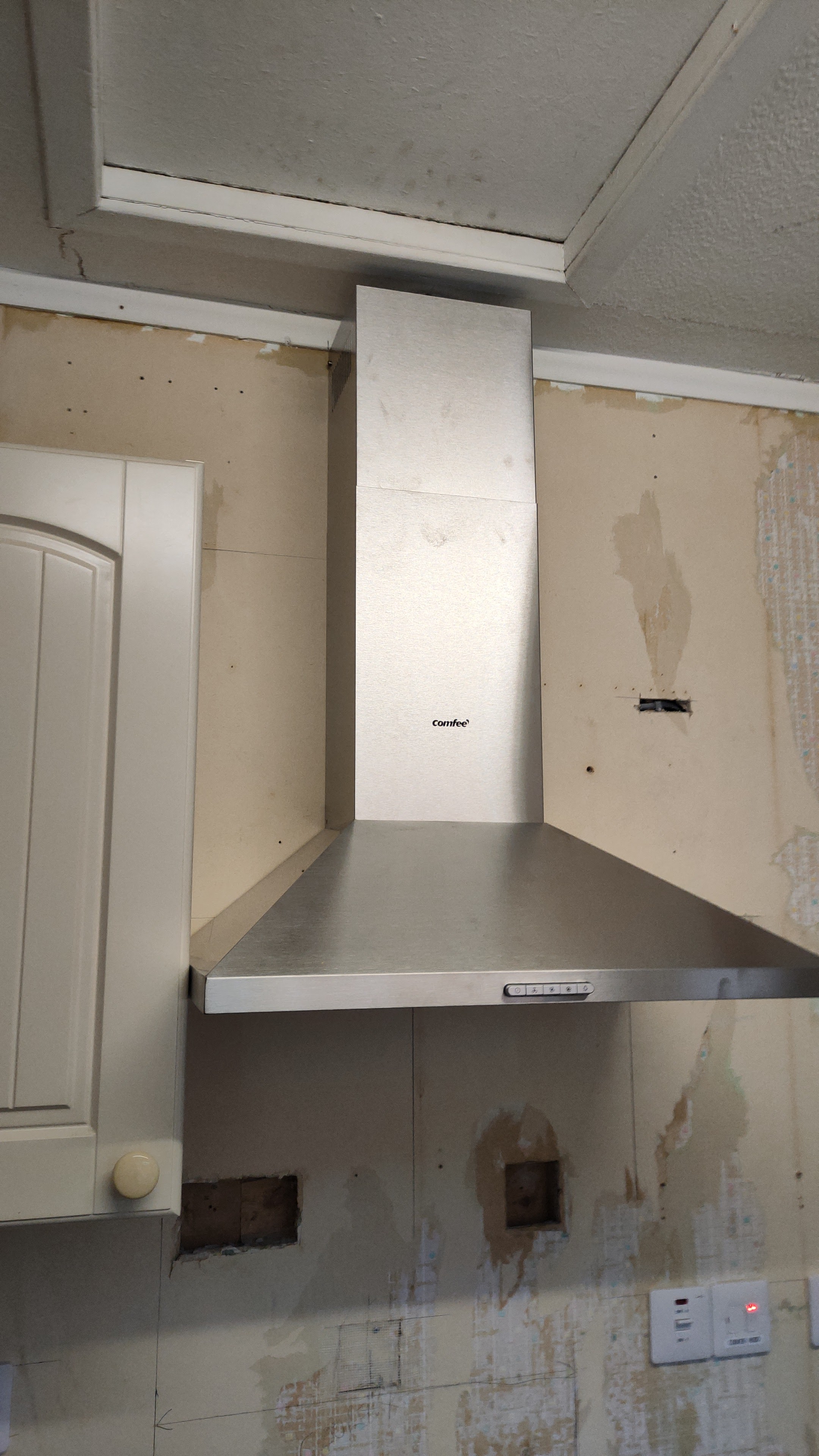
We are also controlling the pace of the house projects fairly well. Here at home this is what our kitchen wall looked like as the electrician was putting in some new wires and the associated sockets so that we can use our new electric cooker, the gas one having been taken out and given away locally to someone who had a need for it. The square shaped holes in the picture are a necessary part of what an electrician does when he has to feed new wires up from beneath the house. Patching the holes up again is a necessary part of what we have to do to make the house as we want it but this will take time so we can expect to be living with these holes for some time as the kitchen renovation slowly takes shape. 

With the electrics done a cooker hood is screwed to the wall and trunking fed off the top into our attic space where it is connected to an existing roof vent to carry away all our cooking smells. This all sounds very simple but it required imagination, some large drills and the ability to survive in a dusty environment, the attic, my least favourite part of the house.

The solution, however, is innovative, practical, and is typical of the way we are bringing our own ideas into play. Of course it will mean that with the right wind the whole village may be able to smell what we are cooking, but we can live with that.

Next on our time line, we hope, will be the fuel that heats our house. We have a gas central heating boiler but being where we live, in a very rural location, there is no piped gas main buried under the road outside. Instead the stuff is delivered periodically by lorry which discharges liquid propane into a pressurised tank located in our front garden. This does not fit well with our views on green energy and neither is it the cheapest way to heat the house so this is something we want to change, just as we did in our previous house, where the fuel was oil.
Some months ago we contacted a company that specializes in installing air-source heating systems and since then we have been pursuing Scottish government funding to help us afford to make the change. The application process is complex and would be daunting to many - long periods of waiting on the phone to speak to an advisor, complex emails and lots of legal jargon have to be negotiated before eventually we have a successful outcome. Soon we shall have a start date for what will be a major transformation for the house, something we were determined to achieve from the day we moved in.

We have another ambition too. Beyond our back fence is a hill which on the map is called Cnoc a' Bhuic, although for some reason it is known locally as the Uridgh. On top of the hill is a concrete pillar, an Ordnance Survey trig point, again shown on the map, but this is a wild place and it is not easy of access due to the dense vegetation on the lower slopes. However there is a rather intriguing gate in our back fence. So might there be a path up the hill from there? 
This is the straight line route.

Our first exploratory forays reveal that to reach the more open ground higher up we must first hack our way through a dense jungle of gorse, bramble and rhododendron, beneath which is very squidgy mud. Oh, and there's a steep-sided burn to cross before even arriving at the steeper bit. 

So, by deploying a couple of washing line poles we create a bridge across the burn (no more muddy wading) and since this solution fails to scare one of our younger visitors it must be ok. Cutting through all the dense vegetation takes a massive effort (even with the assistance of a chain saw), but with each attempt we get higher and higher up the hill and after numerous spells of hacking and chopping we eventually have a route through to the bracken-covered upper slopes.

Having made it this far we find faint tracks with hoof prints in the soft ground which tells us there are animals, sheep or deer, roaming about here. We can expect that with the coming of Summer there will be new bracken growth covering everything and this will make route finding on the hill very much harder, so we are keen to make some sort of a path now and then use it regularly to keep it clear. We also need to lay down some route markers since, once having climbed out of the denser vegetation, we suddenly realise that it is extremely difficult to find the route down again. It may be hard to believe but it is definitely possible to get lost in the wilderness which lies just beyond our own back garden.

One of our higher forays was in the company of some of our friends' children and we discovered a small cave, clearly used as a shelter by the animals who live up there. 
The view from inside is spectacular but we doubt this is why the animals visit it.

At the time of writing those words we had yet to make it to the summit... but then another sunny day came along and we went for it, a summit push. 

The actual route, tracked on my phone as we ascended and returned, was definitely not a straight line and on our descent we chose a slightly easier route, one involving less scrambling. It is not an easy climb and navigating the route down again is equally hard, risky even, since once the ill defined path is lost, finding it again is a real challenge.
The evidence of our achievement is here, the owl pellet on the top of the trig point showing that the wind was not strong but it was extremely cold so we did not linger on the summit. There were views in all directions but nothing beat looking to the west, along West Loch Tarbert and out to the Atlantic beyond.

Saturday, March 4, 2023

The Great Bathroom Adventure - episode 4

Bathroom flooring day finally arrives, on schedule, and a layer of red stuff now covers the rather messy bare timber floor. It is waterproof, tough and non slip, contrasting with the walls and adding a splash of warmth to this room. A quick call is made to Malcolm, our plumber, for him to come and finish off, to install the toilet, a sink, and a new radiator and several days later he arrives, spanners in hand. 


The final result is worth the wait, lots of contrast between the pale colours on the walls and the black furniture. And yes, that's a blue whale providing some marine interest.
Or to put it another way, here's the before and after...


So this is the first of our planned room-sized projects done and dusted. Others will follow, some big, some more cosmetic but an end is nowhere in sight. What it does mean is that our focus can shift elsewhere, outdoors even, where unexpected things are happening.


With the lengthening days, surprises are appearing in our garden. 
From beneathour mossy grass things hidden underground are emerging in large numbers, green at first,  and then these begin to acquire yellow buds which soon open into flowers. Daffodils have always been predictors of spring and now we know that the bulbs are there we will always look forward to seeing them emerge from the sloping plain that is our garden. It is also nice to think that such beauty came free with the house, so we're not complaining.

Less attractive, however, is the continuing discovery of rubbish thrown away by previous inhabitants of our house and now also appearing from beneath our back garden as we dig about. This reflects an attitude that is beyond our understanding.

Saturday, February 25, 2023

The Great Bathroom Adventure - episode 3

The big day approaches, the day when our plumber comes back to connect the pipes, fit a shower mixer tap and turn the water on so we can wash our bodies again inside our own home. Whilst we prepare the bathroom walls for this epic moment we manage to find a few more jobs that are suited to this man's particular skills so this won't be his final visit here but it will move the bathroom adventure a little closer to an exciting conclusion.

The familiar white van draws up outside and boxes of tools and lengths of plastic pipe are carried into the house ready for use. The day is then enhanced by sawing and banging noises as a plywood floor is laid (a job for the apprentice) ready for the vinyl floor covering we have chosen, whilst beneath the floor, new pipes are connected, all of which will soon fill with water. Exciting stuff.

Then I get a call to assist with one rather heavy item, our new shower screen. This enormous piece of glass (10mm thick) has to be carried up the steep steps leading to our front door then manoeuvred inside and lifted into place. It is immensely heavy, far beyond what a doctor would prescribe for a human to carry, let alone walk up steps with. I shall not dwell on the anxiety associated with this whole process, the thoughts of what might happen should it slip through the fingers, of the crushing impact upon the toes followed by the shower of broken glass shards across the head and shoulders and possibly into my neck. This is the stuff of many YouTube 'fail' videos, in case you're interested.

When the day comes to an end we have a working shower in place. And we love it. The pale colours are ours. The tile pattern is our choice. It is neat and spacious, big enough to be comfortable in, given that the bathroom itself is a small room. It is just what we imagined. There are a couple of small modifications we'll make so the enormous glass screen is less frightening to walk near (pictures in due course) but we can use the shower. Phase three is complete.

There now comes a pause in the bathroom project schedule as we wait for the availability of a flooring fitter who has the right skills to give us a waterproof floor in the colour we want, which is red. We have decided it has to be red. This is the only colour that works for us with what we have chosen for the walls, so no compromise here. Perhaps we should have planned things a bit better timing-wise to avoid waiting for the floor to go in as this has to precede the final fitting of the toilet and sink but we're not unduly bothered. A bathroom is forever.

During this pause, however, another house project is starting not far away. It is the kitchen, another room we have form for making changes to in previous houses. There is much we find inconvenient about the present layout, the decor is dated beyond words but with a kitchen we must take it in stages since it is a working environment, needed each day, and there are no alternative places where we can cook our food.
[Well actually that isn't quite true. If push comes to shove we could cook in Martin, our campervan, or we could even use our single burner emergency stove, simple, but it would work.]

By now our ripping-out skills are of the highest order and we are keen to deploy these wherever they are needed. We have experience of the way the inside bits of the inner walls of our house are put together and this gives us the confidence to apply these skills to the built-in kitchen cupboard, another enclosed space that we feel we can do away with. It takes less than two days, a hammer, a small crowbar and some muscle to make the walls and the wooden door disappear completely from view. Only on the ceiling does the cupboard outline still remain but suddenly the kitchen has grown in size and we can plan the next phase, an electric cooker to replace the gas one which came with the house and is currently awkwardly positioned in one corner.

Of course, all good projects must start with a plan, so here it is, in 3D so we can better visualize where the different pieces will go. Just as our plumber departs we welcome first of all a gas fitter who is swiftly followed by an electrician whose banging and thumping noises assure us he is making holes in our walls through which his wires can safely run. In two successive days we go from gas to electric cooking and have the power sockets where we want them, ready for the kitchen we want to start to take shape. The gas cooker, far from old, is not wanted so we offer it up online, free to collect. There is no piped gas supply to anywhere local so there's no point in trying to get money for it. It's only useful if you have bottled gas.

All is going to plan inside the house so, given the absence of rain hammering on our windows I am motivated to attack the garden with a spade, removing large chunks of turf from a roughly circular patch of the sloping, mossy area some would refer to as a lawn. We're creating a garden pond and I soon discover that even though it is not actually raining, any hole dug in the garden fills with water very quickly and good waterproof footwear is required. We have a readymade climate-assisted natural shortcut to our pond creating efforts. Normally one would expect to have to line a garden pond with a water-retentive liner but given the amount of rain that regularly falls here and the sloping nature of the land beyond our garden, the pond might just retain water all year without needing anything else. Time will tell, of course, but one unexpected advantage is that we don't have to worry about getting the pond level. The water does this for us.

Monday, February 6, 2023

The Great Bathroom Adventure - episode 2

There is absolutely no point in showing here a picture of the en-suite shower room which is now missing from our bedroom, obviously, because there is nothing to show any more! In fact all there is left is a pile of broken plasterboard pieces and a collection of nail studded timber pieces and I refuse to photograph these. The final part of this project was to relocate a power point, which is fed  from beneath the house, and this gave me the opportunity to correct a couple of other wiring issues too. Perhaps this is not the time to dwell on the confused state of our house's electrical wiring but if we move to the plumbing, this is interesting, to say the least. Our house has had at least one earlier central heating system and the pipes for this still lie beneath our floors, empty of water and gathering dust but causing confusion when it comes to trying to work out what is what. Rather more annoyingly, some of these redundant pipes still rise up through holes in the floorboards and have been chopped off just beneath our interior carpets. The pipe-less holes in the floor whistle when the wind blows hard outside, cold air rushing up into the house from below so plugging these holes when I come across them has become routine now. Gradually we are sealing up the house from the outside elements. We are also accumulating a considerable quantity of copper pipe as I remove more and more of the old redundant bits.

But I digress.

Returning to our (now missing) bathroom, we are accumulating materials, new wall cladding panels and tiles, ready to go full steam ahead as soon as our plumber returns. However there is a sequence that must be followed. The tiles that will surround our new, enlarged shower cannot by fitted until the shower tray is in. Wall panels must precede the toilet and sink fitting and we have temporarily removed the bathroom radiator ready for its replacement with a heated towel rail but deciding where this fits in the project timeline is less clear. 

Finally the big day arrives. A white van draws up outside and soon our plumber is carrying boxes into the house, assorted pieces of our new bathroom. The 'before' picture above is what confronted him although it hardly does justice to what is happening beyond the window where our first snow of the season is settling on the ground. The forecast is for cold weather, a good excuse to stay inside and move forward with the tiling which will surround our newly fitted shower tray.

But hold on. These are big tiles; more like great rectangular ceramic tea trays. Which begs the question... which way round do they go, horizontal or vertical? And how do we match up the joints - all in line or offset, like house bricks. Important decisions have to be made but eventually we make a start and soon discover that once the first few are done, larger tiles means quicker tiling. Who'd have thought it.

We have an intriguing mix of wall coverings to install in what is quite a small space but the end result will give us a bathroom which is uniquely ours, in contrast to the rest of the house which still reflects the previous owner's taste. As each wall disappears behind a new colour, one we have chosen to give us a smooth modern look, our vision becomes reality. When we have finished, the room will be ready for the return of our plumber, the man who will give us back a working bathroom.