Wednesday, March 24, 2010

Final days in Italy

At the end of this week we will be filling our two enormous suitcases and taking them away from here. Like many others, we negotiate the mysteries of the Internet to make bookings for our return to Britain, taking advantage of the considerable discounts available to those who can make travel plans some way ahead.

Doing financial transactions on the Internet can be a nerve-wracking experience; we follow the trail of data from one screen to another, trusting that the thin thread connecting our computer to the world-wide web via an Italian service provider holds on for long enough for us to complete the process. Somehow it no longer seems incredible to us that we can do these things so easily from wherever we are. If we need to find out when a bus in Scotland will depart or the cost of a window seat on a train leaving London, this information is available to us, our car-free life having forced us to learn the skills and given us the confidence to apply them when we need them.


Our last week in Italy is a time for reflection. Soon the sights that our eyes have become so used to will once again appear foreign. Take the arches, for instance. Everywhere we look these shapes taunt us with their simplicity, defying gravity and even time itself. The arch is used inside, as in our apartment where the curved ceilings are supported by walls up to a metre thick, and outdoors where tightly packed mediaeval buildings are connected by these apparently fragile arches of stone, many hovering in space despite the absence of mortar. These simple, man-made structures could be centuries old, proving just how robust the form is, how clever its use has been. Whole towns have been built using little else, hanging together solely because of the arch, a shape that occurs over and over again.
It is so prevalent in the landscape that one quickly takes it for granted and ignores it.
Its strength lies entirely in the pressure of each stone on its neighbour, each one passing the load to the next, outwards into the supporting buttress. Take just one stone from the arch and it will fall, so interdependent are its pieces. Even such a thin arch as this one, just one stone thick at the top, will easily support a man walking across it. If there is one single shape that just shouts 'Italy' then I nominate this one, the arch.

And if there is one single plant that surely does the same then, hardly surprisingly, it must be the olive. As we leave Italy the new growth shoots are appearing, pushing upwards towards the light despite the frosts and snows of the winter only a few weeks past.

We are told that it is regarded here more as a plant than a tree; the trunk continues to lengthen each year, stretching ever upwards. And it seems almost impossible to kill an olive - no matter how much it is cut, the root will always throw out new shoots, from anywhere along its length. The effect of this after many years of pruning is a vast, contorted and twisted root-ball spread far beyond the girth of the original plant. Somehow over many years, and with the help of man (it must be said), this organism may well have learned the secret of immortality.

Which only leaves me to reflect on the Italians themselves and the society in which they thrive. So many aspects of British society are governed by rules and laws which are intended to protect us from harm. It seems strangely comforting, therefore, to find a place where an individual is expected to use his own common sense to judge whether or not something is safe.

Take the level crossing in Ventimiglia where impatient pedestrians will duck under the closed barrier to cross the line and we have seen armed polizia nonchalantly watching nearby. The trains only pass slowly at this point so the danger, they would argue, is no greater than crossing a road. And who needs stop lights at a pedestrian crossing when surely drivers can see when someone needs to cross the road. Natural courtesy applies and this is acknowledged with a smile and a wave of the hand. Standing forward of the driver in a crowded bus might be unsafe and might even make driving more difficult but who in Italy would think to challenge those standing there or interrupt their conversation with the driver. The trip into town is, after all, a social occasion. Then there are the domestic gas and electricity meters and valves which, rather than being locked away inside, are located at street level outside the buildings. Dangerous? But why would anyone with common sense want to interfere with such things.

These examples reflect attitudes that are very much at odds with how things work in the UK. They present us with many questions about our own society, making us think about how protected we are and what we lose as a result of this. There is, it seems, another way and we are grateful for having the opportunity to discover this.

Saturday, March 13, 2010

Travel plans

With less than three weeks to go till we depart Italy and begin our return to the Western Isles of Scotland, we closely watch for news that might disrupt our travel plans. Back in February we were returning from a short trip back to London when our return flight was cancelled at the last moment. This brought home to us, for the first time, how vulnerable we are in these situations, how the airport suddenly becomes an alien landscape and how frightening it can be when this sort of thing happens. Suddenly we had become part of the crowd scene normally only seen on the TV news - people milling around looking for information from the airline when there was none available.

We also learnt just how big a place an airport is. Our flight was cancelled after we had checked in and had passed through the security barrier - we were 'flight-side' - so we had to be led back on a roundabout route, guided through various code-controlled barriers, till we once again stood in a queue for re-booking a flight. Several hundred confused people had to be rounded up and walked a distance of about a quarter of a mile through the airport complex, a not inconsiderable logistical problem for any airline. Some will no doubt provide a better service when something like this happens, I am sure some will be far worse. For the passenger it is the feeling of helplessness that is so distressing, the lack of control over what is happening and what made it worse for us was that we were travelling with my mother and her companion, both of whom are elderly and have mobility issues.

The reason for this disruption - the French air traffic controllers were striking - was an event far beyond our control. Now we hear that on the date booked for our return at the end of March another strike is being planned. It is difficult to see how this might affect us (our airline is not involved) but nevertheless we must consider planning for the eventuality so we are better prepared.

No matter how difficult these events make it for us to get there (we will walk if we have to) soon we will be participating in the re-birth of our catamaran home in far-away Scotland. And in case anyone is wondering how this is done, take a look at the picture below, a bizarre set of drawings we spotted in a Ventimiglia hotel, of all places.

'Comment naissent les bateaux'.(How boats are born) shows an 'elfe marin' and a 'sirêne' (mermaid) blending together to make this fine vessel, a very modern-looking multihull. We just can't wait to get started on Cirrus Cat.

Sunday, March 7, 2010

Visitors

Our friends Rich and Gerry are the latest visitors to stay with us here in Torri and from the very first day they threw themselves into a punishing mountain walking regime, despite the threatening weather. Just like others who have visited us here, their legs sprung boldly into action up our steep mountain slopes before their over-stretched muscles shouted 'stop!' and we gave them time for recovery. Having the Ligurian mountain scenery so accessible for the last five months seems to have given us something of an edge in the lower limb fitness stakes when compared with most of our visitors, that and the 61 steps up to our apartment door, of course.

Our evenings with Rich & Gerry were occupied with playing a card game we were taught by our son Ben some weeks ago, a new one (to us) and one that now seems to have slipped permanently into the repertoire of our lives. Sadly the one-word English name by which this game is commonly known is so vulgar that I will avoid writing it here by loosely translating it into the French phrase - 'Tête de Merde' - in the hope that this will offend less. (Anyone interested in knowing the rules should follow this link.)

A few weeks later and I have reached a significant milestone, my 60th birthday. This time our visitors are my mother and George, her companion, and we were treated to meal out in the Italian style. To those used to the British way of eating a meal it may seem strange to be served a succession of tiny portions of different foodstuffs, one after the other, over a period of several hours, all nibbled along with pieces of bread and (of course) floated down with wine.

There is far less mixing of tastes on the same plate as we might be used to in the UK, each mouthful being just a single tasting experience rather than a blend. 'Meat and two veg' it is not. At our meal each morsel arrived on a new plate (in lesser restaurants the same plate is re-used), was dressed with olive oil from a different region and was flavoured with marjoram or rosemary if the chef felt this was needed. Eating this way the diner is encouraged to focus on one single flavour and one texture before cleaning the palette (with wine of course) then being served the next. In Italy a meal is expected to be a social occasion which takes as long as it takes - no rush - and it ends when it seems right that it should.

The final dish was the fruit course and mine arrived with a blazing roman candle stuck in a strawberry, a nice touch and a very memorable end to the delicious birthday meal.

Encouraged to show our distinguished visitors more of the area we live in we popped into France to take in the noisy delights of the Menton Lemon Festival, complete with its fire-breathing, orange and lemon dragon and a parade of near-naked dancers. Then on another day we explored the back streets of Savona just along the Italian coast, a town which boasts a Sistine Chapel with a ceiling painted almost as artistically and dramatically as the more famous Roman one. Savona was the home of Pope Sixtus IV, one of the line that give their name to such chapels.

Kate and I are not great at being tourists and do not generally give sightseeing the priority many think it deserves. We generally prefer to shun the crowds and sneak away somewhere quiet where we can appreciate something nobody else would be remotely interested in - like a set of attractively curved roadside benches which would put at risk the toes of any occupants from passing traffic or else we just gaze at the colours of the mountain landscape we are in, generally dark green but for the next month or so splashed with bright yellow of mimosa flowers.

As spring starts to creep out from under its winter shell we begin to think of leaving this land behind us to return to the boat we left far away on the west coast of Scotland, to meeting up with the many friends we left behind there and to continuing our travels around Britain.

Saturday, February 13, 2010

Sunlight and snow

After spending two weeks staying with friends near Lyon in France we have now returned to the apartment in northern Italy. Over the next few weeks we have visits here from friends and family to look forward to but already we are thinking about and making plans for when we return to the UK at the end of March.

It is warmer here than in Lyon but not warm enough yet to manage without some form of heating in the apartment. Our stock of logs for heating has dwindled but of course every day the sun rises higher in the sky giving us a little more warmth and soon will come the day when suddenly, between one day and the next, we will have an extra couple of hours sunshine up on our roof terrace. This is because the village lies to the north of a rounded hilltop which is just high enough to keep most of our village in shade through November, December and January. February, however, is the month when, depending on where in the village you live, the sun is high enough at midday to pass over the hill for the first time.

Every inhabitant is affected; generally the higher above the ground you live, the sooner the sun will skim the hilltop and transform your life. Some people take this very seriously and they mark on the calendar the exact day when the extra sunlight is due to arrive so they can be out of doors or up on the roof terrace to witness the event. To some it is a significant moment in the year, the day that some spring-like warmth, if not spring itself, begins to return.

Until that day arrives we take other pleasures where we can. One evening we saw this rather alarming fire in the western sky but took comfort in the knowledge that it was merely sun shining on cloud.

Out on the hills, some early signs of spring make a showing.

There is a type of orchid that is quite common here and the sun brings them popping out of the ground underneath the olive trees where the ground is often fertilised; horse manure from the local equestrian centre is a favourite enrichment material.

Making such an early appearance does carry considerable risks, however, and this year many of those early flowers will by now have been well and truly clobbered. A sudden burst of north-westerly winds has brought cold air down from the Alps and, unusually for Torri, a layer of snow right down to the bottom of the valley with frost quickly following which puts a crust of ice on our world. Dependant upon who you speak to in the village this is either a once in four-year event or once in a 70-year lifetime. The village might nestle amongst mountains but the reality is we are only 80 metres above sea level and at this latitude snowfall is an extreme event, lying snow even more so.


Of course we know that a few degrees of frost pales into insignificance when compared with what those in the UK have put up with this winter but somehow we expected more warmth when we first decided to to live on the coast of the Mediterranean sea. It serves to indicate, perhaps, that weather is not necessary just a local phenomenon. We all live in the same atmosphere, after all.

Sunday, January 24, 2010

Retirement, but not as we know it!

This week we have been working hard, far harder than we might have chosen to had we thought about it for too long. This week we have been laying large, square, floor tiles.

This came about because, well, we like to think we are kind people and when friends have a problem, like a job that needs to be done, we try to help if we can. Our French friend, Guy, is waiting for operations on both knees and one hip whilst his wife, Noëlle, is waiting for him to lay floor tiles in their 'salle de séjour' or living room. So, realising that laying floor tiles is the last thing we would want to do with stiff and painful knees and a defective hip joint, us Trotts have come to the rescue.


There is a payback for us, of course, in that whilst we are staying with them in their comfortable, centrally-heated house in the countryside just north of Lyon we are fully fed with whatever Noëlle can conjure up in her plentiful kitchen. This is worth more, in my humble opinion, than forty-five square metres of 'carrelage' (tiling), an aching back and bruised knees. Fortunately Kate and I both like garlic, which is generously added to most things we eat, and also wine, which is generously supplied by Guy from his vast cellar beneath the house. Eggs are kindly donated by a dozen hens who run free in the garden and there are fresh vegetables as well, safely protected from the hens of course, and every day we are eating winter salad freshly picked but a few minutes before.

One of the differences we observe in houses we have either stayed in or visited in both France and Italy is the absence of fitted carpets. In both countries they seem to regard the concept of a wall to wall woven wool floor covering with some distaste; in their view it is a source of infection and a completely unnecessary complication when it comes to cleaning. On the contrary I, as an Englishman have grown up with the idea that a fitted carpet is something desirable, indeed something to be aspired to, so the unforgiving ceramic floors seemed rather strange to me at first. Whilst I can see the sense of this in a warmer climate, as in parts of Italy, where a cool surface seems a generally good idea, here in Lyon where the winters can be every bit as fierce as those in the UK this explanation seems to make little sense. The fact that we have not unduly noticed cold from these hard floors penetrating the soles of our feet is because every house we visit has had a handy stock of slippers (the French word is pantoufle) close to the front door, a variety of colours and sizes to cater for every visitor. As likely as not these are soft, backless 'flip-flops' and a common sound, therefore, is the whispery 'shflipp, shflipp' noise made as one progresses across the tiled surface.

Not surprisingly, perhaps, 'les pantoufles' are big business over here. Your average shoe shop will have a large and prominent display of the things, often outside on racks where they hope to catch passing trade. One such shop, situated in Italy but close to the French border so as to catch the carloads of French tourists who pile across the border each day for the slightly lower prices on food and many other items, we named 'Pantoufle-R-Us' for its stunning external display. And to think that all this is due to tiled floors.

Noëlle, keen to show off the new tiles as soon as possible to her distant family and also being a regular internet user, carries her small notebook computer and its integral webcam with her as she tours the house. The computer uses a wireless internet connection and she chats with the screen as she walks about, a bizarre sight, but for efficiency one cannot fault her technique. She tilts the screen so that her sister, who lives in Switzerland, can admire the tiling from afar - far better than any photograph.

Saturday, January 16, 2010

The warmth returns

We like to remind ourselves, regularly, of where we might have been living and what we would have been doing had we not decided to spend the winter months here in Italy, the big 'What if.....' question.

On the TV set in our apartment we receive a limited selection of news broadcasts and despite being in Italy our satellite dish captures UK news, that is news targeted at people living on the British mainland. So we have been subjected to the bad weather, the snow, the frost and the ice all in a vicarious sort of way through the medium of the TV set. As a result we know something of what we would have been going through weather-wise if we had chosen to stay in the UK. We can see clearly that we would have had to suffer extremes of cold but we also recognise that we would have had the advantage so far as coping with the snow because we could have chosen when to go out, when to travel and when to stay in hibernation. Retirement does, after all, have its compensations.

The UK news media (or those we have access to) are finally, after weeks of single-track weather reporting, looking outside the UK for headlines. As it happens these are not difficult to find - when a large city in an impoverished country gets demolished by an earthquake the headlines tend to make themselves - but even without this tragic event, I doubt that news of the substantial thaw would have generated enough weather-related interest to get into the headlines.

In the village of Torri the focus seems different. Since just before Christmas the temperature has hovered just above or slightly below freezing point and the humidity rising from the river has imparted a bone-deep chill to anything exposed to it. The villagers who normally gather in the piazza had scuttled away into their homes, hiding away from the weather as much as they could - there is no pleasure in talking about cold weather.
Now, just as in the UK, there is a sudden change and as the sun peeps over the mountains earlier each day we arereminded of where our warmth comes from. There is a sense of excitement in the air as the days lengthen. Leaning on the wall to gaze at the river once again becomes popular and even working up on mountain terraces among the olives now becomes pleasurable. Walking about we observe how the well-watered grass has covered any bare ground with a long green carpet. Soon, other signs of spring will be with us and just as we watched nature prepare for autumn and then winter we now look forward to the experience of a blooming re-birth. Winter is a short season here.

Some hardy specimens here never gave up at all, their battered flower heads evidence of their battle with the worst that nature could throw at them. Quite why they choose to expend so much precious energy in a winter-long display I cannot say but more than one species has stayed boldly in bloom all through December and now into January. Rosemary, the commonest of the wild-growing shrubs here, retains a battered flower array but there are others too, like a bright pink one, which Kate calls the 'rubber glove plant' as the petals resemble tiny surgical gloves.

There are berries too, which come in a variety of colours. The black ones here are produced by one of the least endearing plants we have found here. An invasive creeper, it is tough and well armed, both the stem and the leaf edges being lined with tiny sharp hooks which grab and tear at clothing and which will seize passing legs in an instant.


Then there are 'fluff' plants which have bunches of seeds each equipped with a strand of a white whispery material just waiting for a passing animal or a gust of wind to carry it away.
Very soon now we will be treated to a fantastic visual spectacle when the Mimosa flowers open. Today we caught the first glimpse of what is to come on a roadside tree in Torri. These trees are grown commercially here and the flowers sold for use in decorating festival floats and floral displays. There are orchards full of them, whole valleys covered with their fine green leaves and yellow flower sprays just about to burst into vibrant bloom for January is their month. They can wait no longer than this.
One final natural oddity is shown in this picture.
Our mountain vegetation is usually thorny or spiky and there is one shrub, a sort of broom, that grows long, sharp, spears with needle-like points.

This one grows beneath an olive tree and a ripe olive has fallen and skewered itself on one of the spikes.
Of course I could have set up this shot myself just for fun.... but I didn't.

Friday, January 8, 2010

Spotting the unusual

I am intrigued by the strange and the bizarre and I'm sure I am not alone in deriving pleasure from spotting something completely 'off the wall' that others pass by or take for granted.

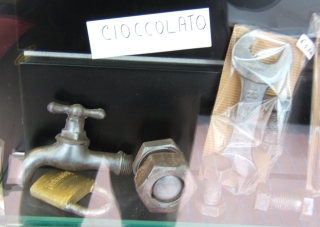
So it was with some satisfaction that I managed to spot and photograph the contents of this Ventimiglia shop which proudly displays a tap, a padlock, nuts, bolts and spanners all made entirely from chocolate. Inside I could have bought a chocolate paintbrush (used) or chosen from a range of other chocolate items - a drill, a hammer, a coffee mill, an ash tray complete with cigarettes (symbolic, this one - eat away your habit), even a sewing machine, all of which sit happily side by side with more conventional confectionery items. I didn't spot the chocolate teapot but I'm sure it must have been in there somewhere.

Our young friend Maartje, who is currently holidaying with us, was attracted to the shop and being a lover of sweet things she made a beeline for a rather tasty spanner which the shop's owner kindly gift-wrapped for her. Maartje's appetite, however, proved stronger than the wrapping and the spanner was consumed with gusto before we arrived back in Torri.

The chocolate has provided her with enough energy to tackle some of our higher mountain paths accompanied by our son Ben who is also on a visit, and more recently to go walking with our village's only two donkeys. These are working animals who wander at will on tracks and roads around Torri but their owner felt that, it being Winter, they might have been missing their usual human company so he was happy for Maartje and Ben to take them on the track up the valley to Collabassa. One of the donkeys, quite by coincidence, is also named Benjamin.

And whilst on the subject of walking, and for those interested, Kate's knee seems to be healing well and she is walking a little further (and higher) every day. She is still not quite up to the rougher paths so caution is still needed but our 61 steep steps up the apartment door are causing her less problems every day.

We came across another piece of bizarre-dom in San Remo, just along the coast from us and a substantial modern city within which lies the medieval 'città vecchia' or old quarter. Once fortified against marauding Saracens from the African continent, the place is a maze of alleys and steps dating back to the 11th century with a nearby tower that was also once part of the city's defences.

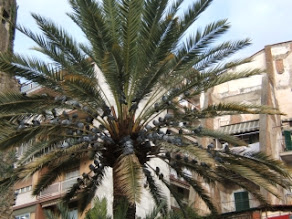
Growing beside the tower is a substantial palm tree which has become the home of the city's entire pigeon population, their small bodies lined up side by side and weighing down the branches until they droop. Why these birds should have chosen this tree, amongst all the others, is a mystery and just why the sight of this struck me as strange I cannot say - maybe it has something to do with the juxtaposition of the exotic and the banal placed centre stage in a city so proud of its heritage.

I do need to conclude by saying that the bright sunshine evident in these photos should not lead to the conclusion that we are experiencing Mediterranean-like warmth here in northern Italy. The cold spell that is drowning Britain seems to be Europe-wide and the population of Torri is also experiencing an unnatural chill; the cold air just seems to drop to the valley bottom as soon as the sun disappears behind our surrounding mountain tops.

Thursday, December 31, 2009

Lupi New Year

The Italian village of Torri is divided into three areas, corresponding roughly to the interconnected blocks of dwellings that lie each side of the bridge. Our apartment is in one of these, known as Lupi.

The unprepossessing concrete bridge, a replacement for an ancient stone one that the retreating German army destroyed at the end of the last war, is in some ways the centrepiece of the village, a focal point when we look out of the window. The bridge spans the river Bevera that rises miles away in the French Maritime Alps and dives down the steep valley past the villages of Olivetta and Collabassa. Here it passes under an ancient stone bridge, wide enough only for a handcart, but for most of its course, the river is contained at the bottom of a steep sided valley where it has cut its way down to the bare white limestone rock. The valley is so steep that the only way to cultivate the land is to build terraces and stone retaining walls, these being scattered all about the hillsides. For most of the year the river drifts lazily through a dry landscape, pausing in clear rock pools then wandering its way downstream. But there is evidence here of a different sort of river which also passes this way because each side of the river there is an exposed band of white rock, swept clean of vegetation, loose rock and soil. Nothing stops here long enough to put down roots because this is the river's own expansion zone; this is the flood line.

Throughout the time we have been staying in Torri the river has languished in the bottom of its bed showing not the slightest inclination to rise up and show us what it can do. Then, just a few days before Christmas all this changed. The same cold breath being felt in the UK was expanding right across Europe and in a somewhat milder form, even down here close to the Mediterranean. Our temperatures dropped below freezing for several days, snow fell on the mountain tops and in Torri the usual group of river-watchers gave up leaning on the wall and retreated to their homes.

Then there was a sudden change. In the space of 12 hours the northerly wind first dropped calm then re-started from the south. This wind, originating in Morocco on the African continent. brought a warm rain to the Ligurian Alps, melting the ground and any snow lying on it. When the river started to rise, the rain still fell and in Torri's narrow valley the water had nowhere to go, nowhere to expand to. Suddenly the trickle became a flood and the flood became a torrent.

On Christmas Eve the afternoon dragged on as the rain continued to fall. Every building dripped water, every tributary stream boiled and hissed. The River Bevera changed to a pale brown as the level rose. In the space of less than half an hour mid way through the evening the level rose 12 inches to cover a lower bridge support and it then begin to lap across the car parking area which normally lies more than 6 feet above the river.

Anxious car owners had already moved their cars up and away from danger and they watched from above as the flood inched its way over the gravel surface until the whole area was covered.

It pounded and roared all through the evening but some time in the early hours the rain stopped falling so by morning the river level was already falling. Down it went, just as fast as it rose, and finally three days later the water under our bridge has become clear so we can see the fish swimming about again. How they survived the torrent is a mystery they keep to themselves.

All that remains now is for us to organise a trip to the beach at Ventimiglia where the wood swept downstream in the floods has washed up, so we can stock up our log stack in the cellar.
Happy New Year everyone!