Friday, January 27, 2012

Wildlife and landscapes

The other morning I arose early to try to bag a nice sunrise photograph. What I had in mind was to catch the sun just as it rose above the Isle of Arran, which lies to the east of us. To start the project I put on generous layers of warm clothing then left the house in the cold half-light of the morning. Passing the village bakery at this time the nostrils are assaulted with one of the most enticing smells known to man, fresh bread straight from the oven, but I walked on by and turned up the lane to the golf course, immediately regretting not wearing wellington boots as rainwater squirted up from each step I took across the sodden grass. It was a fine morning but before I could get into a good position overlooking Kilbrannan Sound a dark cloud had raced overhead to spoil the sunrise. The photographic results were hardly worth the effort but in one of the shots I managed to capture Airds Castle, or what little remains of it, in the foreground. [Sadly this picture has since been lost so you will just have to take my word for it.]

As I studied this from my viewpoint on the edge of the rain-drenched golf course I tried to imagine the role this place had played in this landscape. A river of ice had once scraped out the 100 metre deep chasm lying before me and as the glacier receded there would have been a terrific ice cliff here at which the waves nibbled away until eventually every drop had floated away. The sea level would then have been higher than today (there is a line of old cliffs all around the area as evidence of this) but over time this changed, the land itself rising higher to form a new shoreline. Then at some point humans began to settle here, one of whom spotted the craggy outcrop overlooking the water and saw it as a defensible position, from what, nobody knows. After the immensely powerful natural forces that had shaped everything around me, man’s impact here seems very small.

Back home again and the list of different creatures entering our back garden continues to rise. Two rabbits come through from the back now to nibble at some of the more succulent grasses, generally keeping pace with any winter growth, although it has to be said they they seem to prefer next door’s slightly longer herbage to our sodden greenery.


Then a pheasant dropped by and stood at the fence, gazing longingly at the longer grass next door but not quite being able to work out how to get there.

Most interesting is this specimen, strangely reminiscent of Kate, who stacked a trailer-load of wood into a neat pile next to our coal bunker. Memories came flooding back of our winter in the mountains of northern Italy two years ago when we survived on donations of olive wood for the fire and filled our glasses with wine in cartons from the local Lidl supermarket. The smell of the freshly split logs now invades us as we step outside but we must wait many months before we can reap the benefit of the heat energy stored here. Unlike the olive wood, these spruce logs are full of sap and need to dry out for many months before we can burn them.


We are delighted to learn that our youngest son Ben, having just returned from a musical trip to New York, is at last achieving some success and recognition in the world of music, such that we are beginning to lose count of the number of bands he now plays with. Over the next few months almost anyone living in Britain will have an opportunity to see and hear one of them, The Albion Band, in concert, as they are on a huge nationwide tour. We’ll be off to Edinburgh in March to see them.

Saturday, January 14, 2012

Mooring soon

After many years in the planning, things are finally taking shape for visitor moorings to be laid outside Carradale Harbour, making it a place where yachties like us can moor up for the night during the sailing season.


My involvement in this has been to use Cirrus’ chartplotter to generate some latitude and longitude positions so that the required permissions can be obtained. In this photo, imagine a line of yachts just right of centre, quite close to the shore, lying between 55° 35.627’N, 5° 27.904’W and 55° 35.664’N, 5° 27.963’W and you get the picture. Having visitor moorings in place will put the village on a par with many other small communities in the Clyde and indeed all over the Western Isles. It is because there are so many places to stop that makes this area so attractive to sailors and word will soon get around that Carradale has moorings, sheltered from the westerly winds, close to the shore so that yachties can pop ashore for a drink or a meal. We can expect a steady stream of yellow-welly-clad visitors to Carradale this summer.

Given some dry weather Cirrus’ lower parts will soon start to get some attention. I have promised her that the many layers of antifouling paint will be scraped off this winter and made a brief start at this job last week. But then decorating inside the house once again took over our lives after Kate disappeared upstairs and began stripping the sad-looking wood-chip paper from the bedroom ceiling, not a job for the faint-hearted. In the end I noticed what she had achieved and had no choice but to join in and apply some layers of fresh paint but then when my back was turned again she had started stripping the walls too. So we decided finally that a complete room makeover was the only option left and each evening now we admire the paint splatters in each other’s hair and are reminded of our house makeover in Yeovil last winter.

On a day off we drag ourselves to the top of Deer Hill, our favourite jaunt from the house, to admire the winter views and smell the winter smells. It is a rare day of almost calm. The sea is smooth with tinted ripples dappling its surface although the air is cool, threatening frost.


Thursday, January 5, 2012

Hogmanay

A sparrowhawk appears suddenly in our back garden, a sneak attack around our bird feeders which are coveted by its prey, plump chaffinches, blue/great/coal tits and tasty looking blackbirds. The hawk’s strategy is to fly low and fast over the rooftop or around the side of the house so that its approach is hidden… until the very last moment.

Perhaps the washing lines strung across the garden from three poles are hunting obstacles, but given this bird’s manoeuvrability in flight they are clearly not a deterrent. Seeing such an animal in our tiny garden and so close to the house, seems amazing and we can hardly contain our excitement. I am standing by the rear window talking on the phone, puzzling the caller with my yelp of delight then my silence as I battle with competing demands – should I try to get a photo or summon Kate so she too can see – then the hawk is gone, away to try his luck elsewhere. Several days later I am again on the phone when I witness a successful attack and the hawk flies off with a dunnock taken from the ground beneath our kitchen window.

Just before Christmas we took a wild walk through forest tracks to the north of Carradale, past Christmas trees decorated with long streamers of dead grass blown there by the wind, when a golden eagle swooped low over our heads, its white markings above and below the broad wings identifying it as a juvenile, something we would never have guessed from its size alone. We both stood awestruck as it disappeared behind some trees, our heads rotating wildly in case it should reappear, but our presence no doubt alerted any nearby prey and the first glimpse was all we got.

The new year has arrived and another visitor, less welcome than the flying raptors, has come to our notice. Late in the evening we hear scuffling noises in the ‘coombe’, a word used here to describe the space inside the house but outside our bedroom walls where the roof slope overhangs the ground floor. This requires investigation so in the morning I don protective boiler suit and dust mask then crawl along the rafters to the spot where we think the noise emanates. There is nothing to see, of course, other than some shredded carpet underlay (our mistake in storing it there) and a few small parcels that DNA analysis might identify as animal droppings. Even without this slim evidence it seems very likely that a wee beastie would want to seek the warmth of our home for shelter and since it would be impossible to make the house completely secure from all species of small mammal, we cease to worry and get on with our lives.

We soon learn that the first days of a new year are an important time here in Scotland. This is a time for visiting friends and neighbours and not a time when we can expect to be alone for long. Suddenly our lives have evolved into a social whirl as invitations pour in and our house in turn fills with visitors.


We first met David, Liz and their charming daughter, Sophia, when Cirrus Cat was berthed in Cornwall in 2010 so we were delighted to have them arrive unexpectedly for a visit. Sophia has now grown from a delightful baby into an energetic and indefatigable three-year old to whom every experience is new and exciting. Bedtime stories read by friendly older people, sleeping in a strange bed for one night then waking up in morning semi-darkness in a house where the lights won’t turn on and a kettle of water is being heated on the coal stove because the storm outside has brought another power cut, all this may be a far cry from her normal everyday existence but she is endlessly adaptable and seems to take it in her stride.

The early morning is particularly wild, wind gusts shrieking around the house, rain blasting against the windows and the electricity failed just as I had finished in the (electric) shower, rather conveniently so I thought. We apologise to our guests for the absence of promised hot showers as our stove is now the only source of heat, its flat top only enabling Kate to cook porridge for breakfast and to boil water for hot drinks. By the time our guests leave us there is still no power and unlike the brief 4-hour power failure in last week’s storm, this one lasts all day and through the following night. In the morning we still have no electricity but we know that many of our neighbours in the village will be worse off than us as they rely totally on it for heating and cooking. Reduced to a more primitive lifestyle than we usually enjoy we begin to consider what lies before us. The telephone is silent, mobile phone signals are absent and we find ourselves more out of touch with the world than if we were sailing offshore on Cirrus. There is no television nor radio, no hot water other than what we can heat by the kettleful and as darkness descends on Carradale for a second night, no streetlights illuminate the world outside. Although the storm has abated, every so often there is a squall which brings wind and a shower of rain or hail but in between these the sky is clear and there are stars and a sliver of moon in the sky, our only source of light. It is the inability to communicate that means most to us and our thoughts become ever more fanciful. What if civilisation has collapsed and world order broken down? How would we know? Here we are isolated from the world without any way of finding out what is happening ‘out there’. Whilst we may be able to keep ourselves warm, for the moment, our food supply is limited, more limited still once the freezer thaws out and food stored in it goes bad. Our survival might soon depend upon our ability to hunt and kill animals or to gather shellfish from the shore. Although there is nothing remotely edible visible from our windows, we know there are deer in the forest. But how does one bring down a deer with only a hand axe and a screwdriver as weapons?

The next morning it is stormy and wet again so, still without electricity, we go foraging for food, in the car, to the shops in Campbeltown. The blackout in Carradale is localised, it seems. In Campbeltown there is electricity, lights, warmth in the shops and smiling faces. Civilisation as we know it still exists; world order is intact.

Saturday, December 17, 2011

Weather windows

As they tend to, the latest storm has moved on elsewhere for the moment and as I write, the air has calmed down just a little back in Scotland.


We know this because even whilst away the Internet gives us access to the Campbeltown webcam which has survived the big storm to give us this lovely shot of the Christmas lights coming on behind the harbour. Unlike a few days ago when the surface of Campbeltown Loch was being picked up and thrown about by the wind, rain spotting the camera lens, now twinkling lights are being reflected off the water and the boats are looking snug and safe.

Meanwhile, in Worthing we gaze at the sunset from the window of our Tony’s flat, not a million miles from Kintyre but a rather different skyline to the one we are used to, the one which often has eagles glaring at us from the skies above who I often imagine to be drooling at the sight of prey they see far beneath them.


Worthing has a large population of very large gulls which soar overhead then swoop down on chip-wrapper leavings before settling on the rooftops at night. There is also a large elderly population here, not that dissimilar from Carradale really, but here they must be generally less mobile as so many of them are rampaging around the streets in their electric wheelchairs, bouncing up and down the kerbs and risking life and limb crossing busy streets. There are so many of these contrivances that a booming sale and repair market has spring up, bringing new life to the business community. I can’t make out whether it is just my imagination but it seems that a rider’s grim face always appears along with the whining sound of a mobility scooter. Perhaps one should not underestimate the degree of coordination required to pilot one of these chariots, steered as they are via the smallest of joysticks and for an elderly person not brought up on the wonders of Playstation or the Xbox, guiding this machine around pedestrianized streets must represent a significant challenge. So the serious face may be nothing more than concentration, with a touch of blind panic thrown in. I do wonder, however, whether the faces might also be reflecting our disapproval, as if we, the able-bodied, make the rider feel they are doing something antisocial, as if we are saying “You are a menace to us all on that thing!” or “Surely you’re fit enough to be walking!” Perhaps it is just that society hasn’t quite made the adjustment to accept this relatively new form of transport as a part of our lives. Perhaps the first person to ride on a horse also had a grim set to their features that were misinterpreted by those around them.

From Tony’s place we move on to Ticehurst to visit my mother, herself of a venerable age but as yet not having succumbed to the mobility scooter. She has always been a good walker, striding along towing others in her wake, and few people in her own age group have ever been able to keep up with her. Approaching ninety now she complains at her failing faculties but she still wants to get out and about in the countryside whenever she can. It frustrates her that she cannot do this as often as she likes and wintry weather in particular cramps her style. She has made the right choice in living in the most benign corner of the country, weather-wise, a place where rainfall generally comes in fitful sprinkles or sometimes not at all and wind barely ruffles the hair.

Or so we thought…

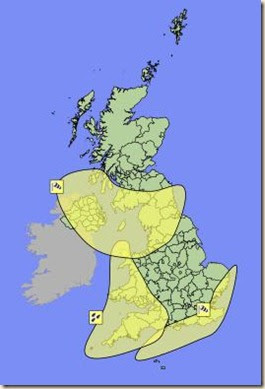
Yet another of those bizarre Met Office overlaid maps with their threatening amoeba-like blobs of colour tells the story of wind and rain for the next few days. It seems we just cannot escape, no matter where we go. We now need to time our journey home so as to slide between the yellow growths as they shuffle across the country, not an easy thing to achieve. Somewhere in the past, before the advent of amoeba-covered charts, we would have set off blindly and got home safely without the stress that comes from worrying about where the predicted rainstorm is going to strike or when the forecast wind will carry us away. Are we really better off today with the help of all this information?

In the end our journey home proved far more acceptable than the forecast led us to expect. Some rain showers did find us and there was some wind but somehow we managed to avoid anything really nasty. Back here in Scotland the landscape has changed in our absence but our house has survived whatever has been thrown at it whilst we were away. Only the windows bear testament to the storm, spattered as they are with a salty residue, a little bit of Atlantic Ocean transported across Kintyre, no doubt.

We have barely recovered from our journey but can’t wait to get out and about so we can see what effect the onset of winter has had. There are white tops on all the summits now and with ice on the path up Deer Hill, some care is needed.


Whilst tradition dictates that we bring a tree inside the house at this time of year, it wasn’t difficult to find a suitable one outside for this picture… and the halo on top came free. So we wish all our readers a very Merry Christmas and best wishes for 2012.


And regards from Ailsa too.

Friday, December 9, 2011

Storm warnings

Once again we are putting ourselves through the torment of a seemingly endless car journey the length of Britain, our legs going stiff from sitting in the car for so long, our eyes straining to see through the spray picked up from the motorway surface and atomised in front of us, our arms aching from hanging onto the steering wheel shuffling it from side to side.


Can there be anyone left in this country who derives any pleasure from driving long distances on our roads… apart from Jeremy Clarkson, that is?

The day before we set off the ‘Rest-and-be-Thankful’ pass on the A83 between Inverary and Tarbet was blocked by a landslip, as it frequently is in winter, this time the steep slope beside the road being made unstable by the vast quantities of rain we have been experiencing of late. Minutes before we arrived there the road was again pelted by hail but despite this we did get through safely and by the time we were on the motorway heading south on the outskirts of Glasgow we thought we were through the worst. Then one of the black-edged clouds hovering up in the sky, stuffed to bursting with snow, caught us by surprise, determined as it was to empty its load on the M74 before we could get away. The sky darkens, an icy wind whips up and our wheels are soon making dark tracks through a white blanket covering the road surface. We can tell though that this is more sleet than proper snow as the flakes are splattering wetly on our windscreen (proper snowflakes are lighter so they don’t actually touch the windscreen, they are buffeted away on the wedge of compressed air which rides just ahead, skimming over the roof of the car) but still the lower portion of each car and lorry disappears into spray and our wipers sweep great blobs of sticky white stuff aside. We push on into the maelstrom for fifteen minutes or so until we see light in the sky ahead and we know we have survived the worst the cloud can do. The air warms a little now and we emerge into a dryer world, one just beyond the reach of the cloudburst.

But we still have many miles to travel, we are just starting out, and there are plenty of other clouds up there with our names etched on them so we plod on hour after hour, stopping now and again for coffee, switching places in the car, then back on the road again.

We stop for one night in Coventry then journey onwards to Worthing in Sussex the next day. It is here that our mission takes place, helping to install Tony, our eldest, into a new apartment. Our little yellow car is being used to transport more than just us. Somehow we have managed to squeeze a table and four chairs in through the rear door together with inflatable mattresses and sleeping bags for us to use until we are able to fit out the apartment properly. On arrival there is much to be done to ensure Tony can live there worry-free. We get to meet his neighbours, learn to navigate ourselves to the nearest shops, install his personal effects then take a break to visit son Mike in Yeovil, part of a round tour of our scattered family.

Out of interest, when we are away we like to check on what the weather is doing back home on Kintyre, just to see what we are missing out on. When the south coast of England does receive severe weather the locals make a big fuss over it, going on about how unusual it is, how many years since this temperature or that rainfall. For those of us living on the west coast of Scotland, severe weather is more the norm and what we class as exceptional is more extreme than most people have the stomach for. Kate and I reserve the term ‘exciting’ for these events and when we check with the Met Office we see immediately that just such an exciting event is winding itself up over our area of Scotland. Their colour-coded severe weather warnings overlaid on the map of Britain tell us that the central belt of Scotland, which stretches from Campbeltown to Edinburgh, is being blasted by a storm of truly magnificent proportions. Since moving to Carradale we have already experienced several of these storms and we have great confidence in our ‘wee hoosy’ in its ability to stand up to storms of this severity. Being so far away when this one hits means that things are completely outside our control anyway but nevertheless it still leaves us with a feeling of disquiet. There will almost certainly be a path of destruction carved across Scotland in fallen trees and damaged roofs and this time all we can do is take comfort in the thought that if we were at home then there would be little we’d be able to do either, apart from lose sleep listening to the wind howling past outside.

Sunday, November 20, 2011

Rhonadale ramble

It takes no more than a dry day with maybe the promise of some sunshine to get us pulling on the walking shoes, making up some sandwiches and planning some sort of a walk.


We must remember though that it is winter now and the shorter days mean we need to take things more seriously – spare clothing, a torch, hats and gloves travel with us now.

Rhonadale had in fact been winking at us for some time; we were just waiting for the right weather. Sufficiently close to seem easy, sufficiently far away to be a challenge, this roundabout tour of the Carradale glen would take us on a hillside traverse broadly following the border between the forest and the lush farmland that has brought people to this place for so many centuries. But first, a small lesson in terminology. We live in Carradale, one of a number of ‘dales’ in this area of Scotland, a place where one might expect the word ‘glen’ to be more normally used. We have the Norsemen who once lived here to thank for this since the King of Norway once ruled the Scottish Western Isles and left more than his DNA to the generations that followed. Locals today tend to ignore the tautology and refer to the broad green valley through which the twisting tongue of Carradale Water flows as ‘Carradale Glen’, as if the Norsemen had never set foot here at all, but we who walk here for the first time try to visualise the place as it might have once been, wild and largely untamed.

The Forestry roads allow us to complete a circuit of the valley without excessive height gain or loss but at the cost of some considerable mileage as these roads follow every contour of the land. Much of the timber here shows the results of recent gales which have battered the area, fallen timber lying untouched and showing clearly the direction the wind followed. Above the treetops though, the cleared land is providing a habitat for the Peregrine Falcon, several of which we could see soaring above us, scanning the land for small birds which are their main prey. We are fascinated to watch their tail feathers which in soaring flight are held tight together then they are suddenly fanned out to act as a brake when they need to slow down or change direction. This is the speed-freak of the animal kingdom whose 200 mph dives give their prey little chance.

By contrast another raptor, the buzzard, has a hunting strategy which is quite sedate, even lazy. I photographed this one squatting on a bare tree at the back of our house, just sitting there waiting for lunch to amble beneath him.

After some miles our forest road comes to an end without warning leaving us no option but to trek across recently felled woodland, a difficult and dangerous undertaking, to reach the farm below us from where we can cross Carradale Water over one of its few bridges. ‘Off-piste’ walking is not easy anywhere around where we live and progress slows as we stumble through the mesh of fallen branches and stumps, slipping and sliding, until finally we are alongside the barbed-wire fence which protects the forest from incursion by sheep. Clambering over (there is no other option) we are now on rough moorland and can descend rather more easily to Brackley Farm in the valley bottom. It slowly dawns on us though that we have only now arrived at our furthest point from home and our legs are already complaining, quiet murmurings of discontent which become louder with each step.

The sun at last emerges from cloud cover but lies low above the hills, casting long shadows though still warming our faces as we march homeward. We realise, as we contemplate the distance we still have to go, that with this walk we might have bitten off a little more than we realised, more than we were prepared for. Our legs shout more and more loudly with each step. Aches and pains brought on initially by the netball and badminton we have recently each begun playing in the Village Hall reappear now and resolve themselves into thigh-stabbing twinges as we progress homewards.

Perhaps it was too much to expect that we would simply be able to pick up the sport where we left off so many years ago and not suffer the consequences.

But all the aches are forgotten when Kate spots these gorgeous specimens on the roadside verge, a tiny white cap, barely half an inch (two centimetres) tall, peeping through a bed of moss.


Then another fungus, blue and spiky edged, almost hidden amongst the leaf debris and grass and growing out of something decaying beneath.

Somehow we find the energy to open our front door and run a hot bath to drop our legs into to ease the aches and pains. Not for the first time we reflect on the pleasure we get from pushing our bodies around the mountains of our land. Many years ago when I used to come north to Scotland with friends to romp over the mountains around Glencoe we used to have a saying, ‘Pain is pleasure’, a strange way of expressing the joy we all felt after a good day on the hills.

Saturday, November 5, 2011

Remember, remember...

On the 13th April 1570 a couple living in York, England, gave birth to a son who in later life was to attempt to alter forever the course of history of his country, a man who in failing to do just that ultimately achieved immortality, for his name if not for himself. Sadly, perhaps, he was to die a few months before his thirty-sixth birthday without ever knowing that sometime in the future his name would come so readily to the lips of every English man and woman and that his deeds would be celebrated each year with a festival of fire, fireworks and fun. I refer, of course, to Guy Fawkes, or Guido as he liked to be known, a man who became famous for failing, in 1605, to set off a charge of gunpowder beneath the Palace of Westminster in London.

Guy Fawkes may have been unknown until the moment of his downfall but what is clear from recent events is that he is making a comeback today in the shape of masks being worn in cities all over the world by protesters in need of anonymity. His stylized face has become an international symbol for rebellion and were it not for the manner in which his body was disposed of (quartered and distributed to the four corners of the kingdom) one might be fearful of him turning in his grave at the thought of the royalties he is missing out on.

Having both been brought up with ‘Guy Fawkes Night’ as a part of our lives, Kate and I arrive at the first November of our life in Scotland with little understanding of the significance of this event to the people who now live around us and to others like them who live in the more northern parts of the kingdom. One has to delve into history a little to understand and appreciate that it was only two years before the gunpowder plot, in 1603, that King James VI of Scotland acceded to the English throne thus also becoming King James I of England, immediately announcing his intention to unite the two realms and give birth to the concept of Great Britain as we know it today. Guy Fawkes, as well as being a fanatical Catholic, had no love for the Scots and it was his and his fellow conspirators’ intention to assassinate the king (together with most of his government) and place the king’s daughter, Princess Elizabeth, on the throne instead. Fawkes’ capture, trial and execution are now amongst the most well documented of historical events and almost from the moment of his death Londoners were being encouraged by Act of Parliament to celebrate the king’s close escape by lighting bonfires, a custom that continues to this day even if the cause being celebrated is lost in time.

The union of England and Scotland might have been in the mind of King James but at the time it was far from popular elsewhere in either country so despite his intentions it was not until 1st May 1707, in the reign of Queen Anne, that full union between the two countries finally came into being. All this is water under the bridge now, of course, but with an understanding of the historical perspective it is far easier to understand why the story surrounding Guy Fawkes is less likely to be celebrated here in Scotland. At the time of the plot the two countries may have been separate ‘states’ but most who lived in Scotland would have regarded the goings on of an absent and far from popular monarch down south in London as largely irrelevant.

All this having been said the village of Carradale is not slow to seize an opportunity to light a celebratory bonfire or to set off a few fireworks. We don’t need the excuse of a close escape from assassination for this, merely a group of schoolchildren with home-made lanterns keen to venture out in the dark in the safe company of the rest of the village.

The stars had been blazing away in the clear sky for some hours by the time the participants were all gathered at the primary school, lanterns were lit and held aloft, then the skirl of the pipes announced the start of the procession across the village to the playing field where things were starting to get underway. An enormous pile of wooden pallets, kindly donated by Jewsons, was soon alight and we were queuing for hot soup just as the pipes started again, this time to coincide with a spectacular firework display, funded courtesy of the Kintyre Windfarm Trust. There may have been some English people present who looked expectantly for the effigy atop the bonfire but somehow this was not necessary for the occasion and the absence of Guy Fawkes took away nothing at all from the event. Maybe we were just celebrating the beginning of the winter season – who cares anyway.

Despite the cold of the night we felt bathed in warmth from the company of villagers like us who have chosen to make this place their home. When we finally steered ourselves the short distance back home, half a moon was staring at us from above, lighting our way like a searchlight though hiding the galaxy of stars behind it. The air was still and it was quiet once more, the wildlife going back to sleep again, glad it was all over for another year.

Saturday, October 29, 2011

Windows too

Our lives in Carradale have been brightened by changes to our house, alterations we never expected to have done so quickly. This is largely due to us being used to a world where engaging tradesmen is a slow process, where even getting someone to come round and estimate can be tiresome and from there onwards you are forever waiting for the call that tells you they are about to start. In our part of Scotland we are discovering that things happen rather differently.


Without fail, all our tradesmen have been enthusiastic workers who turn up on time then just get on with the job, barely even stopping for a cup of tea. Sometimes the only indication that they have arrived has been the thump of their ladder on the roof while we are still struggling to wake up. It seems the only impediment to their work is the weather but this has to be pretty grim by most people’s standards before they stop working and take shelter.

Windows now fitted into our sloping roof at the back of the house transform the landing at the top of our stairs and the new window in our ‘Tiny Room’, our spare bedroom or workroom, creates a bright room where before there was darkness as well as giving us a fresh view out from the back of the house. Alex, Willie and Jim all worked impressively hard in atrocious conditions, a cold wind blasting in from the west bringing with it showers liberally sprinkled with hailstones - and this was the better of the two days! It has to be admitted that before everything could be made watertight there was some slight ingress of water but this is not a big issue – we sailors are used to this. The new room is Kate’s room, a place where she is safe in the knowledge that she can spread out her ‘personal things’ there without fear of interference from any of my ‘man-related’ things. My collection of these, drill, angle-grinder, bits of pipe, etc., are currently migrating towards the garden shed.

Just for the moment though we have to park our re-organisational skills as we are prompted by our diary to embark on a long journey south in our own car, its first venture outside Scotland and indeed its very first contact with a motorway.

Although Kate and I share the driving, a distance like this is something of a challenge for our small car. However we decide that using it will enable us to make visits to our scattered family without having to put too much thought into the planning so ‘Daffy’ is duly loaded up and off we go.

After an overnight stop in Leicester we are soon deep in the Hampshire countryside looking for a yurt [a portable, bent wood-framed dwelling structure] in which we spend three nights celebrating the birthday and retirement of our friend Gerry. Our yurt was called ‘Beechy’ and was one of six similar ones nestling in the Meon Valley that twenty-four of us honoured friends occupied for the weekend. This was a new experience for all of us but we were pleasantly surprised by the cosy interior and once the wood-burning stove was alight it was amazingly warm. The whole weekend was superbly organised by Gerry’s husband Rich in his own inimitable style, convivially relaxing, a great time spent in the company of many new friends, a few old ones and a dog called Sam.

Everyone, except Sam, contributed to the catering arrangements which meant that we fed and watered ourselves well, perhaps a little too well, and the weather was kind to us too, a blast of warm continental air arriving just as we did and not a drop of rain falling on us.

The same could not be said of our return journey to Scotland, however, during which at times we found ourselves navigating almost blind along heavily trafficked roads hidden under dense clouds of spray. The previous day whilst stuck for hours in almost stationary traffic on the M25 it struck me that motorways share many of the characteristics of a prison; from the moment you turn onto the approach slip road you are completely trapped, unable to leave until the next exit comes along, until you have done your time. Any free will you think you might have is completely subrogated for the duration of your sentence. The only tolerated behaviour is driving in one direction at a similar speed to everyone else, stopping is not allowed, no matter what happens, and if like me and thousands of others you have been given a long sentence then you just have to serve your time, sitting behind the steering wheel shuffling forwards an inch at a time wishing you were somewhere else. Under these conditions it is small wonder that our baser urges emerge for none of us have committed any crime to put us in this place. Yet bizarrely we voluntarily incarcerate ourselves time and again without a second thought. The motorway experience has become an accepted feature of modern life, to be suffered in silence without complaint.

Our release from this prison finally comes as we cross the Erskine Bridge just west of Glasgow and turn along the shores of Loch Lomond. Suddenly we are surrounded by hills all tinted shades of brown and gold, until the rain starts again and the landscape disappears into the haze and is lost to us. 1,460 miles of driving since we left home and there is little that beats switching off the ignition outside our own front door.