Tuesday, September 28, 2010

Achievements

Two completely different and unrelated events dominate our lives at this juncture. One concerns our son Ben, whose band’s first single “Little Love” has just been released and is available to buy on the Internet. After talking to him, any understanding we thought we had of the world of the modern music industry has been revealed as hopelessly inadequate. But this does not prevent us from appreciating the effort and skill that has gone into the performing and actually we love the music; it is played here over and over again. Success or failure of the enterprise that Bang Bang Romeo represents now rests upon the readers of this blog buying the music, or so I am led to believe. Just follow this link – SPOTIFY

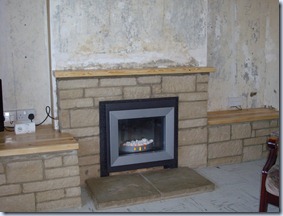
The second event is a little closer to home. It concerns our living room and the stone monstrosity that we have made into something we like and can admire. At one point only a few weeks ago we came close to demolishing the whole structure, in fact the only thing that stopped us was the risk that in doing so we might create far more work for ourselves than by leaving it in place.

Investigation soon revealed that the massively built structure was only loosely attached to the wall behind; the reality is that it was little more than a folly. So began the job of changing this into something a little more functional which would not fall on top of and maim our first visitors. This has involved taking a risk and following a vision locked somewhere inside our heads, for better or worse, and now that it is complete, even alongside the bare walls in the rest of the room (which we cannot decorate until our builders have finished remodelling the rest of the room) we feel we have created something better than before. We are quite proud of our handiwork and also in some way surprised that we should feel this way. Perhaps this is because making things was not a part of either of our working careers so we are discovering for ourselves the sense of achievement that working with our hands can bring.

Outside the house autumn is beginning to show off in the Somerset countryside and there is much to admire just a short walk away. Not only do we live conveniently close to what we need for our DIY – we have no less than four plumbing suppliers within a quarter mile radius and our corner of Yeovil also happens to be the Mecca for screws – but a short stroll from the front door takes us into another world, a valley where the river Yeo trickles softly by and nature is busy producing its bounty – berries in all shades. Alongside this the landscape is gradually tinting from green to the reds and browns of autumn and a leaf carpet is beginning to form. We have discovered a little wonderland on our doorstep, somewhere we plan to visit regularly to watch the seasons develop.

Wednesday, September 22, 2010

Salcombe

Finally we could resist it no more. The strings attaching us to what has been our floating home for so long have eventually and inevitably pulled us back on board Cirrus Cat for a short, late-season break. A quick study of the five-day forecast tells us that there is nothing in the way of equinoctial gales in prospect so we gather the necessities, some food and a few clothes, then charge off west to Plymouth. Our son Mike is with us, which surprisingly is all it takes to tilt the economics of public transport away from trains and buses towards a hired car, still a form of public transport, but one usually thought of as expensive by comparison. Not so, it seems and certainly when you take into account the inconvenience of changing trains, missing buses and walking for more than thirty minutes up hill and down dale with luggage, the decision is an easy one to make.

We are not strangers to hiring cars and this time the hire company, almost apologetically and for the same price, gives us one larger than ordered and so brand new it still has that lingering smell of molten wax that is unique to all new vehicles. My only complaint was the colour, black, a rather obviously negative safety feature.

A fast but rough sail on Cirrus has taken us to Devon’s Salcombe Harbour, a place clearly reaching the end of its busy season for this year. We know this because moorings are available for us to pick up and there is space on the visitor pontoon. In the main street the town’s shops are well, to be brutally honest, rather strange in that they are all remarkably similar, being small and selling high fashion leisure clothing of one sort or another. It is the end of season and we find the word ‘Sale’ pasted here and there across the plate glass although obviously there is a ‘Salcombe’ way of doing these things. There is a shoe shop, for example, where a price reduction means that everything is reduced to a mere £100. We consider ourselves fortunate indeed that we have enough shoes between us so we can pass on by without being tempted.

So here we are lounging about at leisure on board as the sun dips behind the surrounding hills, entertaining ourselves as usual by observing the comings and going of others on boats and bemoaning the misbehaviour of our dinghy’s outboard engine which forces us to row ourselves ashore. We try in vain to persuade the thing to run for more than a few seconds without over-heating and leaving us stranded just out of reach of land or boat. I have cleaned it by poking its inner parts with stiff wire, replaced its little rubber impellor which is supposed to pump cooling water up from the sea and generally molly-coddled it by polishing various parts, all to no avail. We watch enviously as everybody else’s outboard engine chugs smoothly past. We end up contemplating ways and means by which we might casually exchange our non-working outboard engine for an identical but fully-functioning one we have just seen going past on the back of a small dinghy. Can we resist the temptation secretly to row over in the dead of the night and swap ours for that hanging off the back of this boat?

Maybe because of the influence upon our consciences of the Papal Visit (Deo Gratias) we are still bereft of motorised dinghy power when we depart Salcombe the next day. 

The light wind is now from a south-easterly direction so once out past the turbulence of Bolt Head we hoist our secret weapon, the multicoloured spinnaker, which brings out the sun and pulls us along for hours across Bigbury Bay towards Plymouth. Suddenly there are German voices on the radio warning all ships to keep clear of an area just three miles to the west of us. Loud booming comes echoing across the sea as warships start firing out to sea. This is not playing, it is live ammunition and only a few miles away from us! Strange, we think, didn’t the war end over fifty years ago? We hear the radio operator on the German warship Hamburg getting excited when a sailing boat (not us) sails too close beneath the guns and a rather alarmed and embarrassed yacht skipper replying over the airwaves for all to hear. All ends well for them while we escape unnoticed into the River Yealm, a beautifully sheltered, wooded chasm that has no less than three pubs at its head. It is a favourite stopping place for yachtsmen all along this coast. We can cope with a little excitement at sea but being this close to significant naval action is not really our thing and we are glad to be out of it. We leave them to their games.

Tying up to a convenient pontoon we suddenly find ourselves surrounded by large catamarans – Cirrus is amongst her big sisters between whose hulls we could almost slip unnoticed. 

The south-west just seems to have more multihull yachts per square inch than another other corner of this country and they are here in the Yealm because it is mid-week and end of season; the river is a little too overcrowded with moorings to attract them normally. This is a busy place but the fast-flowing tidal river is rich with life, much of which hangs onto the pontoon itself just below the waterline. Peer over the side and you’ll see a colourful world which is unnoticed by most of those who stop here overnight.

It seems we have had the best of the weather for our few days away. Our final night is quiet but the day dawns misty with rain floating in the air although just enough wind to enable us to sail our way past all those warships into Plymouth Sound. Hamburg is still there making trouble for small vessels but we ignore it and sneak stealthily back to our mooring.

Tuesday, September 14, 2010

Moving forward in our own way

Well that’s one job finished at least. It seems like forever that I have been labouring away in the smallest room, putting tiles over… well everything, the floor, the walls, even around around the window. And the job is finished at last. In almost exactly one month we have finally done all we can to one room in the house, getting it to the state we want it. All that remains is to fit the toilet, the shiny new beast that currently sits nonchalantly in front of our television, and putting this in its correct place is something our builders will do in a few weeks time.

So it is time to move on to the next job. I pick up my largest hammer and Kate points me at the thing we laughingly call ‘the fireplace’.


This substantial construction was built many years ago largely as a ‘feature’, we think, as the house currently has no usable chimney. It is a part of the house that has clearly undergone several evolutions in its lifetime, the latest of which was put together in the same way that one might a nuclear shelter, great blocks of stone cemented together with real intent although strangely the structure turned out to be barely attached to the wall behind. If weight were an issue, the house would be leaning in towards the end of the room where it all lies. As it is the feature just sits there and tries to look good. In reality, though, it is like a library without books; we have a fireplace without a fire at the centre, just a blank space that looks as though it is waiting for something to arrive. So, looking for inspiration, we have paid a visit to a local fireplace showroom and, with a minimum of modification…

…yes, we think we can fit something in there. The neighbours are less than impressed by the heavy banging (those bricks were built to last) which shakes our foundations and theirs but in the end we have a pile of rubble in plastic sacks which goes to join the old toilet in the garden.

Although we never think of our house as old, this particular job has been a bit like going on an archaeological dig. We find ourselves opening a way through one fireplace only to discover another lurking behind it then inside this, is that the outline of yet earlier fireplace, a piece of pipe leading away into the wall, some dusty wallpaper and even a narrow chimney ascending to the top of the house? We peer fascinated into the hole, brushing away the ancient cobwebs and try to imagine what sort of heating machine might have stood here once before. But we don’t linger as we know that this is the domain of giant arachnids who have been awoken by the modifications we are carrying out to what has been for so long, their house. More than once we have seen spiders as big-as-yer-‘ead lumbering away into dark unreachable corners, eight legs pumping energetically up the wall. The house spider’s body must be able to stretch itself thin, like that of an octopus, so that it can disappear from sight through the thinnest of cracks and then peer out at us, laughing no doubt. There are, of course, many metres of well insulated cavity space for them to live in behind our walls. And we are quite happy for them to stay just there.

Wednesday, September 8, 2010

Somerset follies

Even we, who have spent nearly all the last four weeks tearing apart the very house we live in, eventually decided we needed something of a break, or at least a change of scenery. Holidays, of course, are normally only the privilege of the working population; we retireds no longer qualify. But a morning out on our bikes, exploring Somerset lanes barely wide enough for a car and a bike to pass definitely felt like a holiday after all our time spent around the home.

Whilst browsing on the Internet for maps showing things of interest around Yeovil we had spotted a couple of NCNs nearby, numbers 26 and 30, running just to the south of the town. National Cycle Network routes are the motorways of the cycling world. Just as motorways serve to isolate legitimate from prohibited traffic, so the NCN routes seek, whenever possible, to isolate (or protect) the cyclist from motorised traffic. Sometimes a route has no choice but to follow a road and a common solution is to paint a lane for cyclists on the tarmac itself. Rather safer is where a separate pathway is built alongside or away from the road but from a cyclist’s perspective the very best solution is for an NCN route to follow a country lane which carries no significant motorised traffic at all so that a cyclist can use the whole road in safety. And squeezing their way through the Somerset countryside there are some amazing examples of this rarity, some sunken deeply into the bedrock centuries ago and barely wide enough for a horse and cart. The deep and dank sandstone walls flash past us as we ride along carefree and happy. Most car drivers would not venture here for there is no room for a car to pass another and the stone sides are unforgiving. But there is just room for two bikes to pass.

We are heading towards Barwick Park Hall and a local landmark known as ‘Jack-the-Treacle-Eater’. 


This is a folly, a structure with no purpose other than to please the owner who had it constructed, and one of four built on the estate at each primary compass point back in the 17th century. The statue on top is of the winged messenger, Mercury, and the story goes that the little room beneath it was once the home of the man employed by the lord of the manor, a man whose job it was to run with the mail to London.
So Jack was the postman. And the treacle? Well, this is what he sustained himself with en route, or so the story goes.

Then, as we stare at the arch we realise that we are looking at a familiar shape, one that just a few months ago was all around us. It is the unsupported stone arch, of course. In the Italian village of Torri, and indeed in much of that country, such structures are all around, over doorways, supporting whole ceilings and often tiered one above another in a way that challenges one’s notion of stability. The design, apparently first developed by the Romans, is clearly immensely stable with a key stone right at the centre of the arch locking the whole thing together. Unlike this English folly. in Italy many of the arches are constructed without use of mortar, just stones placed together over a timber former which is then removed to leave the stones hanging suspended on their own.

Back home again and on with the wallpaper stripping.


Ah, but who is this strange fellow hiding beneath the kitchen wallpaper and caught having a quick smoke? All in glorious colour too - well, red and blue crayon. Could there be some connection between this large-nosed man and Deb who was so cruelly libelled in our hallway? Once again we may never know the artist whose work we have revealed and sadly this masterpiece is doomed - the wall upon which he is drawn is soon due to be demolished. Currently it separates our kitchen and living room, an area we want to make into one. We have builders with big sledge hammers lined up and plans prepared by a structural engineer who has specified the strength of the beam needed to support the ceiling and wall above. Any day now they will begin work and this single change will transform our house giving us a large downstairs living space. The house is oriented east-west so that morning sun pours in through the rear windows while at the front we get the best sunsets Somerset can offer. We can’t wait for the day when the dust has settled and the sun can shine right through at last, from dawn till dusk.


Tuesday, August 31, 2010

DoItYourself

If this blog seems to be getting more and more like an episode of ‘Grand Designs’ then I make no apologies for this as it is merely reflecting, as ever, occurrences in the daily lives of Kate and myself. Since we began this ‘house renovation’ phase of our retirement, each day we are driving ourselves to carry out at least one job which moves the project on. 


So whereas in January this year we were taking pictures of stunning scenery in the foothills of the Maritime Alps in Italy, and by June it was the dazzling beauty of Holy Island in the Clyde, in September of the same year we treat you to a collage of some very private parts of our house – joists and roof beams. In fact there is a good reason for taking such strange pictures. They are to avoid the need for a visit from a structural engineer (and his £50 charge) who will pronounce on the merits of removing a ground floor supporting wall which currently divides the living and kitchen rooms and tell our builders what size supporting beam to put in. The picture may also give the impression of the way we are tearing apart the environment we are living in.


Take the smallest room in the house, for example, where once a toilet stood proudly beneath the window. Neither pedestal nor cistern operated properly so during our remove-anything-we-don’t-like phase a large hammer and a crowbar took care of the whole assembly in short measure. The remains now reside in our back garden awaiting some sort of transport to the local tip (there are some things that are just beyond the capacity of a folding bicycle). So having destroyed, we can move on to the construction phase and in no time at all I find myself tiling again. The experience gained in France last winter, when we tiled the vast floor area of the salle de séjour, cuisine, WC and couloir in Guy and Noëlle’s Lyon house is coming in useful here although sadly I am having to manage without Noëlle’s fine French cooking and Guy’s extensive wine cellar. But I’m coping.


Despite all the destruction, we are gradually making the house habitable, this being mostly down to Kate who goes around cleaning up the mess I keep making. She also single-handedly took on the task of covering up the existing colour scheme used in one bedroom, the stuff of nightmares. No less than three coats of paint were applied before it disappeared from sight. As a result of all our hard work we feel fairly confident as we welcome our first guests, Kate’s brother Peter and his wife Liz, that we can offer them a limited degree of comfort and cleanliness. (Please note, by the way, that we have a second and fully functioning toilet.) They may not read this until after their visit so I can reveal here that they will sleep on the £2.50 shed-bed (see last entry) and will eat at the recently delivered charity shop dining table.
Friday, August 27, 2010

Re-Cluttering

By the time we started our retirement in 2009 we had slimmed down our lives and reduced our belongings to an absolute minimum so that we could move onto our boat unencumbered, or at least as close to this state as we could manage. The apartment in London from which we moved had a fitted kitchen, built in wardrobes and cupboards so contained little furniture that was actually movable. Knowing that anything we did retain beyond what we could take with us on Cirrus we would have to be stored, at some expense, we rapidly abandoned our sofa (it was well past its best) and as many other large things as we could. The thought of paying week after week for an expensive hole in a warehouse somewhere is a pretty good motivator for this sort of thing and we felt pretty good about it at the time - de-cluttering is supposed to be a therapeutic experience - never thinking that one day, some time in the future, we would move into a comfortable house, a new space, and have nothing to fill it.

Well now we are house dwellers again, and as a result we find ourselves going through the reverse process, re-equipping our lives with domestic hardware, but this time doing it without the benefit of earned income. 

Fortunately we are the sort of people who favour economy over the latest fashionable style and for whom the pleasure in getting a good bargain never really wears off. In just a few short weeks we have acquired a three-piece suite, a dining suite and a double bed, all for less than a good pair of shoes. Until today the bed was our best bargain; we only had to buy £2.50 worth of bolts to assemble the wooden pieces we found in the garden shed. Then whilst returning from the shops Kate's eye was caught by a swiveling chair sitting on the pavement, a piece of paper stuck to the back flapping wildly in the breeze. 'FREE TO A GOOD HOME' it said and we thought aha, we have one of those. So now we have our least expensive furniture item so far. To better this we now need to find something we need and have someone pay us to take it.

One particular item we parted company with some years ago was the television set. This was partly because the last set we did own and use was rather ancient, so no great financial loss was incurred when we parted company with it, partly because we came to recognise that our viewing habits were embarrassingly unintellectual and partly because we felt that none of the content offered on any station we could receive really justified the cost of a licence. But then of course we were still working, with leisure time largely restricted to evenings and weekends, a whole different lifestyle to the one we lead today. So when, after moving in here, we discovered two solid looking TV sets lying about the house we thought it might be a good time to see what had changed in the land of UK broadcasting. As retirees we could expect our tastes to have changed significantly and in the interval since we last had a set of our own surely we could expect the content to have improved too.

The first thing we discovered, in our naivety, was that we could receive nothing on the sets bequeathed to us because the analogue signal in this part of the country has been switched off, just recently apparently. This might explain, of course, why the sets had been abandoned in the first place. Nevertheless we have decided that we'll give TV another chance so, taking our sanity in our hands, we popped into our local Tesco store and invested in the latest technological marvel. The first thing we noticed was that unlike all televisions we have ever owned, this one came in a box which was light enough to carry out of the store and take home on the bus. Rather more mystifyingly, the box is stuffed full of acronyms like HD, DVD and USB which have almost nothing at all to do with the picture we might get to look at on the screen. We know we can expect, when it is working properly, to find our old friends the BBC and ITV have proliferated alarmingly into more channels that we know what to do with. However first of all we must deal with the work of our old friend Will Botchit again who, for reasons best known to him and his maker, seems to have disconnected the roof aerial from the socket in our living room wall. A trip into the wildest parts of the attic will be required to try to rectify this and just at the moment, other more pressing tasks come to mind.


It is a fact that one of the unexpected aspects of the house renovation is the mental stimulation the process is giving us. At any point we look around us and there are just so many jobs we could be getting on with that it becomes a real struggle to focus on the priority of the moment and not be distracted. For me the trick is to make lists, lots of them, plan each day the evening before, and stick to the plan, ticking off each item when it is complete. This is taking its toll on us both. Kate secretly took this candid picture as I was pondering what to do next, trying to remember what I had intended to do with the piece of wood lying in front of me. Something to do with the stairs, I think, which we have 'remodelled' by removing the banister and stripping back to the bare wooden treads.

Saturday, August 21, 2010

Ship to shore

Malcolm:
Cirrus Cat's new home is surrounded by a rolling, wooded landscape, calm waters rippled by the breeze only for part of the day when the tide is full. For she is now in 'cat country', a place where only shallow draft craft can navigate and she is alone with her kind, catamarans, trimarans and other more bizarre craft. When we visited her there we had only a brief time while she floated to unload all we needed. There are the shells and special stones we picked up on faraway places, things we plan to display in our new home, and even the mattress Kate and I have slept on came home with us till next year.

Kate: The change of environment from the boat to a house after fifteen months of retirement on a boat was remarkable. We haven't had much time to think or sort our belongings. We unloaded tools, bedding, books and other items such as clothes we had collected during our period of life as liveaboards. The weather had been kind and the rain held off until we were on our way back to Yeovil.
There is major work to be done in the house. We have to fit a new kitchen, new bathroom and refurbish everywhere. We've stripped wallpaper, today Malcolm took out the toilet, yesterday the cistern for the cloakroom and we are waiting for Andrew and Geoff to come and knock the living room/kitchen wall down after building consent has been given by the inspector. They will install the downstairs toilet, Malcolm will fit the sink, tile the walls and floor and a million other things. Today he also fixed a bed together which had been put in the garden shed. The bolts were missing but we managed to get them from a supplier of fixings and attachments near here.
We are blessed with all sorts of large diy stores and specialist shops close by. Living on the boat in Scotland, Wales and parts of the English coast we have sometimes found it hard to find shops, although there is usually a Co-op store for food. This embarrassment of riches is alien to us but ideal for our purposes. The joy of going to Screwfix, for example, is that we can benefit from our son Mike's discount as an employee of the place. His knowledge of their stock is encyclopaedic and he can teach his Dad a thing or two about tools and fixings.


Malcolm:
One thing we have brought along with us from the boat is our fine gallery of beach pictures, a collection which started many years ago but the circumnavigation gave us the opportunity to add new exhibits as we moved around the country. On the left is one from Vatersay, a sister island to Barra in the Hebrides and since 1991 connected by a short causeway and a tarmac road. Each picture has its own character and each is different. In fact no two beaches are ever identical.


On the right here we have the broken shell beach at Eoligarry on the northern tip of Barra, a beach which is used as a runway for scheduled aeroplane flights from the Scottish mainland.

Kate: We are learning to slow down a little but are both driven to get well on with the renovation project. We feel much satisfaction at the results of our hard work. The physical aspect of it compared with our mentally challenging last few years of paid work brings visible rewards. Although the house is a bit of a wreck, we know that we have made it cleaner and can envisage a great improvement when our work draws to a close and we head off for a sailing holiday again.

Malcolm: Another thing we are having to come to terms with is that we are living in the former home of a certain Mr William Botchit. Will, who fancied himself as something of an electrical DIY-er, clearly knew absolutely nothing about amps and watts and probably thought that all electricity was the same flavour and so long as sparks come out of the end of the wire. Although there is nothing wrong with the house as such, which was built properly, strongly and correctly about 40 years ago, I have rapidly become adept at picking up clues that tell me where the electrical botches are to be found so that I can make things safe.

But at least Will went to the trouble of fitting a rather nice burglar alarm control panel in a cupboard upstairs. Full marks here mate. Pity you didn't actually connect it to anything else, like the doors or the windows, for instance. But the alarm itself works. It starts howling whenever I inadvertently switch it off for more than twenty minutes. Now where did I jot down that reset code?

Tuesday, August 17, 2010

Wallpaper

Living aboard Cirrus, or indeed any boat, one comes to take for granted that many of the ordinary daily tasks we carry out, simple things like washing, getting water or shopping, either take longer or involve surmounting difficulties that simply do not arise when you live in a house. I know this may be a generalisation - those living in a cottage on a remote island where water has to be drawn from a well and the shops are a ferry ride away would say they have difficulties to surmount - but my point is that when we moved into a house located in a sizable town and we suddenly found ourselves with an endless stream of water emerging from every tap, supermarkets of all descriptions an easy walk away and our very own machine for washing clothes, we did not immediately take it for granted. In fact we were surprised and delighted. This is not to say that life is necessarily better though, it is just different. The extra time it used to take us to shower, for example (in the morning you get dressed at least twice - once when you get up to walk across to the marina shower block and once again when you exit the shower), this never seemed like time wasted; it is merely part of the live-aboard experience.

So, reveling in the live-in-a-house experience as we are, for the first week of our land-based life we hardly leave the property. Having for the past few months dwelled on and looked forward to getting started on the house renovation, we now throw ourselves at every job that needs to be done with no idea of pacing ourselves at all. In time we will adjust and find the right balance between work and leisure but it will probably take us weeks to learn how to do this properly.

Take the walls, for example.
 Many of our rooms have wallcoverings that we dislike (a stronger word is really needed) so the wallpaper stripper, a machine that generates enough steam to melt the entire wall if used carelessly, is deployed all over the house. What is revealed is an art form so little appreciated that I thought I would have a gallery of my own right here in this blog. Feel free to wander around.
I am convinced that in the right setting these images would be masterpieces of the WallArt genre which might sell for millions and hang in the most renowned galleries in the world.

OK, so maybe the time is not quite right for this at the moment but I'm sure their day will come.


This floral one is intriguing. Over a period of years the fleur-de-lis pattern has penetrated from the surface of the paper right through into the plaster, tattooing the wall to which it was fastened. One wonders whether this was what the wallpaper manufacturer intended to happen, to leave a permanent record etched in homes around the world.
Less artistic, perhaps, but no less intriguing is this message found hidden beneath the stripy covering in our hallway. We will forever ponder the fate of Deb, wondering who she was and what she had done to earn the epithet. Did she have a happy life? Was she aware that her life might be exposed in this way? We may never know the truth.

In reality WallArt is a transitory art form that lasts only until we have made and applied our own choices on decor. We find our tastes veering strongly towards the plain, pale colours always recommended in TV home improvement programmes and we swerve in horror away from the strident designs we have found around us here.