Wednesday, July 28, 2010

Welsh headlands

I start writing this well wrapped up as I listen to the rain beating against our windows. But although the weather outside is not conducive to putting forth to sea in a small sailing boat, nevertheless we go ahead with plans for the next leg(s) of our journey around Britain. In some strange way we are surprised to find ourselves here, bobbing about off the coast of Wales, as we always thought it more likely that we would sail south on the opposite side of the Irish Sea, down the coast of Ireland. Yet here we are. There is no 'right' or 'wrong' way of passage-making, of course, since the elements will always prevail. Even with the most thorough planning it is only hindsight that tells you that your decisions were correct, or not.

In hindsight the decision to sail south from the Isle of Man was a brilliant one as we were able to dig out our brightly coloured spinnaker and watch it expand above Cirrus' bows like a massive curved bubble, a sail that on a good day can pull us along faster than anything else in our wardrobe. It floated up there with scarcely a wobble for hour after hour and in the end it was the shipping lanes just north of the coast of Anglesey and the need to cross at right angles to the flow, that eventually forced us to bring it down. Not that there were many ships about to see us.

Holyhead marina gave us a safe overnight haven and a place to top up our diesel tank then a little excitement just as we were leaving the next day.

Yacht engines rely on sea water being pumped through them to prevent overheating, a cooling system which generally has only one moving part, the impeller. Made of rubber and spending its life tucked away inside the engine, ours had been spinning away happily for months until three of its little arms decided to break off just as we were hurrying to get out of port ahead of the Dublin ferry. How did we know? Well the steam pouring out of our exhaust was a clue. It is a fact of life that events like this will always chose inappropriate moments to occur so while Kate took charge of Cirrus as she drifted slowly across the harbour like a wounded animal, I dived head first into the engine compartment and ten minutes later, a spare had been fitted and we were on our way again, hearts still pounding after such a close shave with serious engine damage.

The light winds gave me an opportunity to do something I have dreamt about for many years. The cliffs on Holyhead were once, over 30 years ago, my playground as a young rock climber with plenty of daring and a solid, reliable climbing partner called Martin. This same cliff is home to a climb called 'Dream of White Horses' but when clinging to its tiny handholds, never did I really think that one day I would be sailing so close beneath and looking up.

The cliffs are an impressive spectacle as they drop sheer into the sea and continue far below. The rock strata is twisted and buckled and erosion has formed deep inlets, arches and caves over which many of the climbing routes progress. This is definitely only a place for the young and the brave... or maybe the foolish.

As the day progressed it became hot as the wind fell light. Protection from the sun was important now (although we are both well tanned in parts that are exposed regularly) as we motored southwards across Caernarvon Bay towards the tiny village of Porth Dinllaen where we hoped to find shelter from the next depression.

The summer continued as British summers do, reliably infinitely variable, so when next morning we awoke to rain and wind it was an easy decision to stay huddled inside while it lasted... which was most of the day. It was early on the following day that we set off sailing around the tip of the Lleyn Peninsula, the second of Wales' three big headlands. Where Holyhead had let us off lightly, calm seas, the Lleyn jostled us about a little more with a patch or two of well disturbed water but having passed through Bardsey Sound we once again set the spinnaker for a run across Cardigan Bay to Aberystwyth.

The marina here scored maximum points for friendliness and we were sad to leave the place behind the next day but a reasonable forecast beckoned us, so off we went again, ever southwards. Unfortunately the promised nice sailing breeze never quite made it so our engine had to pound away for eight hours as we motored on towards Fishguard in Pembrokshire, finally dropping our anchor beside the Seacat terminal. The harbour here is vast and empty, as if waiting for the marina developers to get started. Don't expect facilities, there are none, but there is shelter and good solid mud came up on the anchor next morning, always a good sign.

One headland to go, St David's, the biggest and most challenging of the three, was saved till last. As we were soon to find out, this is a place where even in light winds the sea can jump up and bite you. Timing is everything here. Only by pressing on against a three knot current past Strumble Head could we ensure we'd arrive in the notorious Ramsey Sound at the very moment the whole body of water starts to move south. But the change is sudden, like passing over a barrier in the sea or stepping off a kerb into the fast lane, the difference being that such tidal crossroads always generate turbulence, the scale of which is directly proportional to the speed of the current and/or the wind. The Sound spat us out into a wall of near vertical waves, holes in the sea opening up under our hull into which our three and a half tonnes of boat dropped like a stone. As she rose again our decks shrugged off the the green water and we soldiered on. Worse was to come. A few miles further on off Skomer Island the 'Wild Goose Race' was waiting and even though we avoided the worst of this, we met waves so steep and confused that we lost almost all control of the boat as were carried through them. This mass of water was moving at over ten knots past the Island's terrifying cliffs, washing us out towards the Bristol Channel, treating us like flotsam. If quiet weather and light winds can produce such waves, heaven only knows what St David's must be like to sail through on a bad day.

This last Welsh headland proved to be the worst by a long margin. We need to spend a few more days now in the peace of Milford Haven to restore our sanity and gird our loins before moving on. Chatting to a local yachtsman we are assured that the worst is over, smooth waters lie ahead. We listen and nod sagely.

Thursday, July 22, 2010

Viking Man

Our travels around these Isles have repeatedly put us in touch with both the lives of people who share them with us today and with those whose past lives have become our heritage, something we British often revere and respect even more. It has come as something of an unexpected pleasure to find our heritage exposed and on view almost everywhere we have travelled so that we have been able to indulge ourselves in discovering the historical context of the places we have been and the people who previously lived there. We have seen patterns emerging, migrations of people, for example, where we have visited both ends of the trail or else seeing similar influences occurring in different places. And by this time we were beginning to feel that we had much of the history of these Isles just about worked out, a sort of mental timeline in our heads which provides us with a reference point on which to hang new information from another part of the land, or another community.

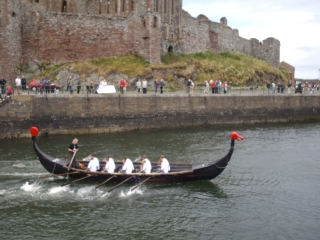
Take the Vikings, for instance. Like most people we thought we knew about them coming over from Scandinavia with their long ships and their well protected noses, how they beat up the locals wherever they landed, but brought some nice jewellery with them. Then in the end they settled down, became part of us and gave us our red hair but mostly we are indifferent to their legacy and if asked, most of us would probably regard their influence in our culture as no more important than, say, the Romans or the Irish or any other group of incomers.

Then suddenly we come to a part of our land which, despite having the same sets of incomers as elsewhere, has a totally different perspective on history.

We find ourselves on an island where the Viking influence predominates above all others and their culture is venerated as if they had arrived only yesterday. And the reason? It is from the Vikings that the Isle of Man gained its governance, a system which has been around longer than anything else in the world and something they are endlessly proud of.

This is a place which is strangely part of Britain yet at the same time it is fiercely separate, a state of mind that begins to rub off on those coming to live here almost from the minute they step ashore. Look around and you'll see a red letter box outside a Co-op store, cars with steering wheels to the right which stop at zebra crossings, all the trappings of Britishness yet somehow I find myself imagining I am in a foreign country, being almost surprised when I hear English spoken. The confusion is compounded by the police force here which has adopted the British police uniform, but only up as far as the neck (do not be tempted to think, as I did, that the white helmet is fancy dress). Only our mobile phone is certain as to where it is....abroad.

Independence of government, however, does not allow escape from the same weather that has dogged the rest of the northern part of Britain these last few weeks so when Peel Harbour finally provides us with an incredible sunset we once again find ourselves planning to put to sea, finding a narrow window of reasonable winds sandwiched between something much worse. Scotland, Northern Ireland, Isle of Man and finally we make an early morning departure from Port St Mary, which nestles down at the toe of the island, and many hours later, Wales is in sight.

We are country hopping and along with us, for reasons best known to themselves, a river of jellyfish wends its way across the Irish Sea. These are mostly a purple coloured variety which have been as plentiful this year as we have ever seen them. At times we have been literally ploughing through solid jellyfish pasture, which makes us wonder where the predators are, whatever creature it is that feeds on these defenceless blobs.

We are moving ever southwards now, no particular timetable in mind, but we are conscious that we'll eventually be sailing into the crowded waters of the south coast of England, a place many light-years removed from the Western Isles of Scotland where we started this year. We have frequently found ourselves alone on the sea, not another vessel or yacht in sight, but at the brink of the summer holiday period we imagine this is about to end. Soon we'll be jostling for the last harbour pontoon space like the rest.

Tuesday, July 13, 2010

On Northern Ireland

Having moved very definitely now into a period of strong winds and rain we find ourselves once again at sea in rough conditions, far rougher than we signed up for when we started out, I might add. We are fortunate indeed to have a boat that can handle this type of thing but it is our own comfort that invariably suffers. The best position to adopt when the cockpit is writhing about, tossing up and down violently in a turbulent sea, is a standing one since legs have built in springs and shock absorbers, something strangely missing from the human bottom. But many hours at sea take their toll on the leg springs. From a place where the currents collide just south of the Mull of Kintyre, in a stiff westerly breeze and horizontal rain there is little to choose anyway between sitting and standing in terms of comfort. Many hours later, landfall finally arrived in the shape of Carrickfergus marina, a place to which we were drawn by the magnetic promise of a 'Stay one night, second night free' offer. Well who can blame us.

We find we have timed our visit perfectly to coincide with my mother's eighty-eighth birthday (Hi Mum!) and also with the anniversary of something that happened a few centuries earlier, the Battle of the Boyne. But it is the latter of these events that has precipitated a countrywide incineration of rubbish on bonfires across the land. The air is full of soot which floats down on our decks and stains the sails, the smell of burning is everywhere and from out at sea columns of black smoke rise heavenwards. The intensity of these 'celebrations', if this is what they are, is startling to us. (In a similar vein some Dutch sailors we met here were surprised to find themselves face to face with a statue of King Willem III van Oranje who they regarded as their own.) Here is a country where we understand the language (just) but the historical perspective is alien. Whereas elsewhere in Britain national flags have become a commonplace sight, hung from houses, fluttering from boats, and sticking out of car windows - in England there is the cross of St George, in Scotland the Saltire (St Andrew), the Welsh have their dragon - many here in Northern Ireland think not of individuality but of unity and it is the flag of the union that flutters from every lamp post, covering the streets in red, white and blue. In the rest of our land this flag is largely reserved for public buildings and the queen's residence but history has given the people who live here a different outlook on the world.

Carrickfergus marina let us down badly in the end. Marine diesel was not to be had due to the public holiday then our berth close to the entrance out into Belfast Lough made us vulnerable in a southerly blow, waves charging in to toss boats and pontoons around like toys. We began to long for something that didn't move around quite so much, I think they call it 'land'. Our plans to sail for the Isle of Man are swiftly abandoned under a torrent of rain.

Which is how we find ourselves in Strangford Lough, a name derived from the Norse for Strong Fjord but which the Irish call Cuan, meaning calm. The Vikings were clearly more impressed by the fearsome current that runs through the narrow, five mile long, neck that connects to the sea, not a place to be tackled when the tide is running against you. A tidal generator planted on the bottom here can produce enough electricity for a small town.

This place provides us with the same calm that the Irish found, needed after so much rough. We may not be exactly where we intended to be but we are where we need to be.

We hear on the News of conflict just a few miles away in Belfast - it appears that there are people who still cannot live comfortably with each other even after so many years - but the evidence of our eyes tells us that such single-mindedness is by no means universal and there are many who have other priorities. The Lough fills with clouds of colourful sails as the Irish take to their boats and go sailing, racing about in competition or just drifting slowly like us. Then, gradually, the wind subsides as the sun sinks lower until we are almost alone, unless of course you include the flocks of noisy wildfowl and the seals, all of whom are here because of the life swimming around beneath our keels. For Strangford Lough is a nature reserve, a vast area of water and the land around it preserved and protected from human interference.

Wednesday, July 7, 2010

The Mull of Kintyre

One of the nice things about travelling slowly around Britain is being able to get to know the places we stop at on the way, places that start out as just a name on the map, or in this case on a record sleeve, and slowly fill in to become a series of memories, of people we meet or things we see and do. One of the curious things about the Mull of Kintyre is just how well known the name is, to anyone over the age of 20, as a result of a very famous song, yet how unknown is the place to most people. For me, Kintyre was just a thin finger of land jutting out southwards, a place one might imagine to be rocky, desolate and largely uninhabitable. The people who live here would certainly dispute this description and the rolling green hills around us here are clearly far from desolate. The city of Glasgow is, after all, a mere three hours away by road and only fifteen minutes by plane into Campbeltown's tiny airport. Also, interestingly, this place has its historical roots not in Scotland but in Ireland, a land within sight to the south just across the North Channel and it is easy to see how the Mull might have been regarded by those looking north as just another piece of their own land.

The broad sea loch into which we gratefully sailed on our arrival here provides good shelter from the worst of the elements, protected as it is by the large lump of Davaar Island which sits in the mouth, but even in the most secure anchorage the fiercest of gales will always test a boat, its crew and its equipment.

Campbeltown boasts a short pontoon where visiting boats can tie up and if no room exists, rafting up outside another boat is the accepted practice. Around midnight after our own arrival a solo Norwegian sailor aboard his thirty-three foot yacht made landfall here after his passage from Largs on the Firth of Clyde. We discovered later that he had been blessed with a gentle sail to Campbeltown Loch but he knew from the omens in the clouds (we had photographed this earlier) that later in the night a severe gale was forecast. However rather than wake anyone by bringing his own boat alongside another yacht, he chose to moor as best he could on his own off the end of the pontoon and away from other boats.

By six in the morning the rain was being driven across the harbour by a south-westerly gale and the surface of our sheltered loch was being whipped into a frenzy. Our Norwegian sailor's boat was being bounced about so much that he decided, reluctantly, he needed to move elsewhere, hopefully to somewhere more secure.

The difficulties of carrying out boat manoeuvres on his own in a strong wind and with the added unpleasantness of torrential rain must have been daunting but nevertheless he cast off from the pontoon and motored away.
The noise of the storm had woken us and we caught a glimpse of his boat as it faded into the mist then, with no apparent way we could help, we decided to leave him to it and return to our own bed to try to sleep some more. We have long since learnt the trick of being able to filter out wind noise, the sound of halyards rapping on masts, water lapping against the hull or heavy rain on our decks so we can sleep soundly. But strangely, from the inside of a boat, the vibration of a propeller is transmitted through the hull by the surrounding water and barely fifteen minutes after we had put our heads down this is what woke us again, even over the noise of the storm raging outside. Peering out we could see a yacht approaching our starboard side where we had left fenders swinging in case of late arrivals. Guessing that this was our lone sailor we knew that in these conditions he would not be able to moor alongside us without some assistance, someone to catch his lines. Quickly we got up, dressed, then dug out our waterproofs and pulled them on. The moment we stepped outside and away from the shelter of our cockpit we were both drenched from head to toe as the water ran in rivers off our backs, rushing off Cirrus' decks into the sea. A grateful head appeared from the yacht as we beckoned him in, quickly making his lines fast to our deck cleats then taking extra lines onto the pontoon behind us.

With a smile he waved his thanks before diving below to catch up on lost sleep, safe at last. We live in a community where giving such assistance is second nature to all its inhabitants; others have offered us help when we have needed it. It is usual and polite practice to take lines from an incoming boat's crew and secure them to a pontoon, no matter what the weather.

Campbeltown has been our home for a week now, giving us the chance to explore further afield. The name Mull of Kintyre refers to a headland at the extreme end of the Kintyre peninsula, a twenty minute bus ride away and a place where we can sit and admire the coast of Ireland just twelve nautical miles away. Some years ago, 563AD to be more accurate, a middle-aged Irishman stepped off a boat here, left his footprints in a lump of rock then very quickly went on to Iona to found a monastery and convert large parts of Scotland to Christianity.

Although one of these facts is certainly not true (the footprints were carved later) the name of this man, Columba, (later canonised) has followed us around Scotland for many months. We have passed islands named after him, churches bearing his name, hotels, restaurants and pubs galore which claim patronage and more particularly I have received my own name from this man, Malcolm meaning follower of 'Colm', which inevitably stimulates my interest when I find myself treading in the footsteps of such an important historical figure. It is strangely moving to be sitting right where his boat would first have touched the sand so he could step ashore. Did he have someone to take his lines, I wonder? While we meditated on these things a small creature that those not visiting this region will miss, the six-spotted Burnet Moth whose British range is now confined to Argyll, came and sat by us.

There is one fact about the Kintyre peninsula that appears in no tourist guide or pamphlet and I suspect does not figure in the education of most locals either. It is perhaps only known to those who monitor broadcasting standards that the shape of the land here was once considered appropriate to be used as an unofficial test for the propriety of images of naked men! Anyone wanting to know more on this should follow the link to find out about the Mull of Kintyre test.

Friday, July 2, 2010

Sunshine and Gales

Weather in the area of Scotland where we are now floating tends to follow a fairly typical pattern during the months of May or June in most years; in a typical year there will be a long period of dry, sunny days. This is just the way things tend to turn out and this year has been absolutely true to form with almost continuous daily sunshine, hardly a break, throughout the whole of June. Even May, looking back, was sunny even though a little too cool to encourage sunbathing. As if to prove the accuracy of this rule, on the evening of the last day of June this year the clouds began to form. Overnight some light rain fell and by early morning on the first day of July we were getting the first gusts of a full blown gale driving horizontal rain before it. Gone is the sultry heat; we are now in a different pattern, depressions forming over the Atlantic which follow time-honoured north-easterly tracks over Northern Ireland and Scotland.

These are important facts when your life is governed by the wind, its strength and direction, as ours is. Our intended direction of travel now is southwards - we are bound for Ireland - and from Troon this means we must wait for winds with a northerly component or else push on, against common sense, into headwinds.

Troon being on mainland Scotland, we berthed there for the express purpose of leaving Cirrus for a week so that we could journey the length of a very hot Britain to visit our English home in Yeovil, a brief visit to celebrate switching on our new central heating boiler. Such was the temperature there that we took no more than a few minutes to decide that we had a working system; we just didn't want the house to be any hotter than the sun was already making it, over twenty-five degrees Celsius. But this is an important milestone in the house renovation project we have set ourselves to complete before the end of this year (a target now driven by the scheduled increase in VAT due in January next year).

Even after dragging our hired car back to Scotland our heads are still full of construction plans and colour schemes - we have become avid readers of newspaper Lifestyle supplements - but back on Cirrus we must turn our minds to assessing the weather and making the mental adjustment to life on board again. Fortunately Troon Marina provides a spectacular shower room where we can stand and soak away to our hearts' content whilst contemplating isobars and thermal gradients.

Today the forecast gave us an opportunity to move very slightly closer to Ireland and we seized the day and sailed west for Campbeltown on Kintyre. It was a wild and uncomfortable sail, six hours of being tossed and shaken about although we sailed as fast as our salt-drenched decks could take us. But Cirrus didn't complain as twenty-five knots of wind screamed through her rigging and pushed against her tight sails. She just bashed her way through every wave making spray-rainbows in the sunshine. No gale this, but more wind than we like to be out sailing in. Campbeltown will have to put up with us for some days now while we wait for something better than this to come along.

Thursday, June 24, 2010

Holy Lowlands

Despite having walked, climbed and now sailed in and around Scotland I had always assumed that the term 'Highlands' was a man-made construct conceived purely for administrative or political convenience. Until, that is, we came across this sign just outside Rothesay on the Isle of Bute which lies on the Highland Boundary Fault. This is a geological phenomenon which divides the 'Old Red Sandstone from the Metamorphic and Archaean deposits' [Thank you Wikipedia]. Aligned southwest to northeast, from Lochranza on the Isle of Arran the fault bisects Bute, continues up the Firth of Clyde, coming ashore near Helensburgh. It then passes through Loch Lomond and eventually reaches the North Sea close to Stonehaven. Without realising it, we find that on our travels we have visited both the landward ends of a vast geological statement on the earth's crust.

None of which would have had much significance to the first inhabitants of Holy Island, a small mountainous lump just off the east coast of Arran, nor even to Saint Molaise who in the 6th century dispensed justice from a well-appointed cave on its western shore. Since 1992 this place has been inhabited by Buddhist monks and now boasts the Tibetan Buddhist Centre for World Peace and Health. 'Respect life and refrain from killing; respect other's property and refrain from stealing; encourage health and refrain from intoxicants; speak only the truth; refrain from sexual activity that causes harm' are the five rules that Lama Yeshe Losal Rinpoche asks the island's visitors to observe. So swiftly running down the list and deciding that none of these would cause us any problems, we tossed Cirrus' anchor overboard just a stone's throw from the island's west flank and watched it bury itself into the bottom three metres below.

To be honest, all we rather desperately wanted was a good night's sleep as for the previous two we had been on a mooring in Arran's Lamlash Bay where the sea had thrown us about all night. We had been out of bed countless times adjusting our mooring ropes, to suit the sudden north-easterly wind which brought long swells into the bay. Our bodies were shaken continuously as we lay trying to sleep, shuffled forward and back as our boat plunged headfirst into the waves then from side to side when she turned edge on to the rollers. After clear days spent fending off sunburn and long evenings admiring stunning sunsets until well after 10 'o clock we had rather taken it for granted that a peaceful night's sleep would follow.

But no such luck. Had we known, of course, that just across the bay we could snuggle up to Holy Island's stony beach and find relative calm then we would have been there like a shot but it takes time to acquire such local knowledge and we are still strangers here.

Holy Island's monks don't have the place all to themselves as they share with flocks of Soay sheep, small brown things with long thin legs that make them look more like cartoon images of sheep than the real thing, and white-fleeced goats. Eriskay ponies also run wild wherever they please and in a small pond these tadpoles had clearly been spending their time in meditation instead of making themselves into frogs as mainland tadpoles would have done many weeks ago.

The monks indulge their artistic inclinations by carving and painting some of the larger exposed boulders that litter the landscape, creating brilliantly coloured images which peep out from the surrounding ferns in a cheeky sort of way. Visitors to the island are encouraged to respect all these things and such is the atmosphere of the place that, strangely enough, they do. A footpath leads to the island's thousand foot summit where, on the top of the concrete trig point, many have left money, coins, exposed to the wind and rain. Some people might drop coins in a fountain as a misguided way to secure personal fortune but this is rather different, I feel, as this money is intended as a gift to the island's inhabitants. Some magic has permeated this place and its spell infects those who come here. And long may it continue.

Two peaceful nights we spent in the lea of this place, quiet evenings where the whinny of a horse or the bleat of sheep carried across to us as the sun set. All the while our anchor chain quietly scooped up kelp from the bottom so that when we tried to bring it back on board a massive load of the stuff came up with it, pulling the bow down until we could reach over and ease each piece off. A brief sail across the Firth of Clyde has taken us to Troon where we shall leave Cirrus for a week to travel south by car so that we are on hand to supervise the first stage of our house renovation project.

Monday, June 14, 2010

Beautiful Bute

A hundred or so years ago when Clyde paddle steamers brought holiday-makers to Bute in their thousands, the masses were landed at the main quay in the little town of Rothesay. Waiting for them conveniently to hand then, just as it is today, is a squat building with a tiled roof topped with ornamental ironwork. Inside was a single room decorated in stunning ceramic tiles, a mosaic floor and fourteen impressive marble-topped urinal stalls, polished copper pipes leading from the glass-sided cisterns overhead. No expense has been spared to restore the Victorian toilets to their original remarkable condition, such that today they feature as one of Bute's most visited tourist attractions. There is a website to visit and brochures are available in any of four languages full of useful information like 'How to get there' and (for those in a hurry) 'Where is the nearest airport?'. The toilets may be both viewed and used, I might add, and unlike in Victorian times, today a Ladies has been added to make the experience complete. The only flaw I can detect is that in the publicity material there is no mention of the opening hours.

To discover this you must stand right outside the building to read the sign, by which time you may be too late.

Bute seems to go out of its way to be as helpful as possible to tourists - footpaths are well sign-posted, information boards are dotted about the landscape and road signs like this one are not uncommon. Here you have a choice of travelling ten or four miles in opposite directions to get to the same place and I have no doubt that this makes perfect sense to someone living on the island.


A catamaran is a rare sight in many of the places we visit so we often find ourselves the centre of interest from other yachties, indeed something of a tourist attraction ourselves. Unlike many other boats the living space inside Cirrus is quite spacious and we frequently find ourselves inviting people aboard for a short tour below decks. In Rothesay harbour we were enchanted by Thomas and his sister Daisy, seen here with their mother, Susan, who explored every nook and cranny on board. Thomas insisted on taking our pictures for his school project so naturally his smiling face appears here as one of our favourite visitors. Hope you had a good holiday Thomas!

Whilst Cirrus is rarely the largest boat in a marina we felt like we were the mothership when a fleet of Cornish Shrimpers arrived for their annual rally (Shrimper Week), more than thirty identical boats all squeezed into the tiny harbour. These are small semi-open sailing boats, modelled on an old fishing boat and ruggedly built with varnished wooden masts and a long bowsprit, not your usual marina-fare at all. These boats can be trailed behind a car, which is how they arrived in Scotland from England, Holland, Germany, even Italy. As they came in they reminded us of ducklings, with their berthing antics providing Rothesay with much entertainment.

And finally...


Don't you just hate it when this happens.

Thursday, June 10, 2010

The Kyles of Bute

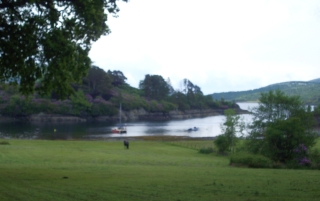
The arrival of the warmest weather this year has seen fit to bless us with has coincided with our floating around an idyllic natural playground apparently made just with the boating enthusiast in mind.

We find ourselves asking 'Where is everyone?' because surely there is not a sailor in the world who would not yearn for such a vast area of deep yet sheltered water. Here there are islands to explore, places to drop the anchor, beautiful sunsets, clean sea breezes to breathe in and mile upon mile of water to sail in. There must be a catch or else every inch would be full to bursting with holiday-makers. It occurs to us that perhaps we are experiencing the brochure writers' weather rather than the norm, but who are we to complain.

The deep channels, carved out long ago by glacial erosion, steep-sided with only slim stony beaches, are scattered with dwellings that have an apparent air of prosperity, something we find difficult to adjust to after so long in the Western Isles. Although the predominant colour scheme is still grey slates with whitewashed walls, houses dotted along the shoreline are taller and grander here, evidence of wealth speaking more plainly and ostentatiously. To understand the history of what we are seeing we have to go back to about 1820 when paddle steamers began making summer trips from Glasgow. With a fast train service from the city centre to the Clyde ports and regular scheduled steamers serving the whole of the Clyde estuary this area could almost be described as 'commuter belt'. The heavily indented coastline makes travel by land convoluted and difficult but for over 100 years travel became possible for the masses and towns like Rothesay on Bute expanded into Victorian grandeur. For many years the wealthy built their holiday or weekend getaways here, grand palaces or more moderate hideaways, taking advantage of the relative peace and quiet. These houses still remain but as roads and cars proliferated the steamers became redundant and by the 1950s all had been replaced by inter-island ferries.

The land is thickly wooded, both Scots pine and deciduous trees growing on equal terms, and everywhere there is the pale purple of rhododendron in flower, an invading plant that tries to choke the life out of much of the indigenous flora but adds startling colour to the landscape.


Cirrus drifts about from place to place, light breezes dominating the early part of the day then wind arriving from any direction, least of all that forecasted. I assume my favourite spot at the bow, legs dangling just above the water as our auto-helm steers us between island and shore, although it is often difficult to remember which is which. At Kames on the Cowal peninsula we shop for provisions so we can continue our circuit of the Isle of Bute whose sides plunge steeply into the Kyles on each side. Once again we make use of moorings that are provided by the local hotel, which offers an impressive menu to attract its customers.

We stay only one night as we have a much quieter spot in mind. An Caladh is a tiny natural harbour tucked away behind Eilean Dubh, one of many islands of this name.

On shore here there was once a very grand house, a veritable castle designed by Robert Stevenson no less, but after it was later abandoned, the building deteriorated to such an extent that it was eventually demolished by the army as a weekend training exercise. There remains little more than a pile of stones today but the view down the East Kyle, presumably what attracted the wealthy owner in the first place, is just as stunning as ever.

Passing by on the shore path was a young lady attempting to walk the entire British coastline, for charity, starting and ending in London, apparently a distance of over 7,000 miles. Her task is a formidable one and in this area where the land bends north and south every few miles this must be terribly frustrating. It occurred to me that our own journey by sea would be doing something similar if we ducked in and out of every watery wrinkle and slipped behind every island.

After two nights at anchor alone in An Caladh there is a change in the weather, 24 hours of solid rain and a brisk north-easterly whining through the rigging. Out come our woollen jumpers and socks again as we prepare ourselves to move on. Perhaps we have discovered for ourselves the reason this area remains so beautifully unspoilt.