Monday, April 26, 2010

Another helping of Mull

We have been reading the blog of our friends Kyle and Maryanne who have been travelling across Scotland on their catamaran Footprint. Moving east through the Caledonian canal they experience the same weather as us whilst taking in the breathtaking Caledonian Canal scenery that we enjoyed last year. Their account has much detail of their day to day lives living aboard the boat whilst travelling about, reflecting our own existence.

They talk of the 'luxury' of a hire car taken for a day so they could visit some places that might otherwise be difficult to get to, a telling comment in this car-mad age when most people would not regard the car as any sort of a luxury. We recently did the same thing on Mull, hired a car for a day so that we could see as much of the island as we wanted with the advantage of being able to stop as we pleased when something caught the eye. (It is worth adding that car hire, like many other aspects of life here, is handled in a casual way. 'You say you've had no accidents or convictions so that's fine by me...').

Our day proved to be sunny and cool but clear and £35 well spent. It was one of those rare days when the air positively gleams and you feel you can reach out and touch objects twenty miles or more away. In total we drove about 100 miles which, to anyone who knows Mull, is something of an achievement.


 Apart from one short section along the shore between Craignure and Salen, Mull's roads, despite being used by the island's regular bus services, are wide enough only for one vehicle. Frequent passing places and basic politeness make it all work, that and a general lack of haste. Few of our car's five forward gears saw use.

Every so often there is a sign encouraging one to visit 'standing stones', inarticulate lumps of rock placed upright on the land many years ago, with no explanation left for those of us who follow. No amount of imagination can visualise what the land was like at the time they were erected and sadly the true shape of the land is now lost to view. Certainly a clearing in the middle of a stand of pine trees, attractive though it is in feeding light down onto the stones today, would not have existed at the time.

In a heritage exhibition centre near Dervaig there are painstakingly excellent models showing what the stone and iron age dwellings might have looked like with information on how it is thought people lived. There is little here to explain the standing stones but models of the 'black' houses, so called not because of the wood smoke which perpetually filled the chimneyless interior but because of the similarity in pronunciation between the Gaelic words for 'black' and 'thatched', give a clear impression of hardships people lived under. Such apparent poverty left no room for sympathy from the landowners, both English and Scottish, who in the 18th and 19th centuries evicted so many people from these lands so that intensive sheep farming could be introduced. Who can imagine what Mull would be like today had these events not occurred.

One highlight of the day was a visit to Carsaig on the Ross of Mull, the southern peninsula that points westward towards Iona. Here we left the car and took a walk under the same thousand foot cliffs that we sailed past last summer. The geology of this whole area is amazing. You get basalt columns mixed with volcanic and sedimentary rocks, some of which are crammed with ancient sea shells, sharp edges of ancient mussels and limpets still sticking out.


Above us were wild goats living in the tiny strip of land between the sea and the cliff, most of which slopes at forty-five degrees, and then higher still the golden eagles soar. There are supposed to be more than 100 of these creatures living on Mull so they are not an uncommon sight. They just float about effortlessly looking more like small aeroplanes than birds. Crows and seagulls will fly up and mob them, but cautiously and with no great effect. They are top predators here and they know it.

Back in Oban after a very cold but delightful sail back along the Sound of Mull we reassess our lethargy and lack of willingness to do more exploring around these islands. This is not a comfortable time of year to be sailing here. When the sun does shine the air can be clear and bright but a cold wind is a heavy wind, or so it feels, and bold exploring is often only rewarded by a night of worry over whether the anchor will hold.

With this is mind, and it being Kate's birthday as well, my proposal to take the Calmac ferry out to Barra in the Outer Hebrides seems to have gone down rather well. Someone else can take charge of the navigation on the five-hour crossing whilst we relax cozily inside. More on this trip will follow.

Monday, April 19, 2010

Twelve months into retirement

From her winter home in Oban we moved Cirrus Cat first to Loch Aline, or Loch Alainn as it is known locally then on to Tobermory on Mull, making use of the new genoa to sail into a brisk south-westerly then into a wild northerly wind, the sail pulling us along at over 7 knots when the sea was flat enough. We still have a lot to learn on how to handle a sail this powerful. Kate expressed some disappointment at the absence of dolphins or seals on our journey but I guess it is just too early in the year for them to show themselves. This time last year we were just setting out on the adventure we call 'retirement', not really knowing what was in store for us. Kate's diaries place Cirrus in the South East of England, at Gillingham Marina in the Medway, and us visiting our friends near Sittingbourne before last minute shopping and casting off to go north.

Reflecting on all we have done in the last twelve months we realise that we have still to complete our original ambition of circumnavigating the UK.

Events late last year cut short this plan and left us 'stuck' here in the Western Isles instead of smugly secure in some West Country creek and although this is something we have always seen as a positive - it has given us much longer here than we expected - we feel in some ways we still have a mission to accomplish. It is early to be sailing this far north, very few boats venture out this early for very good reasons - it can be cold and the weather unpredictable. We will wait for the weather to come right before venturing forth but before long we'll be looking for northerly winds to blow us southwards again.

At the first opportunity we have taken ourselves off into the hills for a spot of walking, just to take in the ambiance that is uniquely Scottish. Lichen drapes from the branches of trees giving them a grey-bearded look and higher up we caught a distant glimpse of two roe deer just at the same moment they spotted us. Not being able to smell us they seemed unconcerned and casually ignored our presence.

We were walking beside Loch Aline looking for, and soon finding, Tennyson's Waterfall where a small mountain stream drops some 20 metres into a natural amphitheatre ringed by a line of brown cliffs. Some of the stones here are soft and green in colour, and the cliff being undercut it is possible to walk behind the screen of water and look out at the view across the Sound to the Isle of Mull in the distance. Of course, Kate just had to risk the cold shower to get here. Her feet would already have been wet because the one thing almost guaranteed about walking in Scotland is wet feet. The ground often has a sort of bounce to it, the moss and the tussocks of grass lying over peat bog or hiding marshy areas into which the feet sink ankle deep.

On a completely different topic, just a few weeks ago we were held up in the UK by the effects of industrial action affecting air travel - in our case it was the French air traffic controllers. Am I the only person to see the irony in the present massive disruption to air travel caused by the Icelandic volcano, just weeks after the end of latest of the strikes here in the UK? Surely the great god of the skies must be thinking 'You call that disruption.... I'll show you disruption!'.

Monday, April 12, 2010

Homecoming Scotland

We are back in Scotland. And before going any further I must repeat the words we have heard now from two separate sources about last winter here in Oban. I quote word for word and they both said, 'It's been a great winter'. This might sound a strange way to describe a long period of intense cold, plenty of fierce gales and more rain than runs off the back of your average duck in a year. But then this is the Western Isles, a place where many people live through choice and without any illusions about what the weather can do. The ferryman taking us across Oban Bay to the Isle of Kerrera put it best when he said 'It's just weather, after all'.

So what was last winter's qualification for being 'great'? Apparently it was the frequent sunny days, short though they were, and relative absence of cloud. It has been very cold here and when the mercury hangs around minus eight for too long then the sea starts to freeze over - we have heard tales of boats crunching though a skin of ice on their way to the island - but this sort of thing does not make for a bad winter up here. Our friends Tony and Joyce, who lived all winter in the marina on board their lovely wooden yacht, told us they wandered ashore for the New Year barbeque festivities but once the New Year was in and the echoes of ships' sirens had faded away they scuttled back below decks again. It was minus ten degrees after all and the chill from the light breeze that had spring up made it just too cold to hang around. But still it was 'great'.

Our first slice of the glory of the place came as we journeyed north from Glasgow on the bus. This three hour trip must qualify as the best way to spend £5 known to civilised man, especially when the sun is casting its longest shadows across the hills and valleys. Setting off at 6pm we travelled the whole journey in what the Scots call the gloaming, that extended period of twilight found in these higher latitudes, across a landscape that although predominantly brown, was full of many shades and textures of the hue. There was last year's bracken (tan coloured) lying amongst tussocks of grass (straw coloured) all barely recovered from the crush of snow. There were brown trees just beginning to think about making leaves and there were acres of heather which hasn't even started at all.
 
The water in the lochs was a deep brown too although it was the splashes of silver and gold reflected from the low sun that most caught the eye. The amazing roadside scenery from Loch Lomond to Mull gave us the most spectacular 'Welcome Home' we could have wished for. And this was just the start.

We have been fortunate indeed to bring high pressure with us to Scotland, sunny skies and light winds which have raised the temperature far above its seasonal norm. As I write the Western Isles are the warmest part of the UK, hotter even than what we left behind on the Italian Riviera! And the sun has brought the gorse bursting into flower, filling the air with its exotic coconut fragrance. Yes, coconut.

Over in the marina, Cirrus Cat has been well looked after in our absence. Our belongings are all safe and dry and the new genoa, ordered last September and sewn impeccably together during the coldest months of the year, fits the boat snugly, an excellent example of the sailmaker's skill.
We can hardly believe our fortune as we gaze about us.

Wednesday, April 7, 2010

Hedgerows and landscapes

On our journey north away from the spring of northern Italy we pause briefly to experience the same season just emerging in southern England. The buds here are swelling in the hedgerows, making this contrivance one of the most remarkable of man's creations. Some examples are nearly as ancient as human habitation; take a 30 metre length of hedge and its age in years can be roughly determined by multiplying the number of species by 110. Hawthorn and holly, beech and hazel, chestnut and alder plus so many more we cannot identify are all constrained together in a narrow corridor only an arm span wide which can stretch for many miles across the countryside. These are highways of life and they are as common here as they are absent from the land we have just left.

We stay for a few of days with friends, deep in Kentish farmland in their timber-framed cottage. From the back window we gaze out past the magnolia tree into a cherry orchard, home to magpies, woodpeckers, several tawny owls, the odd pheasant and many rabbits. A flock of rare-breed sheep, black with white faces (as if part of a photographic negative) are allowed to roam here in order to keep the grass trimmed and this gives a tidy aspect to the place, tidiness being a word that I have always felt applied to the countryside in this corner of Britain. In front gardens there is scarcely a hedge that is not trimmed, a lawn that is not cut or a shrub that is not pruned to within an inch of its life and this sense of order is somehow carried out into the farmland as well.

The land here appears almost flat (until you start walking when you soon realise it isn't) and the skyline is at eye level, decorated with trees, currently bare of leaves with their twisted branches exposed and cold. The English country cottage, black timbers intersecting white plaster, is what we think of when we use the phrase 'old house', just as in Italy it is a tall dwelling built of large, irregular stones, often plastered in yellow and connected in a cluster with others on a steep mountainside. The age of the dwelling in each country may well be similar but the view through the window can never be the same. In Italy the horizon is visible only by tilting the head back uncomfortably and raising the eyes heavenwards. The contrast between Kent and Ligurian Italy could not be more vivid.

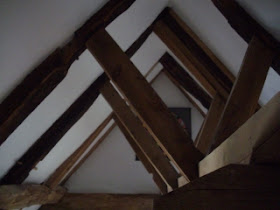
Our friends' house, once three adjoining farm-workers cottages, is a now complex mix of dark beams and interesting corners, all tastefully decorated and with the conveniences of modern living blended neatly in. The positions of the walls between each of the former dwellings are still visible but these do not intrude or appear out of place. Wooden beams are 'original' which means that many have had a previous life somewhere else before being incorporated in the structure, perhaps in another house or maybe a ship. Look closely and you will find curious notches and grooves everywhere or a round hole with the remains of a wooden peg sticking out. Let the imagination wander and you'll see a mast standing here, a rope holding back a cannon or a hammock swinging.

These few days are a pause for for breath, a time for re-acclimatisation and relaxation in comfortable surroundings before we return to the Scotland we love so much.

Thursday, April 1, 2010

Time travellers

Clocks forward, clocks back, lose an hour then gain it again somewhere over the English Channel. Up at the crack of dawn with suitcases piled into my brother's car which then overheats, grinding to a halt on the autoroute somewhere above Monaco. Frantic telephone calls to Guy whose enormous 4x4 sweeps us up from the roadside to get us to the airport on time.

Arrive dazed in a cold, damp Britain then drive to Yeovil to re-unite with our three sons but it's another early start the next day to return our airport hire car. Colder than ever now (we have gone rapidly from a balmy spring in Italy to the wet and windy five degrees of a prolonged English winter) we struggle to cope with the time changes, the driving on the left and the very Englishness of an Indian restaurant meal.

Once again the complexities of our travel arrangements baffle our friends but we are used to this by now. What we hadn't expected was to feel like alien invaders in the familiar landscape of south east Britain where the language is one we understand but don't expect to hear and the customs often seem strangely pointless. We are back in the land of green lawns and nodding daffodils where narrow hedges border narrower lanes and bare trees scrape the sky. It all takes our breath away; we gape like tourists.

We board a train without 'composting' the ticket (when we first came upon this term in France we thought it might be a green initiative to re-cycle the paper from which the ticket is made) and we cross roads crowded with cars that look over-inflated, too large for the inhabitants who drive them and far larger than those most Italians drive. We re-encounter the grey suit still favoured by commuting office workers yet search in vain for the extravagant fur coats so favoured by Italian women. Soft Mediterranean brogue shoes have been replaced by the deck shoe and the trainer and once again we can buy a sweatshirt without some meaningless English phrase like 'Yatching Fitness' emblazoned on it. And where is the breakfast cereal, 'Teddy's Hit', when you need it?

Finally as we re-acquaint ourselves with the windy dampness of the air we must also get used to the absence of church bells, here ringing only to summon the faithful to Sunday prayers and silent in the early hours of the morning for fear of disturbing the Englishman's sleep.
We have returned to a country that is both familiar and strange, comforting because of what we recognise as commonplace yet full of strange sights and odd behaviours that we now know are uniquely British.

Wednesday, March 24, 2010

Final days in Italy

At the end of this week we will be filling our two enormous suitcases and taking them away from here. Like many others, we negotiate the mysteries of the Internet to make bookings for our return to Britain, taking advantage of the considerable discounts available to those who can make travel plans some way ahead.

Doing financial transactions on the Internet can be a nerve-wracking experience; we follow the trail of data from one screen to another, trusting that the thin thread connecting our computer to the world-wide web via an Italian service provider holds on for long enough for us to complete the process. Somehow it no longer seems incredible to us that we can do these things so easily from wherever we are. If we need to find out when a bus in Scotland will depart or the cost of a window seat on a train leaving London, this information is available to us, our car-free life having forced us to learn the skills and given us the confidence to apply them when we need them.


Our last week in Italy is a time for reflection. Soon the sights that our eyes have become so used to will once again appear foreign. Take the arches, for instance. Everywhere we look these shapes taunt us with their simplicity, defying gravity and even time itself. The arch is used inside, as in our apartment where the curved ceilings are supported by walls up to a metre thick, and outdoors where tightly packed mediaeval buildings are connected by these apparently fragile arches of stone, many hovering in space despite the absence of mortar. These simple, man-made structures could be centuries old, proving just how robust the form is, how clever its use has been. Whole towns have been built using little else, hanging together solely because of the arch, a shape that occurs over and over again.
It is so prevalent in the landscape that one quickly takes it for granted and ignores it.
Its strength lies entirely in the pressure of each stone on its neighbour, each one passing the load to the next, outwards into the supporting buttress. Take just one stone from the arch and it will fall, so interdependent are its pieces. Even such a thin arch as this one, just one stone thick at the top, will easily support a man walking across it. If there is one single shape that just shouts 'Italy' then I nominate this one, the arch.

And if there is one single plant that surely does the same then, hardly surprisingly, it must be the olive. As we leave Italy the new growth shoots are appearing, pushing upwards towards the light despite the frosts and snows of the winter only a few weeks past.

We are told that it is regarded here more as a plant than a tree; the trunk continues to lengthen each year, stretching ever upwards. And it seems almost impossible to kill an olive - no matter how much it is cut, the root will always throw out new shoots, from anywhere along its length. The effect of this after many years of pruning is a vast, contorted and twisted root-ball spread far beyond the girth of the original plant. Somehow over many years, and with the help of man (it must be said), this organism may well have learned the secret of immortality.

Which only leaves me to reflect on the Italians themselves and the society in which they thrive. So many aspects of British society are governed by rules and laws which are intended to protect us from harm. It seems strangely comforting, therefore, to find a place where an individual is expected to use his own common sense to judge whether or not something is safe.

Take the level crossing in Ventimiglia where impatient pedestrians will duck under the closed barrier to cross the line and we have seen armed polizia nonchalantly watching nearby. The trains only pass slowly at this point so the danger, they would argue, is no greater than crossing a road. And who needs stop lights at a pedestrian crossing when surely drivers can see when someone needs to cross the road. Natural courtesy applies and this is acknowledged with a smile and a wave of the hand. Standing forward of the driver in a crowded bus might be unsafe and might even make driving more difficult but who in Italy would think to challenge those standing there or interrupt their conversation with the driver. The trip into town is, after all, a social occasion. Then there are the domestic gas and electricity meters and valves which, rather than being locked away inside, are located at street level outside the buildings. Dangerous? But why would anyone with common sense want to interfere with such things.

These examples reflect attitudes that are very much at odds with how things work in the UK. They present us with many questions about our own society, making us think about how protected we are and what we lose as a result of this. There is, it seems, another way and we are grateful for having the opportunity to discover this.

Saturday, March 13, 2010

Travel plans

With less than three weeks to go till we depart Italy and begin our return to the Western Isles of Scotland, we closely watch for news that might disrupt our travel plans. Back in February we were returning from a short trip back to London when our return flight was cancelled at the last moment. This brought home to us, for the first time, how vulnerable we are in these situations, how the airport suddenly becomes an alien landscape and how frightening it can be when this sort of thing happens. Suddenly we had become part of the crowd scene normally only seen on the TV news - people milling around looking for information from the airline when there was none available.

We also learnt just how big a place an airport is. Our flight was cancelled after we had checked in and had passed through the security barrier - we were 'flight-side' - so we had to be led back on a roundabout route, guided through various code-controlled barriers, till we once again stood in a queue for re-booking a flight. Several hundred confused people had to be rounded up and walked a distance of about a quarter of a mile through the airport complex, a not inconsiderable logistical problem for any airline. Some will no doubt provide a better service when something like this happens, I am sure some will be far worse. For the passenger it is the feeling of helplessness that is so distressing, the lack of control over what is happening and what made it worse for us was that we were travelling with my mother and her companion, both of whom are elderly and have mobility issues.

The reason for this disruption - the French air traffic controllers were striking - was an event far beyond our control. Now we hear that on the date booked for our return at the end of March another strike is being planned. It is difficult to see how this might affect us (our airline is not involved) but nevertheless we must consider planning for the eventuality so we are better prepared.

No matter how difficult these events make it for us to get there (we will walk if we have to) soon we will be participating in the re-birth of our catamaran home in far-away Scotland. And in case anyone is wondering how this is done, take a look at the picture below, a bizarre set of drawings we spotted in a Ventimiglia hotel, of all places.

'Comment naissent les bateaux'.(How boats are born) shows an 'elfe marin' and a 'sirêne' (mermaid) blending together to make this fine vessel, a very modern-looking multihull. We just can't wait to get started on Cirrus Cat.

Sunday, March 7, 2010

Visitors

Our friends Rich and Gerry are the latest visitors to stay with us here in Torri and from the very first day they threw themselves into a punishing mountain walking regime, despite the threatening weather. Just like others who have visited us here, their legs sprung boldly into action up our steep mountain slopes before their over-stretched muscles shouted 'stop!' and we gave them time for recovery. Having the Ligurian mountain scenery so accessible for the last five months seems to have given us something of an edge in the lower limb fitness stakes when compared with most of our visitors, that and the 61 steps up to our apartment door, of course.

Our evenings with Rich & Gerry were occupied with playing a card game we were taught by our son Ben some weeks ago, a new one (to us) and one that now seems to have slipped permanently into the repertoire of our lives. Sadly the one-word English name by which this game is commonly known is so vulgar that I will avoid writing it here by loosely translating it into the French phrase - 'Tête de Merde' - in the hope that this will offend less. (Anyone interested in knowing the rules should follow this link.)

A few weeks later and I have reached a significant milestone, my 60th birthday. This time our visitors are my mother and George, her companion, and we were treated to meal out in the Italian style. To those used to the British way of eating a meal it may seem strange to be served a succession of tiny portions of different foodstuffs, one after the other, over a period of several hours, all nibbled along with pieces of bread and (of course) floated down with wine.

There is far less mixing of tastes on the same plate as we might be used to in the UK, each mouthful being just a single tasting experience rather than a blend. 'Meat and two veg' it is not. At our meal each morsel arrived on a new plate (in lesser restaurants the same plate is re-used), was dressed with olive oil from a different region and was flavoured with marjoram or rosemary if the chef felt this was needed. Eating this way the diner is encouraged to focus on one single flavour and one texture before cleaning the palette (with wine of course) then being served the next. In Italy a meal is expected to be a social occasion which takes as long as it takes - no rush - and it ends when it seems right that it should.

The final dish was the fruit course and mine arrived with a blazing roman candle stuck in a strawberry, a nice touch and a very memorable end to the delicious birthday meal.

Encouraged to show our distinguished visitors more of the area we live in we popped into France to take in the noisy delights of the Menton Lemon Festival, complete with its fire-breathing, orange and lemon dragon and a parade of near-naked dancers. Then on another day we explored the back streets of Savona just along the Italian coast, a town which boasts a Sistine Chapel with a ceiling painted almost as artistically and dramatically as the more famous Roman one. Savona was the home of Pope Sixtus IV, one of the line that give their name to such chapels.

Kate and I are not great at being tourists and do not generally give sightseeing the priority many think it deserves. We generally prefer to shun the crowds and sneak away somewhere quiet where we can appreciate something nobody else would be remotely interested in - like a set of attractively curved roadside benches which would put at risk the toes of any occupants from passing traffic or else we just gaze at the colours of the mountain landscape we are in, generally dark green but for the next month or so splashed with bright yellow of mimosa flowers.

As spring starts to creep out from under its winter shell we begin to think of leaving this land behind us to return to the boat we left far away on the west coast of Scotland, to meeting up with the many friends we left behind there and to continuing our travels around Britain.