Monday, November 23, 2009

Autumn borders

The arrival of Autumn here in Torri has finally brought a slight lowering of temperature and nature is at last showing signs of her preparation for Winter. Just as in Britain, we have had an exceptional period of weather here, in our case much dryer than the norm. Our walks now take us through a painted landscape, still the dark greens of olive and conifer but dotted about now are bright yellows of less common deciduous shrubs, colour which in the course of the coming weeks will disappear as the leaves fall.

Our most recent jaunt took us from the quiet and barely accessible village of Collabassa, perched high between the Bevera and the Roya valleys, and along a mountain ridge to Olivetta, a better cared for village with freshly painted houses and murals like this one opposite the village grocery store.

Clearly there is a spirit present in some villages, absent in others, that brings colour and artistry for the enjoyment of the residents and, of course, for us visitors. This village sits just inside Italy and a tiny road zigzags its way into France from here.

Our path runs somewhat lower, broadly following the line of a ridge separating the Bevera and Roya valleys, the twists and turns taking us first high above one river then the other. It is steep and exposed in places, rough underfoot and damp in corners where the sun doesn't reach but arid it is not. Much of the vegetation alongside our path is tough and spiky, shrubs that we half-recognise but with weapons or armour not found on British varieties.

Fruits and berries abound, most of which we don't recognise and leave well alone, but here and there are small trees with round orange fruits like large marbles but soft and sweet inside a granular skin. We think these are lychees but as yet nobody has been able to give us the local name (suggestions anyone?). They grow alongside our path, a fast-food convenience for us as we stroll along although it may be a mistake to eat too many as there is something in them that accelerates digestive transit.

We traverse a steep slope which has been devastated by fire not long before, the conifers standing charred and lifeless, the pale soil exposed to the sun athough ants are already making new homes for themselves. The contrast is sudden, from green and gold to brown and charred, but the path remains intact here so we pass unhindered.

Further on we hover above the town of Airole, still sunlit despite the long shadows and beneath which, in a long tunnel, runs the railway line heading north towards French and Italian alpine ski resorts. We are close to the border which follows natural features, ridges and summits, twisting and turning east and west oblivious to the demands of modern man. High in the mountains, of course, there is nothing to show ownership or nationality, nothing to mark which laws hold sway.

By contrast, travelling by road closer to the coast there is a strange feeling of unreality when one passes between Italy and France and the language of the road changes - 'servizio' (motorway services ) become 'les aires', 'peddagio' (tollbooth) becomes 'péage' and 'il semaforo' (traffic lights) become 'les feux'. Roadside markers change shape, crash barrier design is different and even the roadway markings are not painted the same colour. Next week we have been invited to the Lyon home of our French friend, Guy. Although he regards himself as French, at least half his parentage is Italian and his surname is shared by many in Torri. This trip promises to be an intensive French language and cultural experience for us but he is kind and sensitive (il a sensibilité) and anyway, life is too short to miss such an opportunity.

Sunday, November 15, 2009

Insects, mostly

Just as there are many things about English life that a foreigner would find amusing or strange, here in Italy we remark upon many things that grab our attention for what we regard as their novelty.

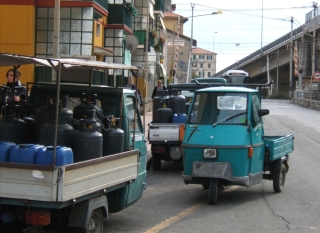
There is a commonly seen vehicle that to our English eyes looks like something recovered from a second World War film set but which in reality is the workhorse of many small local businesses. It comes in various forms, all of which are known as 'Ape' (pronounced 'appay'), the Italian word for 'bee', has three small wheels and a tiny 50cc engine which buzzes, under load, just like the insect whose name it carries. Blue seems to be the favourite colour for these ubiquitous vehicles which are steered from inside the tiny cab, either with a wheel or handlebars, depending upon vintage, I assume.

That might be the end of the story but for the fact that there is a vehicle, much more well known in Britain, that has been named after another insect, the wasp.

The Vespa motor-scooter needs no introduction to me as I can recall years as a self-possessed teenager posing on similar vehicles trying to catch the eye of some passing lovely and I am sure that present-day young men all over the world still ride these machines without realising the meaning of the name in Italian. Again the name must surely derive from the similarity of the engine noise to that of the insect in flight.

Rather louder but sticking to the transport theme we move on up the scale to the tractor, and here we thought we were on comfortable ground until we saw the local version of this vehicle, a single-cylinder diesel engine, often with a furiously spinning, unprotected flywheel protruding from the front, a narrow wheelbase and a small cart on the back.

With four-wheel drive this beast is completely suited to the land it lives on. It can pass along narrow village streets, climb twisting mountain roads, carry loads far heavier than might be supposed and will come to no harm if left out in all weathers. It is perfect for our French friend, Guy who takes us up to his olive trees, 300 metres up the mountainside, so we can help with the harvest. Anything bigger would block the road or possibly cause a landslide as it negotiated the hairpin bends. Sadly, despite the racket the engine makes, now a familiar noise to us, the Italians have yet to come up with an insect to name this after.

They say the Italians are a passionate nation, not something I am qualified to comment on,
but the three black beetles acting out this little scene beside a footpath leading up out of Torri, made us think that there might be something about the sun or the air here that promotes coleopteran promiscuity. We were on an afternoon walk up a tiny valley to find the original source of water supplied to our village before mains-purification came along and were following a rough track balanced precariously on the steep hillside.
The upper valley narrowed to almost nothing and the stream fell over a short waterfall, above which there was lush vegetation and a small clear pool, a secret place enclosed within headwalls of rocky crags above. Even in this wild isolated place there is evidence of man's intervention, retaining walls still standing here and there trying to keep the land in place, preventing the fragile soil from washing away so that olives could be grown. The vegetation is mostly green but here and there a striking splash of yellow-orange catches the eye, a deciduous tree succumbing to the shortening days of late Autumn.

Saturday, November 7, 2009

Central heating

Our apartment here in Torri is built to a pattern that is common all over the Mediterranean, the walls massively constructed in stone and rooms with high ceilings formed as a curved arch without wooden supporting beams. The interior is painted white, the windows are curtain-less with exterior shutters and the floors are laid with rich brown quarry tiles with the occasional rug to soften the echoes. It is a pattern that suits the summer climate better than it does the winter as the apartment interior remains relatively cool throughout the day regardless of the temperature outside. We are grateful, therefore, for the large wood-burning 'stufa' built into our living room wall which forces heat into the surrounding stonework so that it can seep out again all through the night and into the next day.

In a village like Torri, a compressed village environment set in a deep valley, it is only the very favoured inhabitants who can expect to see the sun shining through their windows all day long, especially in winter when the hills send long shadows across the land. Our apartment is more blessed than many as we live high up on the third floor, higher still if you count the cellar which itself is some distance above the road. The apartment has a roof terrace - not the place for vertigo sufferers - and this is probably the highest point in the entire village. All this height comes at a cost, of course, as there are 61 steps between the road and the front door of the apartment, a challenge on a good day, quite painful on a bad one.

All of which brings me to the explanation for my aching legs and to the reason my arms are longer now than when we first arrived. It is well known folklore that a wood burning fire will warm you twice, once when you chop up the wood and once again when it burns in the grate. Here in Torri, however, they say that wood warms you seven times! It goes like this: First it is cut it from the tree, then it is sawn into logs before the wood is transported down the hillside to be stored for drying. When ready, the logs are split apart, then carried home for storage. Finally the wood is taken from the cellar up to the house and then at last it is burnt on the fire.

Thanks to the kindness and energy of Guy, a Frenchman who has family connections in Torri and who sweeps in from France every so often to look after his various plots of land hereabouts, and thanks to a massive expenditure of muscular effort by Guy, myself and from my long-suffering brother, after two days of log splitting and transportation, we now have a sumptuous woodpile in our cellar. This is mostly olive wood cut three years ago and now nicely dried and ready to burn; for kindling we will use pine cones collected on our mountain walks, these being melon-sized and completely dried out, easily stuffed into a large sack which is then slung over the shoulders as we descend. And as a quid pro quo for his wood, Guy is having English lessons from us, in addition to which, when he needs other help, someone to climb a ladder or push about one of his many wheelbarrows, he endearingly calls for my assistance ('Caan yu 'elp me plees?'). His energy and enthusiasm is boundless but outside of the English lessons, we communicate entirely in French, a challenge for both Kate and I as we to try to recall words learnt at school over 40 years ago. After a day with Guy our brains are buzzing with his language, hyperactive with words and phrases we should have used, things we could have said. Fortunately he is a patient man as well as being excellent company, providing us with a completely new insight into the world that is Torri.

Tuesday, October 27, 2009

Torri, Imperia

Only in our third week here and we are learning that there is a lot to know about the tiny village that has become our winter home.

The real heart of the village is the piazza, 'Piazza Caduti per la Liberta' to give it its full title, which is a daytime gathering place for some of the more weathered inhabitants as well as being the focus for a random set of local events. The other evening as we returned from one of our lengthy walks a steel caldron set up on the piazza was being lit on which, from 7pm, castagne (chestnuts) were roasted and served to the villagers together with a highly spiced mulled wine. It was warm enough for us to sit around acknowledging the locals, even if conversation was difficult, and admiring the way the young and old were mixing and enjoying themselves. Such events are so much a part of life that there is no advance publicity and to newcomers like us, the way things just seem to happen, without advance notice, is baffling.

To one side of the piazza lies the ancient but well preserved church, appearing quite small from without but somehow larger than life within - carved saints with expressive faces lining the walls and a classic crucifix figure dominating the nave. Aside from it being a place of worship the church has a way of forcing its way into almost every waking moment, and some less wakeful ones too, for atop the church roof there is a tower which contains two bells. And in Italy, bells are meant to be rung.

Looked at in simple terms, the bells are an audible clock. On each hour of the day and night there is a mechanical striking of Bell 1, one blow for each hour. This same peel is then repeated some two and a half minutes later. It is clear from this that both peels cannot be striking the correct time... and as it happens, neither does. Then on the half hour, or thereabouts, Bell 1 strikes once, followed a few seconds later by another complete peel from Bell 2, one blow for every hour. For those interested, Bell 1 is pitched at approximately B and Bell 2 is a major third lower than this. Thus at midnight and midday we are treated to 24 strikes and half an hour later, 13 individual strikes. (Incidentally when the clocks went back the bells struck 12 midnight twice in succession, a total of 61 strikes in two hours.) As if this is not enough, at 7 am each day there is a longer less regular peel of bells and on Sunday mornings both bells are rung together as a call to worship in the church.

Trying to look on the positive side of being woken at three am by the ringing of bells one could argue that it is a handy way of knowing that it is too early to rise from bed, the bells saving us the chore of raising the head from the pillow to look at a bedside clock. How have we managed all these years without these aural signposts to guide us through the night? It might also seem strange that Torri's inhabitants, many of whom live much closer to the church than we do, need such signposts when their wristwatches provide far greater accuracy than the church.

Such speculation is idle in Italy, however, for church bells are not a timepiece, they are a tradition. For Torri's bells to be silent whilst those in the village of San Pancrazio just down the valley, or indeed any other village all over Italy, were swinging would be inconceivable, unthinkable.

But let us return to Torri, this time using the Via Basso route which follows the lower slopes of Bevera valley northwards from the village until it meets the bridge below an amazing hanging village called Collobassa. This ancient footpath, in its heyday, an essential supply route to the upper valley, remains an impressive construction clinging as it does to the steep slopes using both natural and man-made ledges. Today it is in poor shape but in the past these ledges carried not just people but also water along channels, small aqueducts, still visible beside us as we walked. The drop down to the river is considerable but would have been an everyday part of life before the new car-bearing roads were built. The route dips in and out of the strong sunshine and once again there are strong smells that assault us as we walk. Where there are no olives planted there are pine trees and resin is coaxed from them by the sun, blasting us with scent as we bounce our way along the narrow pine needle-covered highway.

Wednesday, October 21, 2009

Mountain home

This is day three of six months of living in our Italian home in Torri. Easy words to write but not quite so easy to grasp. Almost without exception, visitors to this apartment would be holiday-makers, here for two or three weeks at a time at most, maybe a month if they were lucky. Working people can call this a holiday but for us retired folk we struggle to give a name to what we are now doing here. The atmosphere, our foreign surroundings, the weather, it is all here just as it would be had we come here for a holiday but then we say to ourselves, "We will still be here in six months time." Maybe the reality is that all we have done is to move to another home, one that doesn't float.

All this introspection does me no good at all and does little to ease the throbbing thighs or the calf muscles shouting at me somewhere below. For yes, Kate and I have been out walking. And walking in Torri simply means going up, then sometime later going down. Even if we fancy a little walking on the level the choice just doesn't come into it because the moment we set foot outside our door we are going up or down. Our apartment is at the top of four floors worth of rough stone steps; the roof terrace is higher still up more giant steps. Popping over to my brother Graham's place, just across the village and up another four stone floors, I arrive panting at his door as if finishing a 3-mile jog.

From our walk yesterday I have chosen two pictures to illustrate what we are dealing with. The first is taken from above Torri, looking towards the terraced slopes which loom over our village to the west. The terraces are man-made, earth held back by dry stone walling, constructed to retain the roots of olive trees. Today it is mainly the trees in the lower, more productive terraces, that are maintained, these being managed by pollarding which produces ancient, thickened trunks and slender branches spreading from about head height. Close to the top of the slope in the photo, the faint line is a rough track, just passable with a lot of nerve and a four-wheel drive vehicle. Once you leave the valley bottom, this is what passes for a road, carved out of pure rock and clinging precariously to the hillside.


This next photo was taken from that same track, the camera pointing downwards at an unbelievable angle towards the church in the centre of Torri. Our apartment is just in beneath the shadow to the right - the mountain shades us in the mid afternoon at this time of year, before most of the rest of the village.

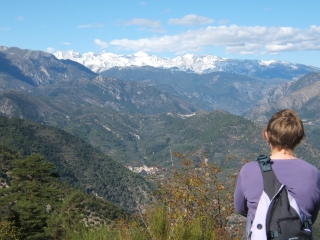
In the course of a little over six hours on a magically sunny day, Kate and I ascended the 800 or so metres up to something called Monte Cogorda following vague footpaths created to give access to the higher olive terraces. From here we could look north across the French border towards snow-topped Maritime Alps and in the other direction the Mediterranean Sea glinted at us with Ventimiglia tucked down at its shore.

As we walk, large brown crickets take to the air from under our feet, revealing their ruby-red wings for a few seconds before landing and disappearing into their camouflage again. Bright yellow butterflies dodge before our eyes milking the tiny yellow and blue flowers which hang on in defiance of the approaching winter. In general the vegetation is tough and spiky but the smells of wild thyme, rosemary and lavender assault our noses, the plants themselves sticky with scented liqueur.

As ever, my eyes are often pointed downwards (I like to watch where I put my feet) and once again a wild animal chooses to cross my path. This slow-worm eyeing me up for a meal, decided I wasn't worth bothering with if it meant giving up the last rays of the day's sunshine.

A direct descent down to the valley is an impossibility so our return is long and arduous, traversing the mountainside on a bluff high above our apartment's roof before leading us down into Calvo, a village further down our home valley. We have met no one all day and even here as we peer into gardens cultivated with plants and shrubs we fail to recognise, we have the place to ourselves. It takes a peel of bells from the brightly painted church to wake us to reality as we finally arrive at the main road so we can march our creaking legs back up the valley to our home.

Thursday, October 15, 2009

Changing landscapes

In the space of little more than a week our latitude has reduced from 56.4° to 43.8° N and as expected, the most immediately noticeable change we experience is the climate - temperature up and humidity down. The sun has real power despite it being October and even sunburn is a reality for us northern types. Our senses are overwhelmed by much around us that feels different and strange, some things being obvious - car steering wheels appearing on the wrong side - and other things that are difficult to recognise and just seem to creep past the retina. Our brains are trying to interpret a world of unfamiliar lines and shapes.

En route we passed through the cityscape that is London and I was struck there by the preponderance of vertical and horizontal lines. There were tall buildings with flat roofs, offices with windows and doors all rectilinear in shape, lamp posts and even tall buses seem to be designed to this same model, sharp right-angles and hard edges everywhere.

Contrast this with the seascapes of western Scotland we have left behind us. The sea always produces a horizontal plane - the widest horizontal in the world - the horizon (hence the word) stretching as far as the eye can see.

In amongst the islands this might be broken by vertical lines, sea cliffs, with the rounded curves of mountains aged by the centuries - shapes too complex to define but with softer boundaries.

So what then is the shape of landscape of our new home in Torri, this tiny mountain village nestling in the foothills of the maritime alps of northern Italy? It takes time to recognise just what makes this place look so different to our unaccustomed eyes. Then realisation dawns. For here the predominant shape is the diagonal. A long sweeping olive-tree clad slope dives into a deep valley bottom where a tiny river snakes its way seawards. The slope is mirrored across the valley by another identically angled slope, equally steep and equally high but there are precious few horizontal or vertical lines, just a collection of buildings tucked into the rock of the sloping hillside. The contrast with the landscape we have left behind is both dramatic and stunning. Although a cloak of old wizened trees softens the land, with branches going in all directions, unlike Scotland the ground cover is sparse, no spread of heather or bracken covering the soil, for here rain comes rarely and the summer sun burns fiercely.

Our first day here is hardly the time to comment on the people who live here but it seems pretty certain that we can always expect the language to be a barrier to deep conversation. Most of the residents speak a local dialect that renders our Italian phrase books totally redundant although fortunately French seems to be understood pretty well; the border is not far away. I used to wonder what prompted my brother to move here many years ago, until back in Wadhurst near my mother's home I came across this sign beside a newsagent's shop. Is nothing sacred any more?

We have spent our first day here adjusting, unpacking those mighty suitcases filled in Scotland and lugged across Europe, shopping and doing a spot of gardening. My brother has a friend whose allotment just up the valley is available for us to pick whatever is growing there. So we have come back loaded with grapes, tomatoes of various types (including some sweet yellow ones), beans, a small melon and a single chilli pepper with enough power to heat a month's meals to burning point.

Saturday, October 3, 2009

Boatyard life

Tonight will be our last night in the marina boatyard on board Cirrus before we depart for our winter home. Sleep might not, however, come easily as we are currently in the grip of the fiercest storm in our experience here. Gusts are whipping across the island and even tucked in behind the raised bank in a corner of the yard our boat is shaking and vibrating beneath us. Our mast pokes up above the bank into the full strength of the wind making the rigging howl and whine, the pitch varying with the wind strength and in the squalls there is a low humming noise as well, as if the mast is being played like a violin string. Leaves torn from the young trees above us flash past our windows, smaller broken pieces of debris settling on our wet deck briefly then flying off again.

As I write the sun shines brightly from a patch of blue sky, as if defying the storm. But every few minutes a rain squall drops from the racing clouds, water accelerates in the fast-moving air and thrashes against us, penetrating every weakness, invading everything it can. All day yesterday the barometer needle swung anticlockwise as the pressure dropped steadily. By evening the wind had reached gale force, the noise rising with it, disturbing our sleep. This morning the air pressure had reached its lowest point and started to climb back up, the barometer needle now moving rapidly. The wind continued to increase in strength; 75 mph gusts are now flashing past us, diving down the slope to the sea behind us then hurtling across Oban Bay, whipping up spray which is driven away into the town. Little is moving. No ferries are leaving port. The population is hunkered down for the duration.

We count our blessings that Cirrus was lifted out some days ago. The marina, still full of yachts, is sheltered by the island but masts are swaying about wildly just the same. We think we are through the worst now; if the forecast is right, the wind will diminish overnight so our journey across to the mainland tomorrow is not likely to be affected.

A boatyard is a strange place to be living, hardly to be recommended. We have mains electrical power here but for the toilet and showers we have to cross the open yard, negotiating puddles and other debris. There are few lights and at night you forget the torch at your peril. Even with this there are hazards, like the sheepdog from the nearby farm who wandered into the yard and tried to round up Kate on her way back to the boat the other night, getting quite cross and nipping at her heels when she would not stay in one place.

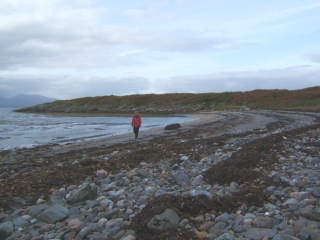
On our last brief walk around the island several days ago we found this deserted beach where we added our footprints in the sand to those of the otters who live here. A truly magical place this, the pebbles carried here from a thousand different headlands all with stories to tell of their journeys.

So today we are packing - one large suitcase and one large shopping trolley - ready for our travels. Somehow, possibly with the assistance of a few ropes, we'll manoeuvre our luggage from deck to ground then across the yard and along the pontoon to the ferry. For the next week we have a complicated schedule, a minor surgical operation, and many miles of our own journeying to undertake.

Monday, September 28, 2009

From sea to shore

It was all over in a matter of minutes. One moment we were manoeuvring Cirrus stern-first towards the marina slip, a delicate operation best done with no distractions and with total sang-froid, next we were no longer afloat, our home had grown wheels and was trundling (there is really no other word for it) across the boatyard to her allotted winter home.
An estate agent might say that this is a tasteful location. From our companionway door we now have a view across the bay - plenty going on here, Calmac ferries coming and going from remote islands, the seaplane landing and taking off just below us, all this on our doorstep - with the early morning sun, when it arrives, sweeping across our stern. Cirrus is tucked in behind an earth bank topped by young trees which will serve us well in the coming months by deflecting the worst of the westerly gales. Trees, as everyone knows, can break wind for some distance 😉 and Cirrus has a sleek young neighbour in the shape of 'Footprint', the catamaran of our friends Kyle and Maryanne.

The two boats will keep each other company through the long winter nights ahead and who knows what the result of that will be!

Thankfully the lift-out experience was a good one for us and we have time on board now to potter about getting some little niggling jobs done, fixing some annoying leaks, cleaning and tidying, things only boaty people would understand. There is an unwritten law that says any hand tool used on the deck of a floating yacht will, if dropped, always bounce into the water and disappear from sight for ever. On land, of course, the result is a ribald expletive but at least my toolkit is safe.

I had rather thought that my engagement with the Scottish health authorities might be drawing to a close about now but having been told one date, sadly when written confirmation came I was to find the operation moved back by five days, thus upsetting many of our carefully planned post-op travel arrangements. I apologise to those friends who we shall not now be meeting and I curse the Lorn and Islands Hospital for doing this to me. If I wasn't now the relaxed person I am I might complain bitterly for this treatment. Instead I seize it as the opportunity it is to spend more time in this beautiful part of the world.

Take me away though, as soon as you can! For while the rest of you throughout the UK have been sweltering in the heat under clear skies (including Aberdeen, of all places) here in Oban we have day after day of overcast and a damp westerly breeze. This is hardly fair is it. Even the locals are beginning to tire of it, common though it may be, and the word they have for it - dreich - is on their lips just a little too often for my liking.