Monday, July 27, 2009

Health & Safety

The tip of the Mull of Kintyre points south towards the Irish Sea like a swollen finger. In doing so it constricts the powerful tidal streams which have squeezed through the narrow North Channel between Northern Ireland and the Scottish mainland. The accelerated water squirts along past the chain of islands, Islay and Jura, Scarba and Lunga, producing ripples and eddies, whirls and waves which for centuries have played havoc with sea navigation in this area.

You only have to say the word 'Corryvreckan' to conjure up terror in the minds of generations of sailors but the renowned whirlpool there is no more scary than the Dorus Mor passage off Craignish point, the so called 'Big Door' through which two opposing currents rush at speeds faster than most sailing boats can move. Our own passage through this was timed precisely as the tide was turning, thus avoiding the worst of the rough stuff.
Clearly this is not a healthy area to spend much time in a boat during stormy weather. So health and safety must clearly have been on someone's mind two hundred years ago (even if the expression itself was not in everyday use at that time) as it was in 1801 that construction of the Crinan Canal was completed.

The sole purpose of this 9 mile waterway is to create a safe passage through from the Western Isles to the Clyde, in doing so avoiding the terrifying turbulence off the end of Kintyre and considerably shortening the sailing distance as well.
For the next 150 or so years the canal flourished as a trade route to the Isles and it was only by the 1960s that road transport finally became a more viable option and the canal fell into disuse. Today we can thank the canal builders and be grateful for the health and safety concerns of our forefathers who have left us with this remarkable working historic monument, now maintained for and used entirely by yachts and pleasure craft such as ours. It is narrow and tree-lined for most of its length, quaintly out of step with the modern world with its manually operated lock gates and tiny bridges operated by wires and weights and levers, but it has become our home for a while as we pause here on our travels.

From a distance, boats using the Crinan Canal appear to hover between the trees as if suspended in mid air and drawn along by invisible string. The place has a strange fairy-tale atmosphere which we share with the many swallows who skim acrobatically over the water, with herons and ducks, with voles and no doubt with the owls who depend on them, with Canada and pink-footed geese and with soaring hen harriers whose screams shatter the peace and echo around the treetops. Also here are the bones of long-gone inhabitants whose 5000 year-old standing stones are still pointing skywards in the place they now call Moine Mhor, the Great Moss. Up to 5 metres of peat has formed since these people roamed here and the land has risen, is still rising, from the crush of the last ice age so it is hard to imagine what their world was like, how they lived and what they lived on. The fact that there are traces at all is just amazing.

Today the area is sparsely populated and the local bus to our nearest town, Lochgilphead, is driven every day by the same man who remembers each passenger, thus obviating the need to issue tickets for a return journey. His bus is always on time although his weather forecasts have proved less reliable, indeed woefully wrong on one occasion, resulting in a good soaking for us on what he predicted to be a dry day. It is a poor show when you can't rely on the bus driver for an accurate weather forecast.

Saturday, July 18, 2009

Mull

Rather surprisingly, to us at least, we have discovered we love the island of Mull.

This feeling has sneaked up on us unexpectedly, catching us unprepared for such strength of emotion. On first sight it is a powerfully wild place, its unkempt rock-bound shores backed by massive mountains whose slopes turn from green to grey as the eye ascends, houses scattered about randomly, each one representing a life so different from anything we have ever known, and of course the climate which arrives salt-laden straight off the North Atlantic.

So what is is about this island that has grabbed us?

Maybe it is the untrammelled acres of untrampled wild flowers that I struggle to resist taking countless photographs of. They lie in wait beside every road and path, little splashes of blue or pink giving their all to be more technicoloured than their neighbours so as to catch the eye of a passing pollinator.

Pink is also the colour of the land out in the west where the Ross of Mull stretches its long finger towards Iona. Seen up close, a small piece of this rock is revealed as a randomly chequered patchwork of orange granite and white quartz crystals all bonded together forever by some volcanic magic. Fire and ice has shaped this land and much of the exposed rock in the deep valleys on Mull still bears the signature of long-gone glaciers which scraped and smoothed to leave crests of rounded rock peeping out from the sea of heather and grass. Even the moraines left behind by the receding ice are still visible as vegetated hillocks; it is as if the glacial thaw has only just finished.


The Island's charms don't stop with the land itself and the nature on it. I simply could not resist this picture of Loch Don Post Office, located not in the cottage but in the shed peeping out from the shrubbery beside it. The main A road (Mull only has one) passes close by and a bus will stop and pick up anyone brave enough to cope with the single track roads which force drivers to swerve alarmingly into the passing places when meeting another vehicle. Bus drivers on Mull must have nerves of steel.


Ben More, Mull's highest peak, rises 966 metres from the sea although its domination of the landscape is tempered by so many other summits close by of similar stature. Mull is so replete with steep-sided summits that its roads have to make devious detours along the winding valleys the glaciers have left behind, a delight for the tourists craning their necks out of car windows but a nightmare for the drivers.


The one thing we have found to dislike here is the absence of coverage by our mobile internet provider so our leaving the island today will be our first opportunity for some days to pick up messages and update this blog. But surely this is a small price to pay when matched against the sunsets that Mull has on offer.

Monday, July 13, 2009

Scottish wildlife

It has occurred to us that having now lived here for some months we might have some useful advice to give on a couple of the smaller denizens of Scotland, creatures whose very abundance keeps them well away from any travel brochure, but who nevertheless will be well known to anyone who has visited these parts. There are really just two worthy of note so I'll deal with them in alphabetical order.

Culicoides Impunctatus
is most likely to appear in the cool indirect light of dusk, especially when the air is not moving above a gentle breeze. They are especially fond of sheltered valleys, woodland and forest areas. They are quite small, are competent but not strong flyers, dislike strong sunlight and prefer dark coloured clothing to light (although I have seen them completed naked so don't take this too seriously). If you have a choice, give the ladies of the species a wide berth as they seem to be heavily into motherhood and with this in mind will single-mindedly seek all the nourishment they can get wherever they can get it. The chaps don't go in for that sort of thing at all, being far too preoccupied with courting and dating the ladies - so to speak - which makes them generally OK to have around, if a little distracted.

For the connoisseur who just can't wait to get these little charmers in their sights there is a useful website which will provide up to the minute information on where to see the best ones in the biggest numbers, anywhere in Scotland.

Ixodes Ricinus is an altogether more sedentary beast.
These little dears are related to spiders and have never learnt to fly but strangely neither do they run or jump about much either, even when they are young. This might cast them as being over-weight or unfit, but as it happens they are invariably very slim (flat) and as difficult to spot without your reading glasses as any young money spider. The best way to observe them is get them to hitch a ride on your skin, something they are perfectly happy to do as they have harpoon-like mouth parts to help them stay there, these also helping them to suck up any fluid they find beneath their little feet, like blood. Once there, no matter how much you scratch their tiny bottoms, they just hang on and never seem to mind.

Here is one of the chaps (the girls always wear red shorts) with its little barbed head fully embedded in the skin of a willing volunteer. (Don't ostriches do this in sand?)
To be sure of not missing these delightful little creatures just take a stroll through some tall vegetation, bracken for example, preferably with bare legs, arms or better still, tummy and I promise you they will soon make themselves at home on you.

Oh and they can infect you with Lyme disease which is not a very nice thing to have.

OK so perhaps these little darlin's are not everyone's cup of tea so maybe you'd be happier with something bigger, like the dolphins which seem to have made Oban Bay their home. The regular comings and goings of the CalMac ferries, the many trip boats, the dozens of moored or anchored boats with dinghies coming and going at all times, none of this seems to bother them as they frolic about, sometimes breaking clear of the sea but generally more restrained, each one showing only a glimpse of black fin before diving again. Difficult to observe (they reserve their best jumps for when you glance away), frustrating to photograph and impossible to cuddle, they are the very essence of animal freedom, choosing to engage with our world on their terms, or not at all.

Thursday, July 9, 2009

Natural phenomena

On one of our most exciting sailing days yet, Cirrus has completed a circumnavigation of the island of Mull, all 87,794 hectares of it, all in one hit. I just had to state this as I'm not yet sure I believe it myself.


Our route took us past the heavily indented west coast of Mull and thus past the island of Staffa, one of the more curious natural phenomena on this earth. Fingal's Cave, well known largely thanks to Felix Mendelssohn's visit back in 1829, is but one feature on this rugged rocky outcrop, but the whole island shares a similar geology. For me, just as startling as the straight lines of the basalt columns which appear to support the island (Nature doesn't often do straight lines on this scale) is the amorphous volcanic topping which sits above this like cake icing, glued so firmly in place that centuries of pounding from the Atlantic haven't dislodged it. Even today, with all we now know about the strangeness of the world we live in, it is difficult to believe that this formation has occurred naturally, so what early man might have thought when they first passed this way is even harder to fathom. Would they have treated the place with reverence or with fear. For me the experience of sailing there and having Staffa to ourselves for just a short while was an incredible one.

The southern coast of Mull, the Ross, is a long, west-pointing finger of land tipped with a sprinkling of islands, Iona being the most well known. The Ross has some of the highest summits on Mull so to pass along this coast means sailing close to mountains sliced off by the sea, the land dropping vertically over 300 metres to sea level then carrying on again for another 100 metres or so below the sea.

The vast scale of all this rock is difficult to get to grips with and photos cannot really give much of an impression. Similarly, the phenomenon we were soon to experience here, wind, did not lend itself to photographs either as it is, after all, invisible. As we sailed into the lea of the first of these mighty monoliths there was a sudden lull, then ahead of us we could see streaks of mist over the water starting right at the base of the cliff and extending out across our path. This was something we had read about in books but had never before experienced. This was katabatic wind.
In simple terms, what happens is that warm air at high level, as on the mountain top heated by the sun, starts to cool down and becomes heavier, more dense. Where it can, and in this case helped by the offshore breeze, the dense air begins to fall down towards the sea 300 metres below. By the time the air has reached sea level it is moving fast, as you might expect from anything falling this distance unimpeded. It hits the surface of the sea and immediately tears this into spray which is picked up and thrown at anything close to the cliff or even some distance away.
We immediately took all sail down and motored past as best we could as the impossible seemed to be happening; we were right beneath the cliff yet the 42 knot wind appeared to be coming directly out of the rock itself. It is no consolation to me that the cliff here is known as Malcolm's Point.
Tonight, by contrast, we are moored in Oban Bay where the waves from a light north-westerly wind keep Cirrus gently dancing about. Kate is weighing ingredients for some exotic pie she is cooking but the scales are being affected by the little bouncy movements of the boat and she can't get an accurate measurement. Gravity is misbehaving.

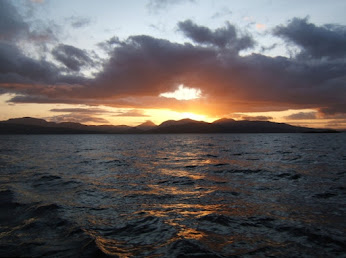
Still, the sunsets over Mull are good.

Wednesday, July 8, 2009

Electronics

Should not normally be mixed with water. But sadly most modern boats rely heavily on gadgetry and ours is no exception. Some things are just so useful to us that we make a concession, fit the thing and connect it up, then without realising it we soon come to rely totally on its functioning on demand every moment of the day.
One such gadget, known to us as 'The Dongle', we use for tapping into the Internet so we can, amongst other things, get a detailed weather forecast and update this blog. So far on our travels it has reliably found us an Internet connection of some sort almost everywhere we've been but for reasons known only to our internet provider the place we are currently using as a base from which to travel out to visit nearby interesting anchorages, Tobermory, is a T-Mobile black hole. Fortunately we anticipated this might happen somewhere along the way and we have a Plan B which comes into play. This involves touring the streets of whatever town or city we happen to be in until we locate a convenient wifi hotspot. These can be found almost anywhere these days, most usually in a café or pub, but the real trick is to use one without paying over any money. Which might explain why I was to be found lurking outside the An Tobar Arts Centre and café before it opened for business the other morning. Or there again it might not.

We have another gadget which can steer the boat for us using its own compass - the autohelm - and yet another which plots our position on a chart on its tiny screen - the chartplotter (more familiar to modern car drivers in its GPS road-based evolution). These two bits of equipment perform services for us, things we can easily do ourselves, but they take away some of the drudgery so we can relax, be more attentive to our surroundings and better enjoy the world around us.
In the last few months we have experienced problems with both devices apparently stemming from the embedded software, something equivalent to them having a mental breakdown and an unusual set of events, it seems. As it happens in both cases we were able to call the dealer here in the UK who provided technical support to get the gadgets going again, to re-start them so that they could remember what they were programmed to do in the first place. One such telephone call, made using a mobile phone from the middle of the Sound of Mull, gave me a key combination to press on the relevant gadget which I would never have found in a lifetime of trying, and all was well again. I'm not sure what this says about us, about the modern world or indeed about the gadgets themselves (which should not have gone wrong in the first place) but I do think it incredible that I was able to do this so easily from a rocky channel amid the Scottish mountains, and then just carry on sailing.
All of which has no relevance at all to the picture, which just sort of appealed to our sense of the ridiculous. Naturally we slowed our pace whilst passing the sign then once out of sight, speeded up again.

Saturday, July 4, 2009

Water worlds

These Western Isles are so liberally spiced with sheltered havens and anchorages that the waterborne visitor barely knows which way to turn. Each place comes with its own set of properties and potential risks. For example a sea loch which opens to the west is not the place to be when the ocean swell rolls in. But when like now the wind has blown from the east for several weeks and there are no swell-generating depressions anywhere out in the North Atlantic then the sea around the Western Isles becomes as smooth as glass, making even the most exposed anchorages tenable.

One such place is Loch a' Chumhainn which faces north-west out into the Minch just south of the Ardnamurchan peninsula. Fortunately for the non-Gaelic speakers this is also known as Loch Cuan and within its rocky borders there is a rocky lump called Goat Island behind which anchored one night.

Our arrival coincided with the departure of the last breeze before dusk so by the time we had the anchor nicely bedded into the course sand 3 metres beneath the hull the air was still and the surface of the water was free of the slightest ripple. Under these circumstances if the sky is clear and the sun high then the sea will act like a mirror and reflect anything above it almost perfectly. Strangely under some conditions, like if the sky is overcast, then there may be no reflection at all. It is as if the surface of the sea no longer exists; it becomes invisible and the land beneath can be seen clearly. Cirrus Cat, and us aboard, are suspended miraculously some distance above the sea bed with no visible means of support. The drop is alarmingly vertiginous as we lean overboard to observe the antics of the many crabs who inhabit this world of sand and weed and gaze at the tiny fish who float like birds above them.

One wonders what they make of us from below. My guess is they mutter to themselves, "Oh no, another set of retirees on their boat" and just go about their business.

To think that mere water can create such variety, one moment it is clear and the next it is opaque and noisy like this waterfall beside the sea in Tobermory.

Whilst enjoying water in all its many forms, there are limits to the amount that we expect to put up with in contact with our bodies when fully dressed. We cover ourselves with waterproof layers on the assumption that this will protect our clothing and generally speaking this works.

But take a hot muggy day and a small uninhabited island called Oronsay located between the lochs of Sunart and Drumbuie (Loch Na Droma Buidhe) and insert two intrepid sailors already moistened from rowing ashore in a solid rain shower, then dip them in every boggy bit of land you can find, most of which is chest deep in dripping wet bracken and the rest of which is ankle-wrecking tussocks of tough grass and moss, and what have you got - full penetration of water into every article of clothing notwithstanding the waterproofs. What we discovered in the process was what happens when land is abandoned and nature takes over. Once in the past Oronsay was inhabited, the ruins are still there as evidence, but there are no footpaths for humans here now, only a few deer roam the land and they leave few marks. From a distance the island looks an easy walk but this is an illusion because with vegetation this thick every step is difficult and wetter than the last. The landscape was remarkable for being so wildly natural, untamed and raw. We lingered only long enough to get ourselves lost in a few bogs, to ensure the water had properly penetrated our boots, socks, underwear, etc.

Actually we liked Drumbuie. Entering through a narrow gap between two rocky shores it is like arriving in another world. Getting here by land is almost impossible and with little incentive to do so anyway, why would you. Mobile phones are useless and the fm radio barely receives anything either. It briefly becomes home to a few yachties who anchor overnight then squeeze out through the gap and leave. The loch just gets on with life on its own.

Saturday, June 27, 2009

Colours

It seems we are endlessly fascinated by the colour of the water on which we float. This blog is littered with references to the different colours we have observed beneath us, possibly because it has been such an unexpected component of our sailing adventures, something we hadn't really thought about before now.

So once again I gaze over Cirrus's bow into the depths beneath and I can't resist an analogy as the water here is clearly a coca-cola bottle green (for those that can remember before cans). There is just a pale shadow 5 metres below us; our anchor is resting on the bottom of Loch Linnhe, just off the island of Lismore. It is not having to hold on very tight as the air is still and there is little current. The chain drops straight down and the water surface acts as a mirror so I lean over with a camera, catching my own reflection. Brightly coloured purple jellyfish waft by us as the light gradually fades into the long evening and by midnight of the longest day the sky here is bleeding with sunset-red streaks on wisps of cloud.

Motoring into the anchorage we had another view of the Great Glen, from the south west, here seen beneath a clear blue sky and with rare views of all the mountain tops, including the snow-capped summit of Ben Nevis. High pressure has descended on the Western Isles bringing crystal clear air and a sun which is browning our skin despite our best efforts to protect ourselves.
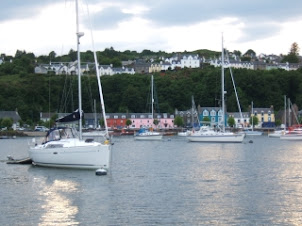
Next day we move on to the Isle of Mull which boasts one of the few sizeable towns in these parts, Tobermory, and this acts as a magnet for sailing boats despite it having no marina and few facilities to offer yachtsmen, unless of course you count the whisky distillery. But take a walk round the harbour and you'll soon realise that by colouring its houses like a children's TV programme, Tobermory has acquired fame far beyond its borders. There was even some local controversy here when a harbour pub wanted to break with tradition and paint its walls black, spoiling the themed look and risking losing thousands of visitors along the way.
The crowded harbour is a mass of white - most modern yacht builders cannot think beyond this as a colour for both the hull, the decks and the sails. Cirrus' two red hulls, cream decks and when sailing, her bright yellow genoa, make her stand out from the rest so she is uniquely recognisable from a distant shore, our own little feast of colour.


Finally I couldn't resist a picture of this strange piece of loch-side artwork. 'A fish out of water' comes to mind but when the tide returns to cover the rocks beneath, the effect must be even more bizarre.

Monday, June 22, 2009

Loch Solitude

The eight-day licence which permits us to transit the Caledonian Canal has almost expired as we approach the final spectacular flight of eight locks at Banavie, close by Fort William. Soon we'll once again have to contend with tides, currents and salt water and maybe we also need to prepare for sailing boats in greater numbers as the holiday season is nearly upon us.
One of the most striking features of the canal for us has been the absence of other boats. It was not uncommon for us to have a Scottish loch all to ourselves for the whole day, miles of water stretching out to the east and to the west, and we rarely shared a lock passage with another vessel. All this was unexpected. Indeed we had established emergency procedures for repelling wayward hire boats which might threaten our paintwork in the confines of the canal, knowing that there is nothing more dangerous than the tired driver who steps out of his car and slips behind the wheel of a boat, then expects it to line up with the pontoon as if he were parking at the kerbside. Kate was to rush forward with a roving fender to protect the impact site whilst I had practised a stony-faced glare guaranteed to keep anyone at bay. But in the end none of this expertise was needed simply because there were too few hire boaters about to bother us.

True, Urquhart Castle did seem to be getting its fair share of foreign tourists if the coach park was anything to go by but the view from the Loch in the sunshine, the aspect the tourists never see, was ours alone.

Thomas Telford would be a disappointed man were he alive today, disappointed because worldwide celebrity status around here goes not to his engineering masterpiece in the massive stone works of the canal but instead to the elusive creature living beneath the waters of its longest loch. So naturally I have to report on our own experiences after having now spent several midsummer nights afloat on its surface. Did Nessie put in an appearance?
The waters of Loch Ness are deep brown in colour as indeed is all the water throughout the length of the canal. Steep waves form easily here (steeper in fresh water than in salt) and the mountains which drop precipitously into the loch throw long shadows which reflect back inverted summits, distorted by any surface disturbance. No matter who first gave birth to the magical monster it is easy to see how it is perpetuated and who can blame the Scots for the monster replicas in purple plastic or wickerwork which are as much a part of the culture as scotch whisky. So maybe, just maybe, that flickering shadow far away across the loch was Nessie flicking her tail for us, who knows. None of this can take away the magic or the beauty of the place. It is just too big and too overwhelming for that.